Alhawiti Naif Mohammad, Al Mahri Saeed, Aziz Mohammad Azhar, Malik Shuja Shafi, Mohammad Sameer
Experimental Medicine, King Abdullah International Medical Research Center (KAIMRC), King Saud Bin Abdulaziz University for Health Sciences (KSAU-HS), Ministry of National Guard Health Affairs (NGHA), Riyadh, Saudi Arabia.
Colorectal Cancer Research Program, King Abdullah International Medical Research Center (KAIMRC), King Saud Bin Abdulaziz University for Health Sciences (KSAU-HS), Ministry of National Guard Health Affairs (NGHA), Riyadh, Saudi Arabia.
Curr Drug Targets. 2017;18(9):1095-1103. doi: 10.2174/1389450118666170130145514.
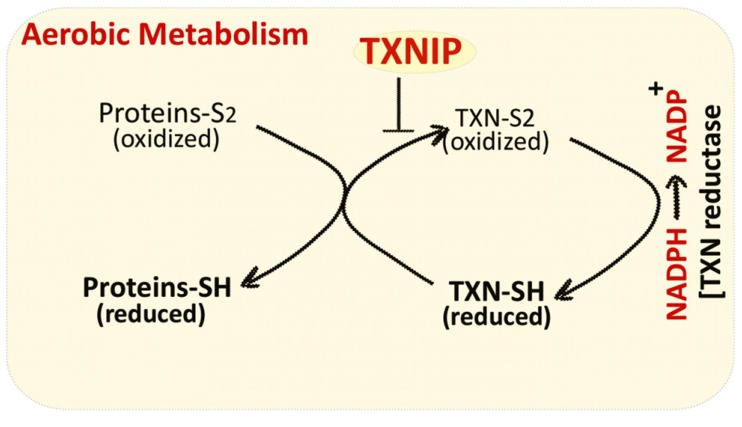
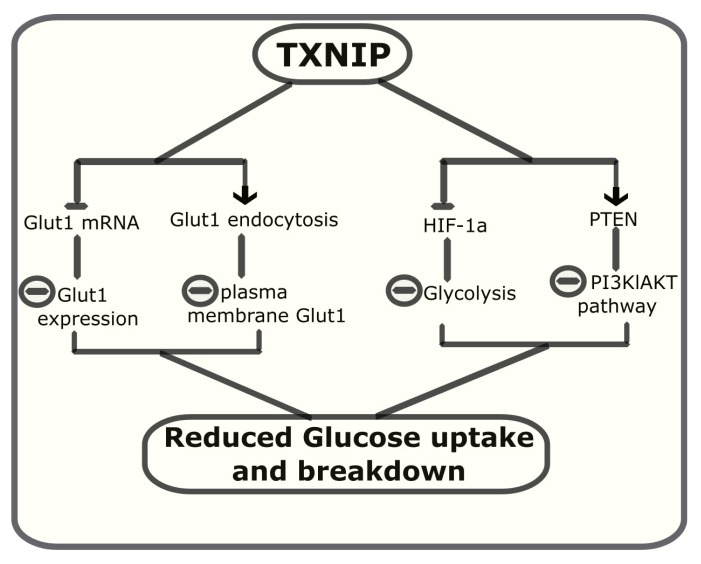
Background & Objective: Thioredoxin-interacting protein (TXNIP) also known as thioredoxin binding protein-2 is a ubiquitously expressed protein that interacts and negatively regulates expression and function of Thioredoxin (TXN). Over the last few years, TXNIP has attracted considerable attention due to its wide-ranging functions impacting several aspects of energy metabolism. TXNIP acts as an important regulator of glucose and lipid metabolism through pleiotropic actions including regulation of β-cell function, hepatic glucose production, peripheral glucose uptake, adipogenesis, and substrate utilization. Overexpression of TXNIP in animal models has been shown to induce apoptosis of pancreatic β-cells, reduce insulin sensitivity in peripheral tissues like skeletal muscle and adipose, and decrease energy expenditure. On the contrary, TXNIP deficient animals are protected from diet induced insulin resistance and type 2 diabetes.
Consequently, targeting TXNIP is thought to offer novel therapeutic opportunity and TXNIP inhibitors have the potential to become a powerful therapeutic tool for the treatment of diabetes mellitus. Here we summarize the current state of our understanding of TXNIP biology, highlight its role in metabolic regulation and raise critical questions that could help future research to exploit TXNIP as a therapeutic target.
背景与目的:硫氧还蛋白相互作用蛋白(TXNIP)也被称为硫氧还蛋白结合蛋白2,是一种广泛表达的蛋白,它与硫氧还蛋白(TXN)相互作用并对其表达和功能起负调节作用。在过去几年中,TXNIP因其在能量代谢多个方面具有广泛功能而备受关注。TXNIP通过多种作用,包括调节β细胞功能、肝脏葡萄糖生成、外周葡萄糖摄取、脂肪生成和底物利用,充当葡萄糖和脂质代谢的重要调节因子。在动物模型中,TXNIP的过表达已被证明可诱导胰腺β细胞凋亡,降低骨骼肌和脂肪等外周组织的胰岛素敏感性,并减少能量消耗。相反,TXNIP缺陷的动物可免受饮食诱导的胰岛素抵抗和2型糖尿病的影响。
因此,靶向TXNIP被认为提供了新的治疗机会,TXNIP抑制剂有可能成为治疗糖尿病的有力治疗工具。在此,我们总结了目前对TXNIP生物学的理解现状,强调其在代谢调节中的作用,并提出一些关键问题,这些问题可能有助于未来将TXNIP作为治疗靶点的研究。