Bauknecht Philipp, Jékely Gáspár
Max Planck Institute for Developmental Biology, Spemannstrasse 35, 72076, Tübingen, Germany.
BMC Biol. 2017 Jan 30;15(1):6. doi: 10.1186/s12915-016-0341-7.
Norepinephrine/noradrenaline is a neurotransmitter implicated in arousal and other aspects of vertebrate behavior and physiology. In invertebrates, adrenergic signaling is considered absent and analogous functions are performed by the biogenic amines octopamine and its precursor tyramine. These chemically similar transmitters signal by related families of G-protein-coupled receptors in vertebrates and invertebrates, suggesting that octopamine/tyramine are the invertebrate equivalents of vertebrate norepinephrine. However, the evolutionary relationships and origin of these transmitter systems remain unclear.
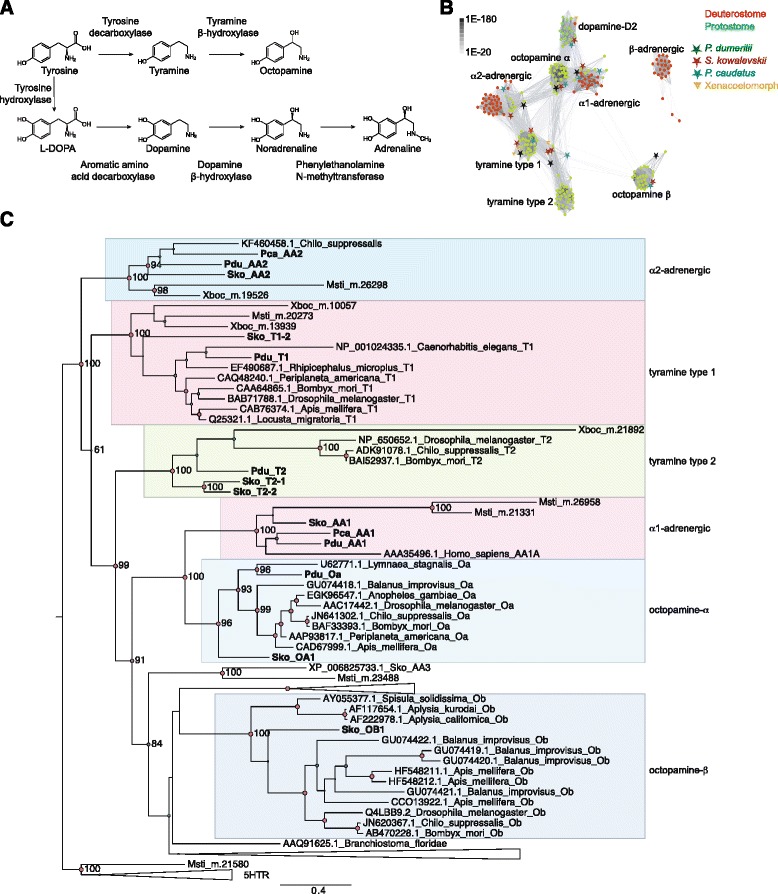
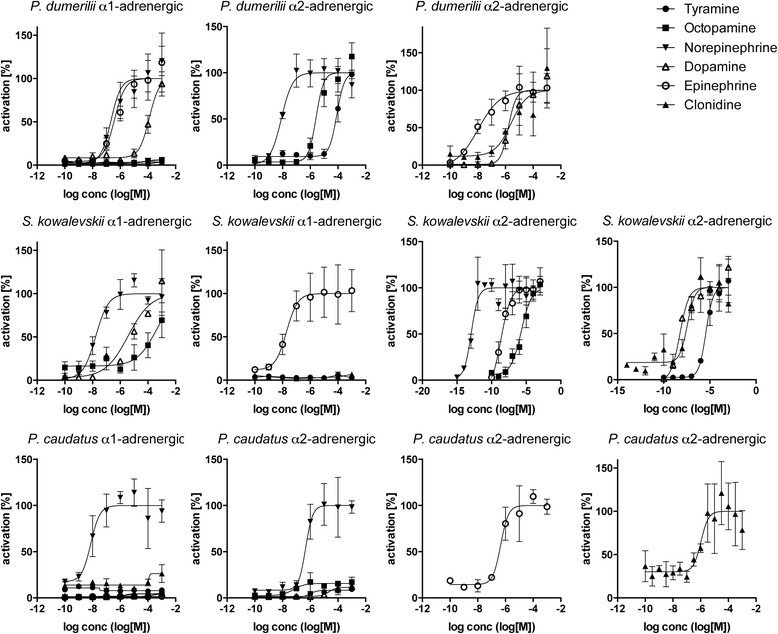
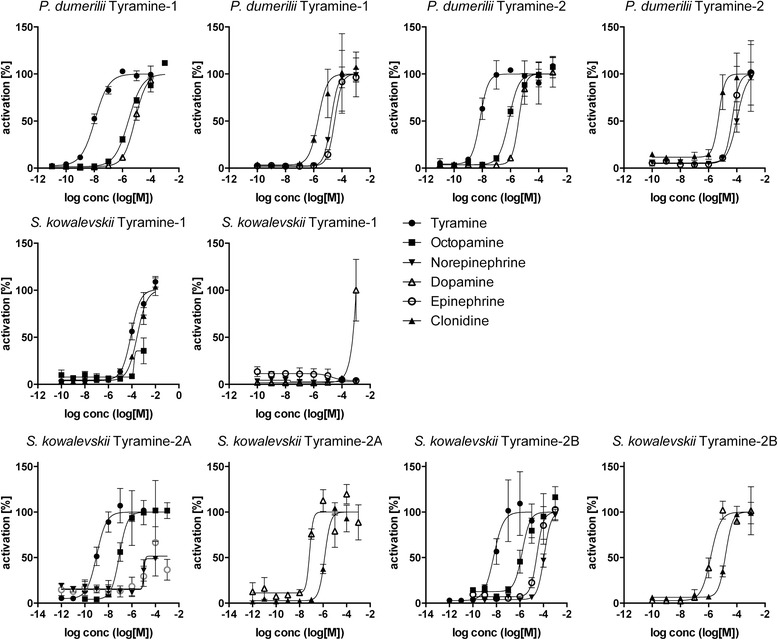
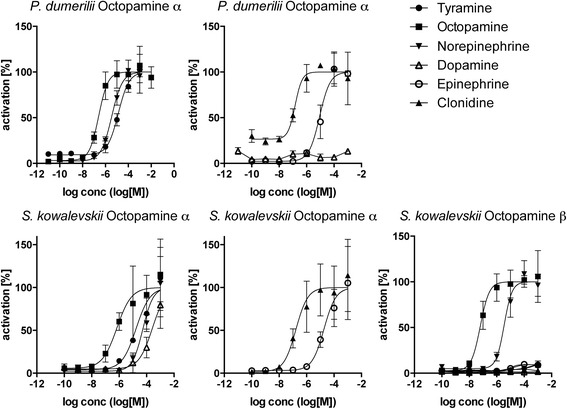
Using phylogenetic analysis and receptor pharmacology, here we have established that norepinephrine, octopamine, and tyramine receptors coexist in some marine invertebrates. In the protostomes Platynereis dumerilii (an annelid) and Priapulus caudatus (a priapulid), we have identified and pharmacologically characterized adrenergic α1 and α2 receptors that coexist with octopamine α, octopamine β, tyramine type 1, and tyramine type 2 receptors. These receptors represent the first examples of adrenergic receptors in protostomes. In the deuterostome Saccoglossus kowalevskii (a hemichordate), we have identified and characterized octopamine α, octopamine β, tyramine type 1, and tyramine type 2 receptors, representing the first examples of these receptors in deuterostomes. S. kowalevskii also has adrenergic α1 and α2 receptors, indicating that all three signaling systems coexist in this animal. In phylogenetic analysis, we have also identified adrenergic and tyramine receptor orthologs in xenacoelomorphs.
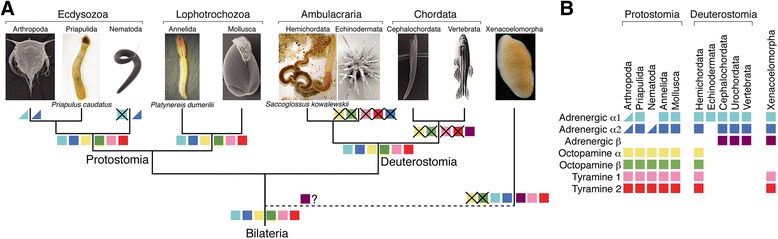
Our results clarify the history of monoamine signaling in bilaterians. Given that all six receptor families (two each for octopamine, tyramine, and norepinephrine) can be found in representatives of the two major clades of Bilateria, the protostomes and the deuterostomes, all six receptors must have coexisted in the last common ancestor of the protostomes and deuterostomes. Adrenergic receptors were lost from most insects and nematodes, and tyramine and octopamine receptors were lost from most deuterostomes. This complex scenario of differential losses cautions that octopamine signaling in protostomes is not a good model for adrenergic signaling in deuterostomes, and that studies of marine animals where all three transmitter systems coexist will be needed for a better understanding of the origin and ancestral functions of these transmitters.
去甲肾上腺素是一种神经递质,与脊椎动物的觉醒及行为和生理的其他方面有关。在无脊椎动物中,一般认为不存在肾上腺素能信号传导,其类似功能由生物胺章鱼胺及其前体酪胺执行。这些化学结构相似的递质通过脊椎动物和无脊椎动物中相关的G蛋白偶联受体家族进行信号传导,这表明章鱼胺/酪胺相当于脊椎动物的去甲肾上腺素。然而,这些递质系统的进化关系和起源仍不清楚。
通过系统发育分析和受体药理学研究,我们发现去甲肾上腺素、章鱼胺和酪胺受体共存于一些海洋无脊椎动物中。在原口动物多毛类的杜氏阔沙蚕和鳃曳动物的尾鳃蚓中,我们鉴定并通过药理学方法表征了与章鱼胺α受体、章鱼胺β受体、酪胺1型受体和酪胺2型受体共存的肾上腺素能α1和α2受体。这些受体是原口动物中肾上腺素能受体的首个实例。在后口动物的科氏囊舌虫(一种半索动物)中,我们鉴定并表征了章鱼胺α受体、章鱼胺β受体、酪胺1型受体和酪胺2型受体,它们是后口动物中这些受体的首个实例。科氏囊舌虫也有肾上腺素能α1和α2受体,这表明所有这三种信号传导系统在这种动物中共存。在系统发育分析中,我们还在异涡虫中鉴定出了肾上腺素能和酪胺受体的直系同源物。
我们的结果阐明了两侧对称动物中单胺信号传导的历史。鉴于在两侧对称动物的两个主要分支原口动物和后口动物的代表物种中都能找到所有六个受体家族(章鱼胺、酪胺和去甲肾上腺素各两个),所有这六个受体必定在原口动物和后口动物的最后一个共同祖先中就已共存。肾上腺素能受体在大多数昆虫和线虫中消失,酪胺和章鱼胺受体在大多数后口动物中消失。这种不同丢失情况的复杂情形警示我们,原口动物中的章鱼胺信号传导并非后口动物中肾上腺素能信号传导的良好模型,为了更好地理解这些递质的起源和原始功能,需要对所有三种递质系统共存的海洋动物进行研究。