Brivio D, Nguyen P L, Sajo E, Ngwa W, Zygmanski P
Brigham and Women's Hospital, Boston, MA, United States of America. Dana Farber Cancer Institute, Boston, MA, United States of America. Harvard Medical School, Boston, MA, United States of America.
Phys Med Biol. 2017 Mar 7;62(5):1935-1948. doi: 10.1088/1361-6560/aa5bc7. Epub 2017 Jan 31.
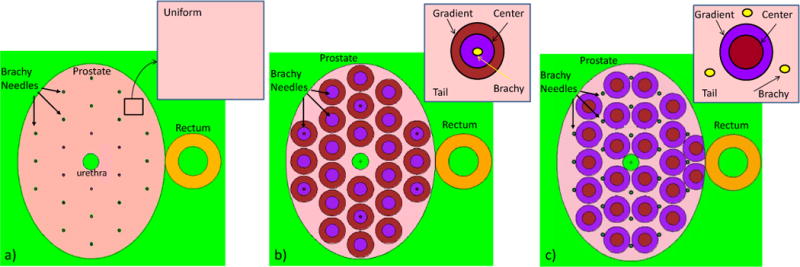
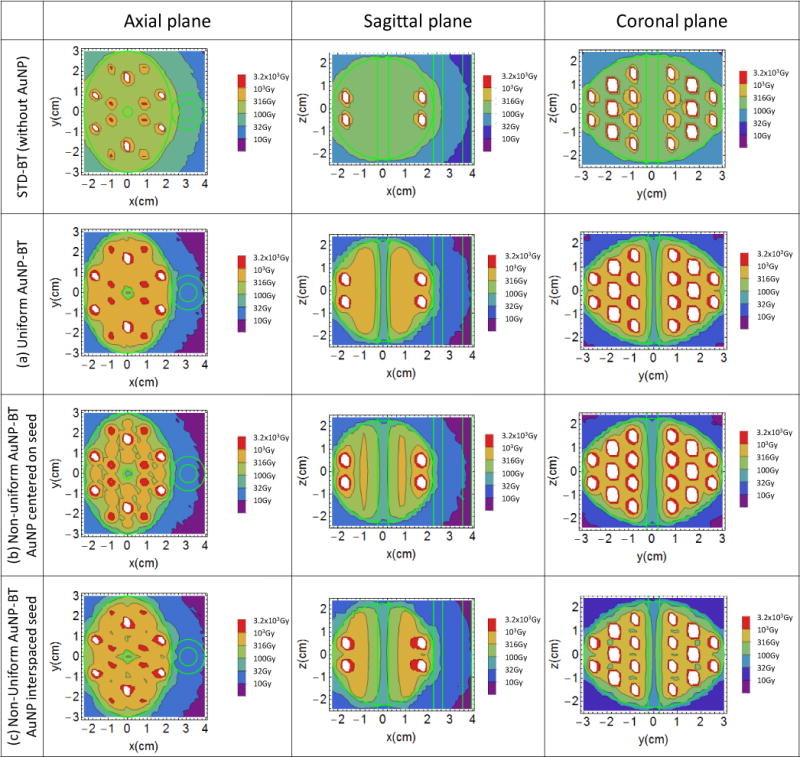
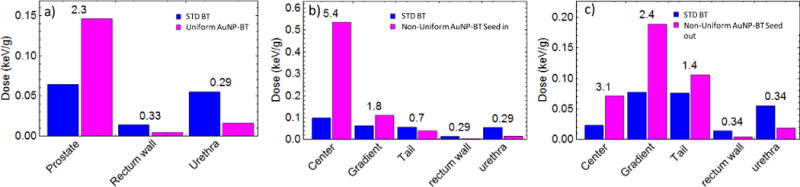
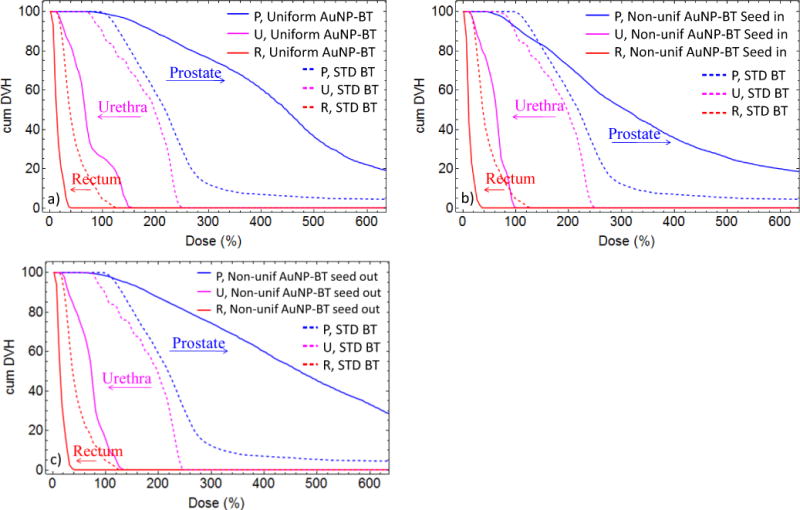
We investigate via Monte Carlo simulations a new I brachytherapy treatment technique for high-risk prostate cancer patients via injection of Au nanoparticle (AuNP) directly into the prostate. The purpose of using the nanoparticles is to increase the therapeutic index via two synergistic effects: enhanced energy deposition within the prostate and simultaneous shielding of organs at risk from radiation escaping from the prostate. Both uniform and non-uniform concentrations of AuNP are studied. The latter are modeled considering the possibility of AuNP diffusion after the injection using brachy needles. We study two extreme cases of coaxial AuNP concentrations: centered on brachy needles and centered half-way between them. Assuming uniform distribution of 30 mg g of AuNP within the prostate, we obtain a dose enhancement larger than a factor of 2 to the prostate. Non-uniform concentration of AuNP ranging from 10 mg g and 66 mg g were studied. The higher the concentration in a given region of the prostate the greater is the enhancement therein. We obtain the highest dose enhancement when the brachytherapy needles are coincident with AuNP injection needles but, at the same time, the regions in the tail are colder (average dose ratio of 0.7). The best enhancement uniformity is obtained with the seeds in the tail of the AuNP distribution. In both uniform and non-uniform cases the urethra and rectum receive less than 1/3 dose compared to an analog treatment without AuNP. Remarkably, employing AuNP not only significantly increases dose to the target but also decreases dose to the neighboring rectum and even urethra, which is embedded within the prostate. These are mutually interdependent effects as more enhancement leads to more shielding and vice-versa. Caution must be paid since cold spot or hot spots may be created if the AuNP concentration versus seed position is not properly distributed respect to the seed locations.
我们通过蒙特卡罗模拟研究了一种针对高危前列腺癌患者的新型近距离放射治疗技术,即直接将金纳米颗粒(AuNP)注入前列腺。使用纳米颗粒的目的是通过两种协同效应提高治疗指数:增强前列腺内的能量沉积以及同时屏蔽因前列腺辐射逸出而处于危险中的器官。研究了AuNP的均匀和非均匀浓度。对于后者,考虑到使用近距离放射针注射后AuNP扩散的可能性进行建模。我们研究了同轴AuNP浓度的两种极端情况:以近距离放射针为中心和以它们之间的中点为中心。假设前列腺内AuNP的均匀分布为30 mg/g,我们得到前列腺的剂量增强大于2倍。研究了AuNP的非均匀浓度范围为10 mg/g至66 mg/g。前列腺给定区域内的浓度越高,其中的增强效果就越大。当近距离放射针与AuNP注射针重合时,我们获得了最高的剂量增强,但同时,尾部区域较冷(平均剂量比为0.7)。在AuNP分布的尾部放置籽源可获得最佳的增强均匀性。在均匀和非均匀情况下,与不使用AuNP的类似治疗相比,尿道和直肠接受的剂量均小于1/3。值得注意的是,使用AuNP不仅显著增加了靶区剂量,还降低了邻近直肠甚至嵌入前列腺内的尿道的剂量。这些是相互依存的效应,因为更多的增强会导致更多的屏蔽,反之亦然。必须注意,如果AuNP浓度与籽源位置相对于籽源位置分布不当,可能会产生冷点或热点。