Willfors C, Carlsson T, Anderlid B-M, Nordgren A, Kostrzewa E, Berggren S, Ronald A, Kuja-Halkola R, Tammimies K, Bölte S
Karolinska Institutet Center for Neurodevelopmental Disorders, Pediatric Neuropsychiatry Unit, Department of Women's and Children's Health, Karolinska Institutet, Solna, Sweden.
Center for Psychiatry Research, Stockholm County Council, Stockholm, Sweden.
Transl Psychiatry. 2017 Jan 31;7(1):e1014. doi: 10.1038/tp.2016.269.
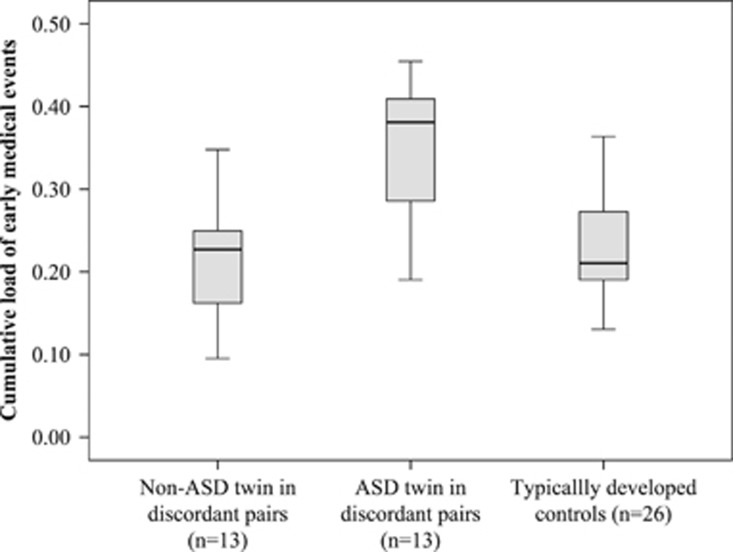
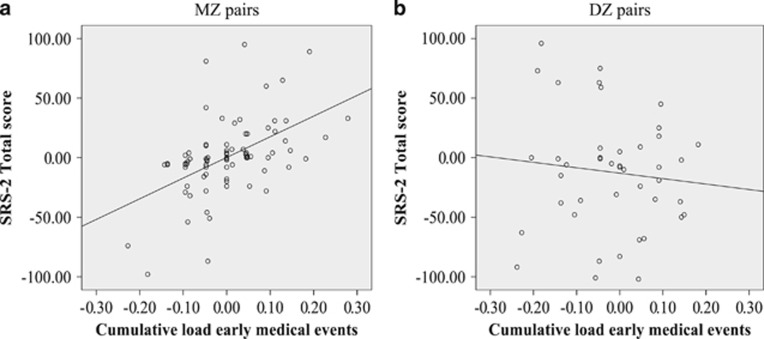
The environmental contributions to autism spectrum disorder (ASD) and their informative content for diagnosing the condition are still largely unknown. The objective of this study was to investigate associations between early medical events and ASD, as well as autistic traits, in twins, to test the hypothesis of a cumulative environmental effect on ASD risk. A total of 80 monozygotic (MZ) twin pairs (including a rare sample of 13 twin pairs discordant for clinical ASD) and 46 dizygotic (DZ) twin pairs with varying autistic traits, were examined for intra-pair differences in early medical events (for example, obstetric and neonatal factors, first year infections). First, differences in early medical events were investigated using multisource medical records in pairs qualitatively discordant for ASD. The significant intra-pair differences identified were then tested in relation to autistic traits in the remaining sample of 100 pairs, applying generalized estimating equations analyses. Significant association of the intra-pair differences in the MZ pairs were found for the cumulative load of early medical events and clinical ASD (Z=-2.85, P=0.004) and autistic traits (β=78.18, P=0.002), as well as infant dysregulation (feeding, sleeping abnormalities, excessive crying and worriedness), when controlling for intelligence quotient and attention deficit hyperactivity disorder comorbidity. The cumulative load of early medical events in general, and infant dysregulation in particular, may index children at risk of ASD owing to non-shared environmental contributions. In clinical practice, these findings may facilitate screening and early detection of ASD.
环境因素对自闭症谱系障碍(ASD)的影响及其在诊断该疾病方面的信息含量在很大程度上仍不明确。本研究的目的是调查双胞胎中早期医疗事件与ASD以及自闭症特征之间的关联,以检验累积环境效应对ASD风险影响的假设。总共对80对同卵(MZ)双胞胎(包括13对临床ASD不一致的罕见双胞胎样本)和46对具有不同自闭症特征的异卵(DZ)双胞胎进行了检查,以了解早期医疗事件(例如产科和新生儿因素、一岁内感染)的双胞胎内差异。首先,使用多源医疗记录对ASD定性不一致的双胞胎进行早期医疗事件差异调查。然后,在其余100对双胞胎样本中,应用广义估计方程分析,对所确定的显著双胞胎内差异与自闭症特征的关系进行测试。在控制智商和注意力缺陷多动障碍合并症时,发现MZ双胞胎中早期医疗事件的累积负荷与临床ASD(Z=-2.85,P=0.004)和自闭症特征(β=78.18,P=0.002)以及婴儿调节障碍(喂养、睡眠异常、过度哭闹和焦虑)之间存在显著关联。一般而言,早期医疗事件的累积负荷,特别是婴儿调节障碍,可能由于非共享环境因素而成为ASD风险儿童的指标。在临床实践中,这些发现可能有助于ASD的筛查和早期检测。