Taghizadeh Mohsen, Malekian Elaheh, Memarzadeh Mohammad Reza, Mohammadi Ali Akbar, Asemi Zatollah
Research Center for Biochemistry and Nutrition in Metabolic Diseases, Kashan University of Medical Sciences, Kashan, IR Iran.
Barij Medicinal Plants Research Center, Kashan, IR Iran.
Iran Red Crescent Med J. 2016 Jul 17;18(9):e31314. doi: 10.5812/ircmj.31314. eCollection 2016 Sep.
Only limited data are available for evaluating the effects of the administration of grape seed extract (GSE) on the metabolic status of female volleyball players.
This study was conducted to determine the effects of GSE administration on the metabolic status of female volleyball players.
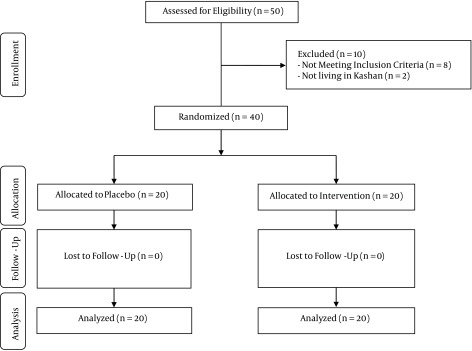
This randomized, double-blind, placebo-controlled clinical trial was performed among 40 female volleyball players. The subjects were randomly divided into two groups, with members of the test group (n = 20) taking 300 mg of GSE twice a day for eight weeks and members of the control group (n = 20) taking a placebo pearl for the same period. Fasting blood samples were taken before and after the eight-week intervention period in order to determine the related variables.
Supplementation with GSE resulted in a significant rise in the plasma glutathione (GSH) level (+265.5 ± 344.2 vs. +2.2 ± 378.2 µmol/L, P = 0.02), as well as a significant decrease in the malondialdehyde (MDA) level (-1.4 ± 2.0 vs. -0.2 ± 1.2 µmol/L, P = 0.01) when compared to the placebo group. In addition, when compared to the group that received the placebo, the subjects who received GSE had significantly decreased serum insulin concentrations (-23.4 ± 23.4 vs. +1.8 ± 25.2 pmol/L, P = 0.002), a decreased homeostasis model of assessment for insulin resistance (HOMA-IR) (-0.7 ± 0.7 vs. +0.2 ± 0.9, P = 0.002), and an increased quantitative insulin sensitivity check index (QUICKI) (+0.01 ± 0.01 vs. -0.01 ± 0.02, P = 0.03). The administration of GSE had no significant effects on creatine phosphokinase (CPK), total antioxidant capacity (TAC), nitric oxide (NO), fasting plasma glucose (FPG), and lipid concentrations when compared with the administration of the placebo. However, after controlling for baseline NO levels, age, and baseline BMI, the changes in the plasma NO concentrations were significantly different between the two groups.
In conclusion, taking GSE for eight weeks had beneficial effects on the plasma GSH, MDA levels, and markers of insulin metabolism of female volleyball players.
关于评估葡萄籽提取物(GSE)给药对女排运动员代谢状况影响的数据有限。
本研究旨在确定GSE给药对女排运动员代谢状况的影响。
本随机、双盲、安慰剂对照临床试验在40名女排运动员中进行。受试者被随机分为两组,试验组(n = 20)成员每天服用300 mg GSE,持续八周,对照组(n = 20)成员在同一时期服用安慰剂丸。在为期八周的干预期前后采集空腹血样,以确定相关变量。
与安慰剂组相比,补充GSE导致血浆谷胱甘肽(GSH)水平显著升高(+265.5±344.0对+2.2±378.2 μmol/L,P = 0.02),丙二醛(MDA)水平显著降低(-1.4±2.0对-0.2±1.2 μmol/L,P = 0.01)。此外,与接受安慰剂的组相比,接受GSE的受试者血清胰岛素浓度显著降低(-23.4±23.4对+1.8±25.2 pmol/L,P = 0.002),胰岛素抵抗稳态模型评估(HOMA-IR)降低(-0.7±0.7对+0.2±0.9,P = 0.002),定量胰岛素敏感性检查指数(QUICKI)升高(+0.01±0.01对-0.01±0.02,P = 0.03)。与服用安慰剂相比,GSE给药对肌酸磷酸激酶(CPK)、总抗氧化能力(TAC)、一氧化氮(NO)、空腹血糖(FPG)和血脂浓度无显著影响。然而,在控制基线NO水平、年龄和基线BMI后,两组间血浆NO浓度变化有显著差异。
总之,连续八周服用GSE对女排运动员的血浆GSH、MDA水平及胰岛素代谢指标有有益影响。