Elisha Ishaku L, Jambalang Alexander R, Botha Francien S, Buys Elna M, McGaw Lyndy J, Eloff Jacobus N
Phytomedicine Programme, Department of Paraclinical Sciences, Faculty of Veterinary Science, University of Pretoria, Private Bag X04, Onderstepoort, 0110, Pretoria, South Africa.
Permanent address: Drug Development Section, Biochemistry Division, National Veterinary Research Institute, P.M.B. 01 Vom, Plateau State, Nigeria, South Africa.
BMC Complement Altern Med. 2017 Feb 2;17(1):90. doi: 10.1186/s12906-017-1597-3.
The rise in antimicrobial resistance in a plethora of nosocomial and opportunistic bacterial pathogens often isolated from commercial eggs, poses a serious public health concern. The existence of these contaminants may also serve as a drawback in the current efforts of improving the well-being of immunocompromised patients. The aim of this study was to determine the efficacy of plant extracts that had good activity on Escherichia coli in previous word on pathogens isolated from eggs for possible use in combating pathogens from eggs.
Acetone leaf extracts of nine trees with good activities against Escherichia coli were tested for their in vitro antibacterial activity against six opportunistic bacterial isolates from commercial eggs (Stenotrophomonas maltophilia, Klebsiella pneumoniae, Salmonella serotype Typhimurium, Proteus mirabilis, Enterobacter cloacae and Escherichia coli) using a serial microdilution method with tetrazolium violet as indicator of growth. Cytotoxicity was determined using a tetrazolium-based colorimetric assay against Vero kidney cells, and selectivity index calculated.
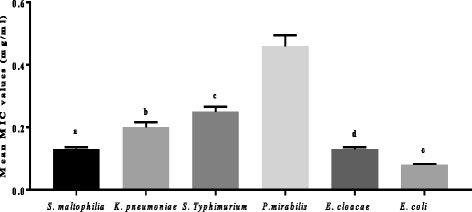
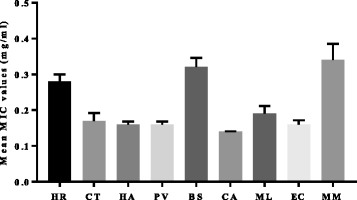
The MIC values range of the different extracts against Stenotrophomonas maltophilia was 0.08-0.31 mg/ml, Klebsiella pneumonia 0.08-0.63 mg/ml, Salmonella ser. Typhimurium 0.08-0.63 mg/ml, Proteus mirabilis 0.02-1.25 mg/ml, Enterobacter cloacae 0.08-0.31 mg/ml and Escherichia coli 0.08-0.16 mg/ml respectively. Escherichia coli was the most sensitive while Proteus mirabilis was most resistant pathogen to the different test extracts, with mean MIC values of 0.08 mg/ml and 0.46 mg/ml respectively. Cremaspora triflora extracts had good activity against all the pathogenic egg isolates, with the exception of Proteus mirabilis. Maesa lanceolata and Elaeodendron croceum had the best total antibacterial activity (TAA), while generally the selectivity index of the extract was low (SI < 1).
The exceptional activity of C. triflora extracts suggests that the plant has potential as a therapeutic agent against some members of the Enterobacteriaceae. Further pharmacological investigations may be interesting in the search for new antimicrobial leads.
在大量常从商业鸡蛋中分离出的医院内和机会性细菌病原体中,抗菌药物耐药性的上升引起了严重的公共卫生关注。这些污染物的存在也可能成为当前改善免疫功能低下患者健康状况努力中的一个不利因素。本研究的目的是确定在之前针对从鸡蛋中分离出的病原体的研究中对大肠杆菌具有良好活性的植物提取物对抗鸡蛋中病原体的效果,以供可能用于对抗鸡蛋中的病原体。
使用以四氮唑紫作为生长指示剂的系列微量稀释法,测试了九种对大肠杆菌具有良好活性的树木的丙酮叶提取物对六种从商业鸡蛋中分离出的机会性细菌分离株(嗜麦芽窄食单胞菌、肺炎克雷伯菌、鼠伤寒沙门氏菌、奇异变形杆菌、阴沟肠杆菌和大肠杆菌)的体外抗菌活性。使用基于四氮唑的比色法测定对非洲绿猴肾细胞的细胞毒性,并计算选择性指数。
不同提取物对嗜麦芽窄食单胞菌的最低抑菌浓度(MIC)值范围为0.08 - 0.31毫克/毫升,对肺炎克雷伯菌为0.08 - 0.63毫克/毫升,对鼠伤寒沙门氏菌为0.08 - 0.63毫克/毫升,对奇异变形杆菌为0.02 - 1.25毫克/毫升,对阴沟肠杆菌为0.08 - 0.31毫克/毫升,对大肠杆菌为0.08 - 0.16毫克/毫升。大肠杆菌是对不同测试提取物最敏感的病原体,而奇异变形杆菌是最耐药的病原体,其平均MIC值分别为0.08毫克/毫升和0.46毫克/毫升。三花厚壳桂提取物对除奇异变形杆菌外的所有致病性鸡蛋分离株都有良好活性。长叶杜茎山和红椋子具有最佳的总抗菌活性(TAA),而提取物的选择性指数总体较低(SI < 1)。
三花厚壳桂提取物的卓越活性表明该植物有潜力作为针对肠杆菌科某些成员的治疗剂。在寻找新的抗菌先导物方面,进一步的药理学研究可能会很有意思。