Rader Erik P, Naimo Marshall A, Ensey James, Baker Brent A
Centers for Disease Control and Prevention, National Institute for Occupational Safety and Health, MS L3014, 1095 Willowdale Rd, Morgantown, West Virginia, 26505, USA.
West Virginia University School of Medicine, Division of Exercise Physiology, Morgantown, West Virginia, USA.
BMC Musculoskelet Disord. 2017 Feb 2;18(1):60. doi: 10.1186/s12891-017-1397-4.
The vast majority of dynamometer-based animal models for investigation of the response to chronic muscle contraction exposure has been limited to analysis of isometric, lengthening, or shortening contractions in isolation. An exception to this has been the utilization of a rat model to study stretch-shortening contractions (SSCs), a sequence of consecutive isometric, lengthening, and shortening contractions common during daily activity and resistance-type exercise. However, the availability of diverse genetic strains of rats is limited. Therefore, the purpose of the present study was to develop a dynamometer-based SSC training protocol to induce increased muscle mass and performance in plantarflexor muscles of mice.
Young (3 months old) C57BL/6 mice were subjected to 1 month of plantarflexion SSC training. Hindlimb muscles were analyzed for muscle mass, quantitative morphology, myogenesis/myopathy relevant gene expression, and fiber type distribution.
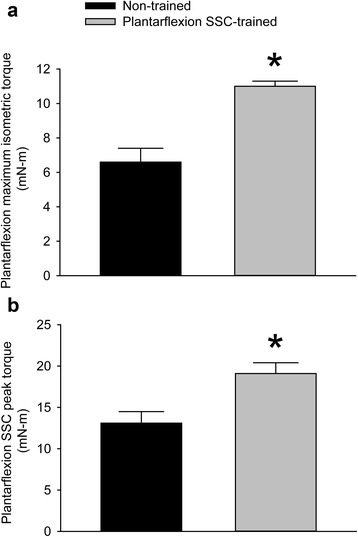
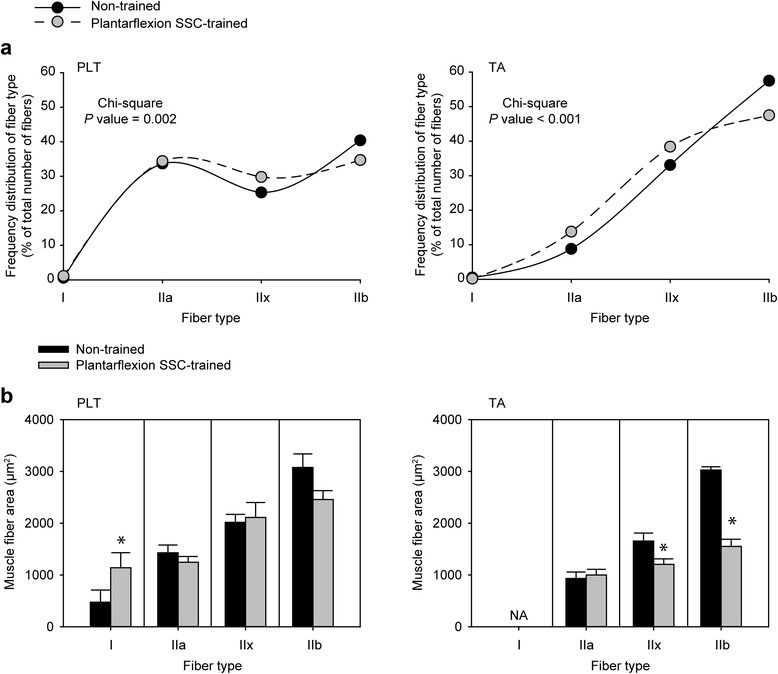
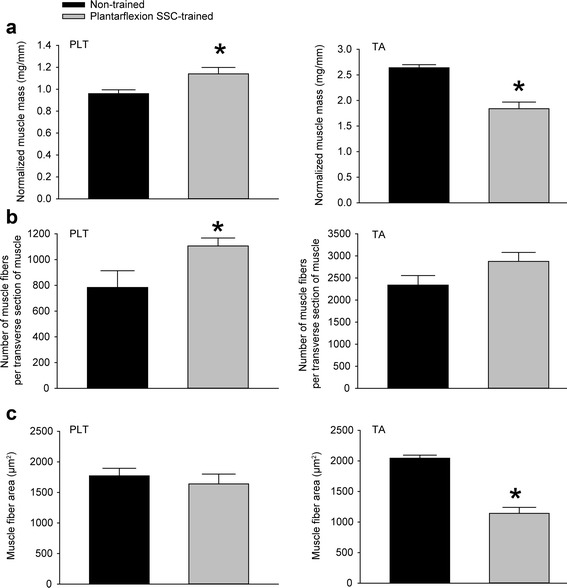
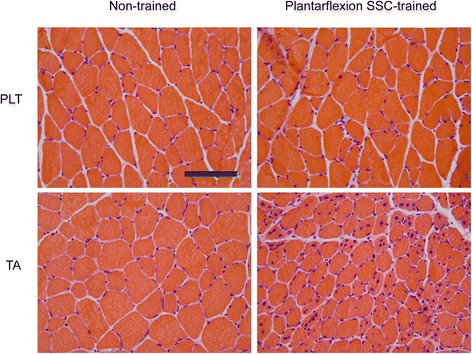
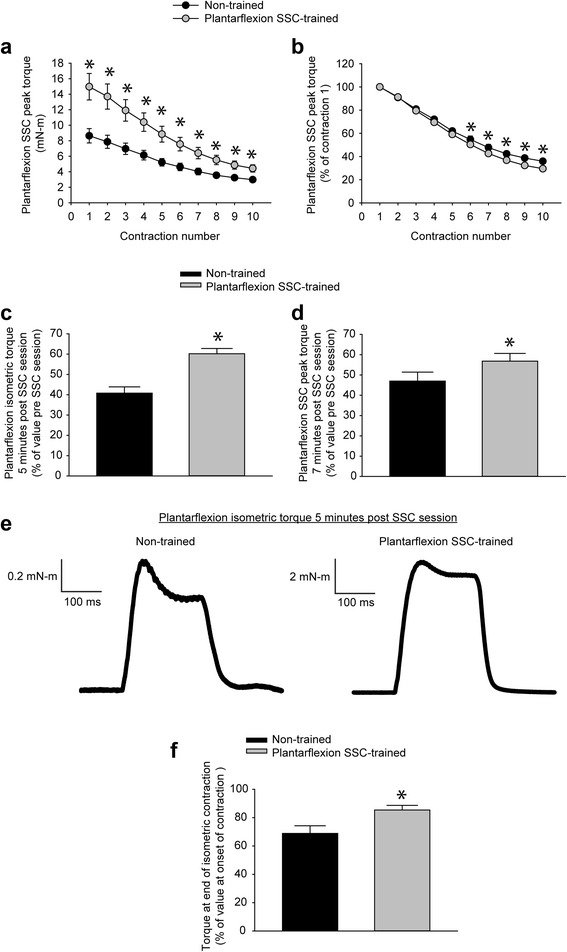
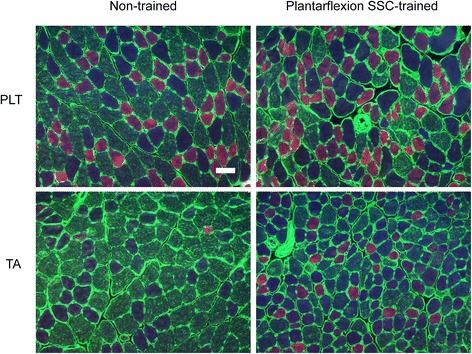
The main aim of the research was achieved when training induced a 2-fold increase in plantarflexion peak torque output and a 19% increase in muscle mass for the agonist plantaris (PLT) muscle. In establishing this model, several outcomes emerged which raised the value of the model past that of being a mere recapitulation of the rat model. An increase in the number of muscle fibers per transverse muscle section accounted for the PLT muscle mass gain while the antagonist tibialis anterior (TA) muscle atrophied by 30% with preferential atrophy of type IIb and IIx fibers. These alterations were accompanied by distinct gene expression profiles.
The findings confirm the development of a stretch-shortening contraction training model for the PLT muscle of mice and demonstrate that increased cross-sectional fiber number can occur following high-intensity SSC training. Furthermore, the TA muscle atrophy provides direct evidence for the concept of muscle imbalance in phasic non-weight bearing muscles, a concept largely characterized based on clinical observation of patients. The susceptibility to this imbalance is demonstrated to be selective for the type IIb and IIx muscle fiber types. Overall, the study highlights the importance of considering muscle fiber number modulation and the effect of training on surrounding muscles in exercise comprised of SSCs.
绝大多数基于测力计的用于研究慢性肌肉收缩暴露反应的动物模型仅限于单独分析等长收缩、拉长收缩或缩短收缩。唯一的例外是利用大鼠模型来研究拉长-缩短收缩(SSC),这是日常活动和抗阻训练中常见的一系列连续等长收缩、拉长收缩和缩短收缩。然而,大鼠不同遗传品系的可用性有限。因此,本研究的目的是制定一种基于测力计的SSC训练方案,以增加小鼠跖屈肌的肌肉质量和性能。
对3个月大的年轻C57BL/6小鼠进行为期1个月的跖屈SSC训练。分析后肢肌肉的肌肉质量、定量形态、与肌生成/肌病相关的基因表达以及纤维类型分布。
当训练使跖屈峰值扭矩输出增加两倍且激动剂跖肌(PLT)肌肉质量增加19%时,研究的主要目标得以实现。在建立该模型的过程中,出现了几个结果,这些结果使该模型的价值超越了仅仅是大鼠模型的重现。每个横向肌肉切片中肌纤维数量的增加导致了PLT肌肉质量的增加,而拮抗剂胫骨前肌(TA)萎缩了30%,其中IIb型和IIx型纤维优先萎缩。这些改变伴随着不同的基因表达谱。
研究结果证实了小鼠PLT肌肉拉长-缩短收缩训练模型的建立,并表明高强度SSC训练后肌纤维横截面积数量会增加。此外,TA肌肉萎缩为非负重相肌肉中肌肉失衡的概念提供了直接证据,这一概念主要基于对患者的临床观察。研究表明,这种失衡的易感性对IIb型和IIx型肌纤维类型具有选择性。总体而言,该研究强调了在由SSC组成的运动中考虑肌纤维数量调节以及训练对周围肌肉影响的重要性。