Zhao Hongjuan, Ning Shoucheng, Nolley Rosalie, Scicinski Jan, Oronsky Bryan, Knox Susan J, Peehl Donna M
Department of Urology, Stanford University School of Medicine, 300 Pasteur Drive, Stanford, CA 94305 USA.
Department of Radiation Oncology, School of Medicine, Stanford University, 300 Pasteur Drive, Stanford, CA 94305 USA.
Clin Epigenetics. 2017 Jan 19;9:4. doi: 10.1186/s13148-017-0312-z. eCollection 2017.
RRx-001, a dinitroazetidine derivative, is a novel anticancer agent currently in phase II clinical trials. It mediates immunomodulatory effects either directly through polarization of tumor associated macrophages or indirectly through vascular normalization and increased T-lymphocyte infiltration. With multiple additional mechanisms of action including upregulation of oxidative stress, depletion of GSH and NADPH, anti-angiogenesis and epigenetic modulation, RRx-001 is being studied as a radio- and chemo-sensitizer to resensitize tumors to prior therapy and to prime tumors to respond to radiation, chemotherapy and immunotherapy in combination therapy studies. Here, we identified another mechanism, viral mimicry, which refers to the "unsilencing" of epigenetically repressed viral genes present in the tumor that provokes an immune response and may contribute to the anticancer activity of RRx-001.
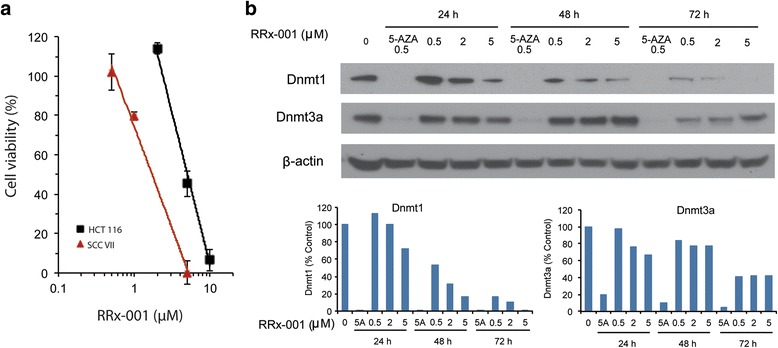
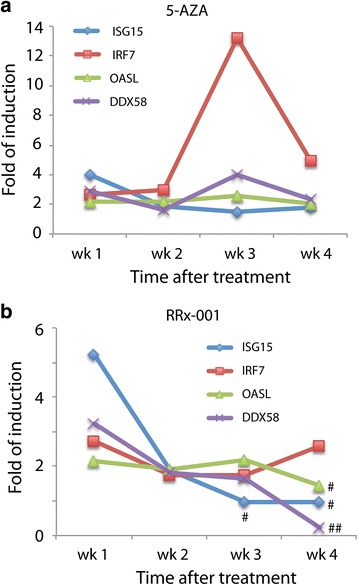
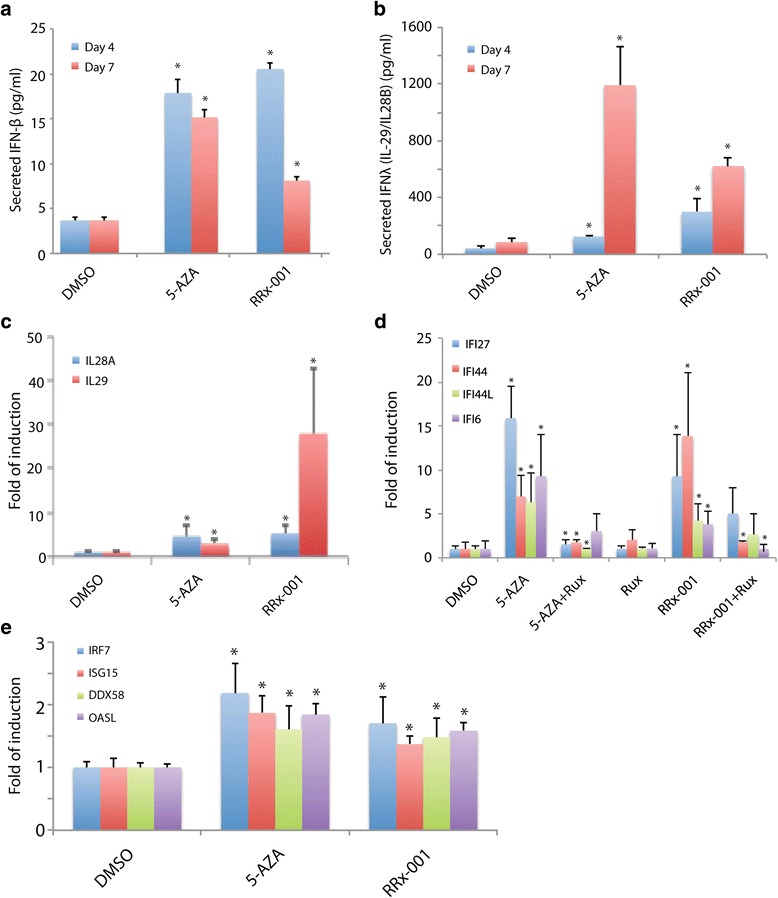
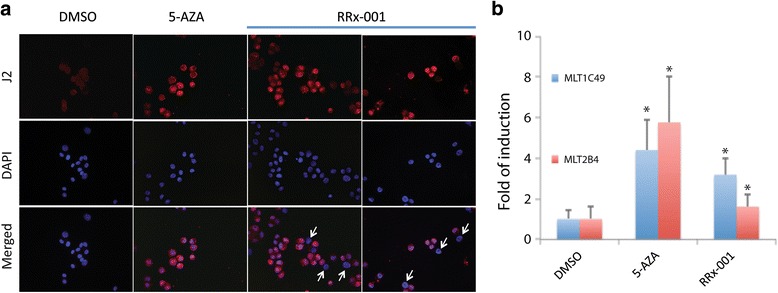
RRx-001 inhibited the growth of colon cancer cells (HCT 116) and decreased levels of the DNA methyltransferases DNMT1 and DNMT3a in a time and dose-dependent manner. Treatment of HCT 116 cells with 0.5 μM RRx-001 for 24 h significantly increased transcripts of interferon (IFN)-responsive genes and this induction was sustained for up to 4 weeks after transient exposure to RRx-001. ELISA assays showed that RRx-001 increased secretion of type I and III IFNs by HCT 116 cells, and these IFNs were confirmed to be bioactive. Transcription of endogenous retrovirus ERV-Fc2 and LTRs from the ERV-L family (MLT2B4 and MLT1C49) was induced by RRx-001. The induction of ERV-Fc2-env was through demethylation of ERV-Fc2 LTR as determined by methylation-specific polymerase chain reaction and combined bisulfite restriction analysis. Immunofluorescence staining with J2 antibody confirmed induction of double-stranded RNA.
Transient exposure of HCT 116 cells to low-dose RRx-001 induced transcription of silenced retroviral genes present in the cancer cell DNA with subsequent synthesis of IFN in response to this "pseudo-pathogenic" stimulus, mimicking an antiviral defense. RRx-001-mediated IFN induction may have the potential to improve the efficacy of immunotherapies as well as radiotherapy, standard chemotherapies and molecularly targeted agents when used in combination. The striking safety profile of RRx-001 in comparison to other more toxic epigenetic and immunomodulatory agents such as azacitidine makes it a leading candidate for such clinical applications.
RRx-001是一种二硝基氮杂环丁烷衍生物,是一种新型抗癌药物,目前正处于II期临床试验阶段。它通过肿瘤相关巨噬细胞的极化直接介导免疫调节作用,或通过血管正常化和增加T淋巴细胞浸润间接介导免疫调节作用。RRx-001具有多种额外的作用机制,包括上调氧化应激、消耗谷胱甘肽和烟酰胺腺嘌呤二核苷酸磷酸、抗血管生成和表观遗传调控,在联合治疗研究中,它正作为一种放疗和化疗增敏剂进行研究,以使肿瘤对先前的治疗重新敏感,并使肿瘤对放疗、化疗和免疫治疗产生反应。在此,我们发现了另一种机制,即病毒模拟,它指的是肿瘤中表观遗传抑制的病毒基因的“去沉默”,这种去沉默会引发免疫反应,并可能有助于RRx-001的抗癌活性。
RRx-001以时间和剂量依赖性方式抑制结肠癌细胞(HCT 116)的生长,并降低DNA甲基转移酶DNMT1和DNMT3a的水平。用0.5μM RRx-001处理HCT 116细胞24小时可显著增加干扰素(IFN)反应基因的转录本,并且在短暂暴露于RRx-001后,这种诱导作用可持续长达4周。酶联免疫吸附测定(ELISA)显示,RRx-001增加了HCT 116细胞I型和III型IFN的分泌,并且这些IFN被证实具有生物活性。RRx-001诱导内源性逆转录病毒ERV-Fc2和ERV-L家族的长末端重复序列(LTRs,MLT2B4和MLT1C49)的转录。通过甲基化特异性聚合酶链反应和联合亚硫酸氢盐限制分析确定,ERV-Fc2-env的诱导是通过ERV-Fc2 LTR的去甲基化实现的。用J2抗体进行的免疫荧光染色证实了双链RNA的诱导。
HCT 116细胞短暂暴露于低剂量RRx-001会诱导癌细胞DNA中沉默的逆转录病毒基因转录,随后针对这种“假病原体”刺激合成IFN,模拟抗病毒防御。RRx-001介导的IFN诱导在与免疫疗法、放疗、标准化疗和分子靶向药物联合使用时,可能具有提高疗效的潜力。与其他毒性更大的表观遗传和免疫调节药物如阿扎胞苷相比,RRx-001具有显著的安全性,这使其成为此类临床应用的主要候选药物。