Lee Hancheol, Kim Tae-Hoon, Baek Yong-Soo, Uhm Jae-Sun, Pak Hui-Nam, Lee Moon-Hyoung, Joung Boyoung
Division of Cardiology, National Health Insurance Service Ilsan Hospital, Goyang, Korea.
Division of Cardiology, Department of Internal Medicine, Severance Cardiovascular Hospital, Yonsei University College of Medicine, Seoul, Korea.
Korean Circ J. 2017 Jan;47(1):56-64. doi: 10.4070/kcj.2016.0045. Epub 2016 Dec 26.
The change of in-hospital and out-hospital treatments, and hospital costs for atrial fibrillation (AF) were not well known in rapidly aging Asian countries. This study is to examine the trends of AF management and outcomes in Korea.
In the sample cohort from Korean National Health Insurance Data Sample Cohort (K-NHID-Sample Cohort) from 2004 through 2013, we identified patients with AF and hospital visit records using Korean Classification of Diseases, 6th Revision (KCD-6). Hospital cost, prescribed medications, radiofrequency catheter ablation (RFCA), morbidity and mortality were identified.
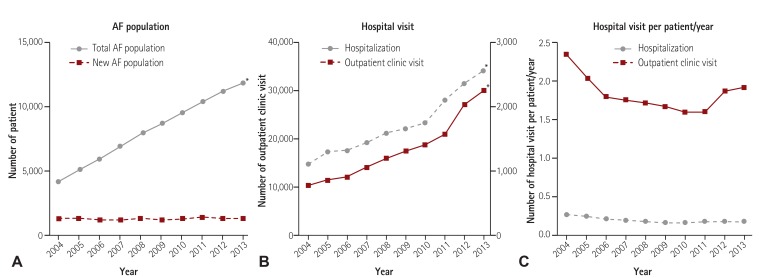
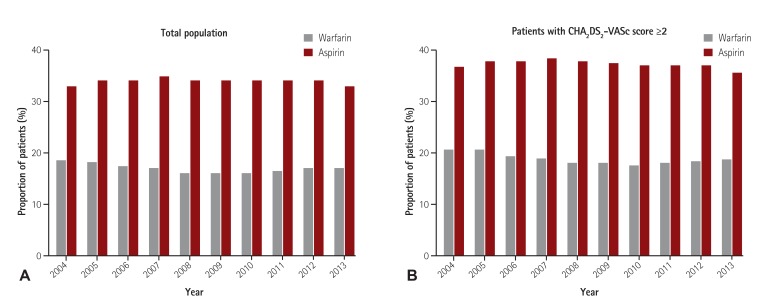
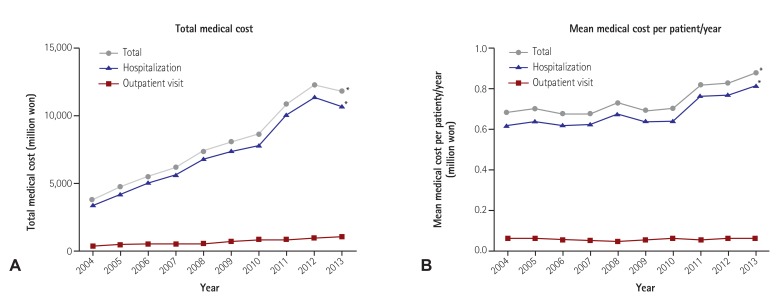
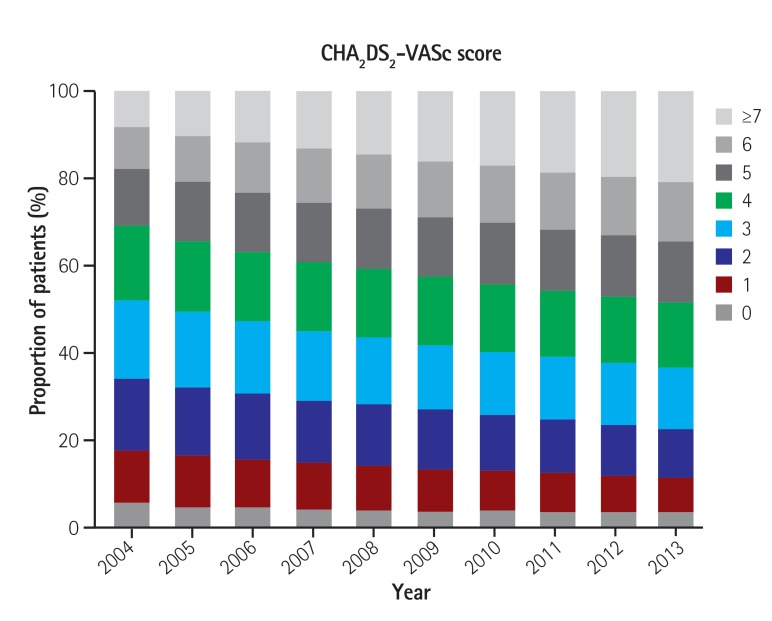
AF-related hospitalization and outpatient clinic visits increased by 2.19 and 3.06-fold, respectively. While the total cost increased from 3.6 to 11.3 billion won (p<0.001), the mean cost per patient increased from 0.68 to 0.83 million won (p<0.001). Although the mean CHADS-VASc score increased from 3.5 to 4.4 in the total AF population, the proportion of patients who receive anticoagulation therapy with warfarin showed no significant change for the decade. The proportion of hospitalization for RFCA was increased (0.4% to 1.1%, p<0.001). All-cause mortality (6.7% to 5.0%), cardiovascular mortality (1.4% to 1.1%) and stroke-related death (1.3% to 0.8%) showed a modest decrease from 2004 to 2013.
During the last decade, AF-related hospitalization and outpatient clinic visits have increased with the increase of many other comorbidities, whereas the rate of anticoagulation did not improved. Although mortality in patients with AF showed a modest decrease from 2004 to 2013, proper anticoagulation therapy is warranted for the improvement of public health.
在迅速老龄化的亚洲国家,房颤(AF)患者住院及院外治疗情况以及住院费用的变化尚不清楚。本研究旨在探讨韩国房颤管理的趋势及结局。
在2004年至2013年韩国国民健康保险数据样本队列(K-NHID-样本队列)的样本队列中,我们使用韩国疾病分类第6版(KCD-6)识别出房颤患者及就诊记录。确定住院费用、处方药物、射频导管消融(RFCA)、发病率和死亡率。
房颤相关住院和门诊就诊次数分别增加了2.19倍和3.06倍。虽然总费用从36亿韩元增加到113亿韩元(p<0.001),但每位患者的平均费用从68万韩元增加到83万韩元(p<0.001)。尽管房颤总体人群的平均CHADS-VASc评分从3.5增加到4.4,但接受华法林抗凝治疗的患者比例在这十年间没有显著变化。RFCA住院比例增加(从0.4%增至1.1%,p<0.001)。2004年至2013年,全因死亡率(从6.7%降至5.0%)、心血管死亡率(从1.4%降至1.1%)和卒中相关死亡率(从1.3%降至0.8%)均有适度下降。
在过去十年中,房颤相关住院和门诊就诊次数随着许多其他合并症的增加而增加,而抗凝率并未改善。虽然2004年至2013年房颤患者的死亡率有适度下降,但为改善公众健康,仍需进行适当的抗凝治疗。