Markl Daniel, Sauerwein Johanna, Goodwin Daniel J, van den Ban Sander, Zeitler J Axel
Department of Chemical Engineering and Biotechnology, University of Cambridge, Philippa Fawcett Drive, Cambridge, CB3 0AS, UK.
GSK Research and Development, New Frontiers Science Park, 3rd Avenue, Harlow, CM19 5AW, UK.
Pharm Res. 2017 May;34(5):1012-1022. doi: 10.1007/s11095-017-2108-4. Epub 2017 Feb 2.
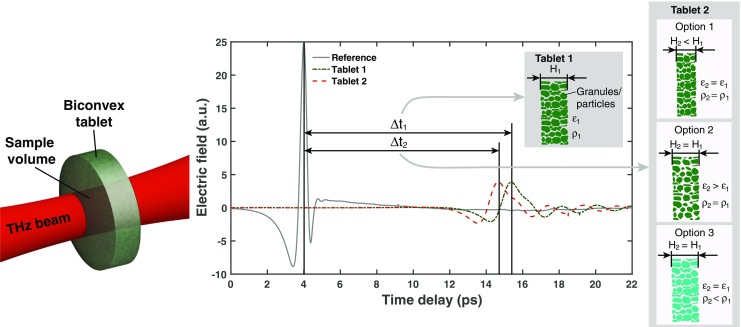
The aim of this study was to establish the suitability of terahertz (THz) transmission measurements to accurately measure and predict the critical quality attributes of disintegration time and the amount of active pharmaceutical ingredient (API) dissolved after 15, 20 and 25 min for commercial tablets processed at production scale.
Samples of 18 batches of biconvex tablets from a production-scale design of experiments study into exploring the design space of a commercial tablet manufacturing process were used. The tablet production involved the process steps of high-shear wet granulation, fluid-bed drying and subsequent compaction. The 18 batches were produced using a 4 factor split plot design to study the effects of process changes on the disintegration time. Non-destructive and contactless terahertz transmission measurements of the whole tablets without prior sample preparation were performed to measure the effective refractive index and absorption coefficient of 6 tablets per batch.
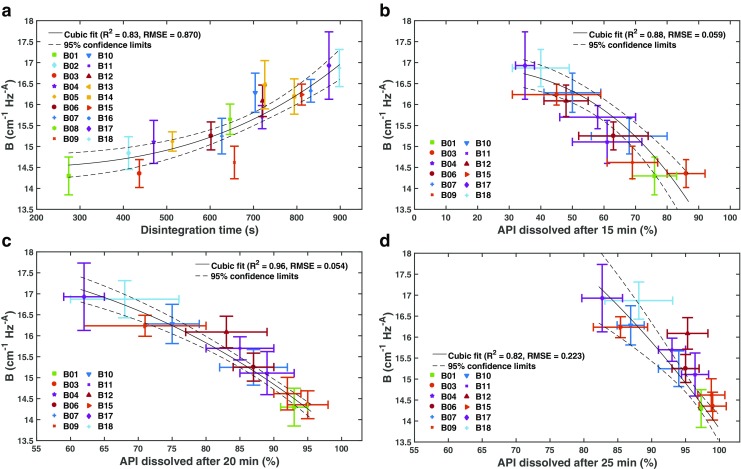
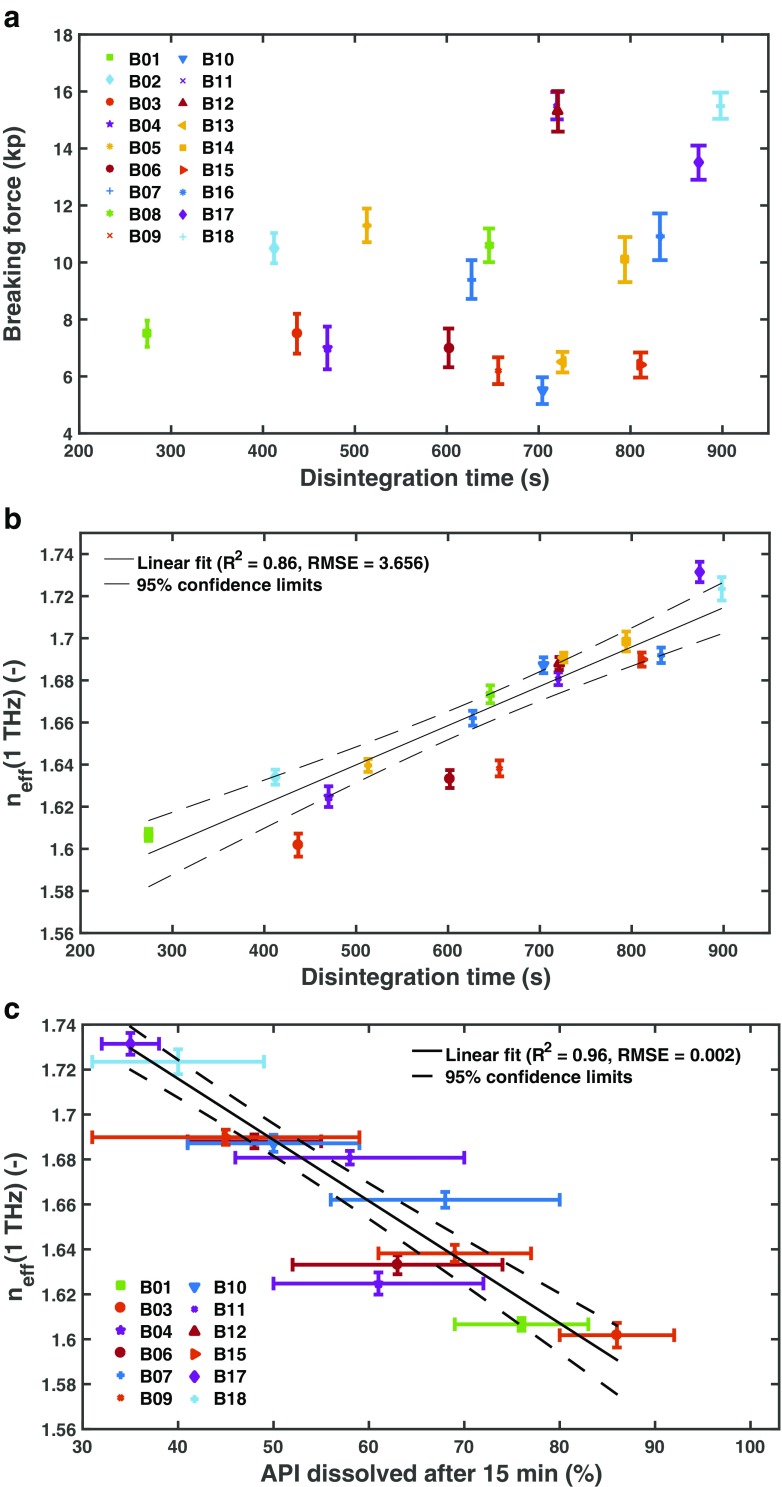
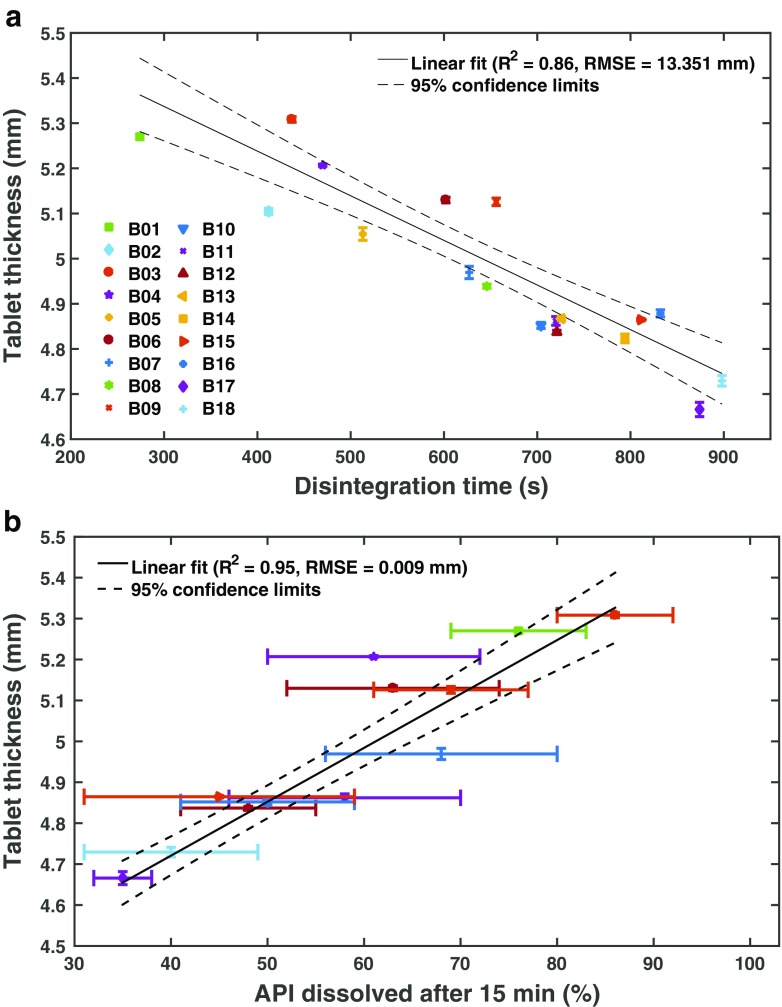
The disintegration time (R = 0.86) and API dissolved after 15 min (R = 0.96) linearly correlates with the effective refractive index, n , measured at terahertz frequencies. In contrast, no such correlation could be established from conventional hardness measurements. The magnitude of n represents the optical density of the sample and thus it reflects both changes in tablet porosity as well as granule density. For the absorption coefficient, α , we observed a better correlation with dissolution after 20 min (R = 0.96) and a weaker correlation with disintegration (R = 0.83) compared to n .
The measurements of n and α provide promising predictors for the disintegration and dissolution time of tablets. The high penetration power of terahertz radiation makes it possible to sample a significant volume proportion of a tablet without any prior sample preparation. Together with the short measurement time (seconds), the potential to measure content uniformity and the fact that the method requires no chemometric models this technology shows clear promise to be established as a process analyser to non-destructively predict critical quality attributes of tablets.
本研究的目的是确定太赫兹(THz)透射测量对于准确测量和预测生产规模加工的市售片剂在15、20和25分钟后的崩解时间及活性药物成分(API)溶出量等关键质量属性的适用性。
使用了来自一项生产规模实验设计研究的18批双凸片剂样品,该研究旨在探索市售片剂制造工艺的设计空间。片剂生产涉及高剪切湿法制粒、流化床干燥及后续压片等工艺步骤。这18批样品采用4因素裂区设计生产,以研究工艺变化对崩解时间的影响。在无需预先样品制备的情况下,对整片进行无损且非接触式太赫兹透射测量,以测量每批6片片剂的有效折射率和吸收系数。
崩解时间(R = 0.86)和15分钟后API溶出量(R = 0.96)与在太赫兹频率下测得的有效折射率n呈线性相关。相比之下,传统硬度测量无法建立此类相关性。n的大小代表样品的光密度,因此它既反映了片剂孔隙率的变化,也反映了颗粒密度的变化。对于吸收系数α,与n相比,我们观察到它与20分钟后的溶出具有更好的相关性(R = 0.96),而与崩解的相关性较弱(R = 0.83)。
n和α的测量为片剂的崩解和溶出时间提供了有前景的预测指标。太赫兹辐射的高穿透能力使得无需任何预先样品制备就能对片剂的很大体积比例进行取样。再加上测量时间短(数秒)、具备测量含量均匀度的潜力以及该方法无需化学计量学模型,这项技术显示出有望成为一种用于无损预测片剂关键质量属性的过程分析仪。