Platek Anna E, Szymanski Filip M, Filipiak Krzysztof J, Dudzik-Plocica Alicja, Krzowski Bartosz, Karpinski Grzegorz
1st Department of Cardiology, Medical University of Warsaw, 1A Banacha Street, 02-097, Warsaw, Poland.
Sleep Breath. 2017 Sep;21(3):601-606. doi: 10.1007/s11325-017-1469-6. Epub 2017 Feb 2.
Risk stratification in patients with atrial fibrillation (AF) is critically important because this group is at high risk of mortality and morbidity. One of the comorbidities potentially affecting thromboembolic and total cardiovascular risk is obstructive sleep apnea (OSA). The aim of this study was to determine whether or not patients with atrial fibrillation and concomitant obstructive sleep apnea have a higher predicted cardiovascular risk than those without sleep-disordered breathing.
The study was designed to be a cross-sectional observational study. Consecutive patients with primary diagnosis of AF who qualified for first-ever catheter ablation between 2011 and 2013 were enrolled. All patients had an overnight polysomnography performed for the diagnosis of OSA and calculation of a 2MACE score-a cardiovascular risk assessment score for AF.
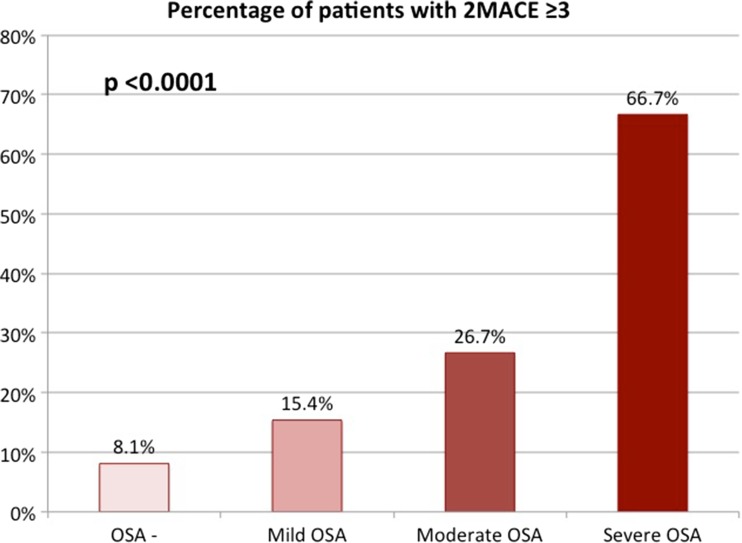
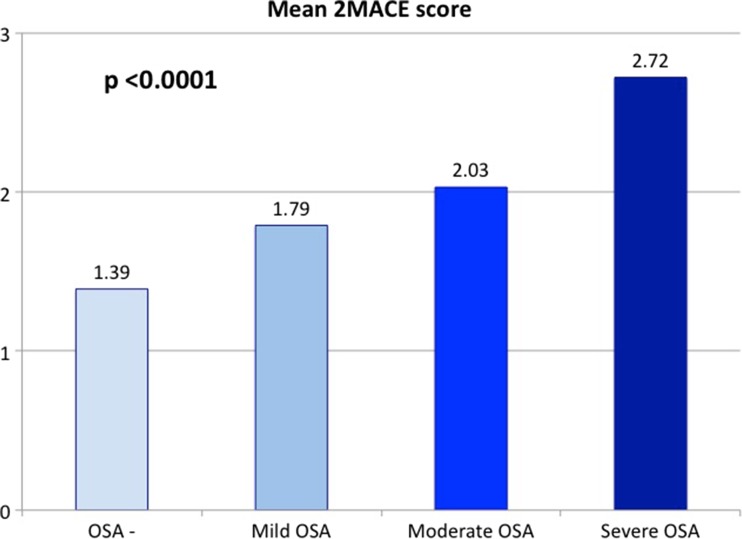
We studied 211 AF patients (mean age 57.1 ± 10.2 years, 62.6% males). OSA with apnea-hypopnea index (AHI) ≥15/h was found in 48 patients (22.7%). Cardiovascular disease and risk factors were as follows: 8 (3.8%) patients had congestive heart failure, 27 (12.8%) diabetes, 16 (7.6%) history of stroke or thromboembolic disease, 194 (91.9%) arterial hypertension, 24 (11.4%) vascular disease, and 31 (14.7%) were current smokers. A significantly higher percentage of patients with OSA was at high risk of cardiovascular disease (29.2 vs. 8.1%; p < 0.0001). The trend remained significant in different categories of obstructive sleep apnea when categorized by AHI into non-OSA, and mild, moderate, and severe OSA. Similarly, the mean 2MACE score was statistically significantly higher in OSA than non-OSA patients (2.1 ± 1.1 vs. 1.4 ± 1.0; p < 0.0001).
OSA prevalence is increased in AF patients and is associated with an increase 2MACE score-an indicator of major cardiovascular events. There is a linear relationship between severity of OSA and increasing 2MACE scores, indicating increasing cardiovascular risk related to OSA severity.
心房颤动(AF)患者的风险分层至关重要,因为该群体具有较高的死亡率和发病率风险。阻塞性睡眠呼吸暂停(OSA)是一种可能影响血栓栓塞和总体心血管风险的合并症。本研究的目的是确定合并阻塞性睡眠呼吸暂停的心房颤动患者与无睡眠呼吸障碍的患者相比,其预测的心血管风险是否更高。
本研究设计为横断面观察性研究。纳入2011年至2013年间首次诊断为AF且符合首次导管消融条件的连续患者。所有患者均接受过夜多导睡眠图检查,以诊断OSA并计算2MACE评分——一种用于AF的心血管风险评估评分。
我们研究了211例AF患者(平均年龄57.1±10.2岁,男性占62.6%)。48例患者(22.7%)被发现患有呼吸暂停低通气指数(AHI)≥15/小时的OSA。心血管疾病及危险因素如下:8例(3.8%)患者患有充血性心力衰竭,27例(12.8%)患有糖尿病,16例(7.6%)有中风或血栓栓塞疾病史,194例(91.9%)患有动脉高血压,24例(11.4%)患有血管疾病,31例(14.7%)为当前吸烟者。OSA患者中具有心血管疾病高风险的比例显著更高(29.2%对8.1%;p<0.0001)。当根据AHI将阻塞性睡眠呼吸暂停分为非OSA、轻度、中度和重度OSA时,在不同类别中该趋势仍然显著。同样,OSA患者的平均2MACE评分在统计学上显著高于非OSA患者(2.1±1.1对1.4±1.0;p<0.0001)。
AF患者中OSA患病率增加,且与2MACE评分升高相关——2MACE评分是主要心血管事件的一个指标。OSA严重程度与2MACE评分升高之间存在线性关系,表明与OSA严重程度相关的心血管风险增加。