Brewster Jordan, Sexton Travis, Dhaliwal Gary, Charnigo Richard, Morales Gustavo, Parrott Kevin, Darrat Yousef, Gurley John, Smyth Susan, Elayi Claude S
Krannert Institute of Cardiology, Indiana University, Indianapolis, Indiana.
Department of Cardiology, University of Kentucky and VAMC, Lexington, Kentucky.
Pacing Clin Electrophysiol. 2017 Apr;40(4):344-352. doi: 10.1111/pace.13037. Epub 2017 Mar 8.
Implantable cardioverter-defibrillator (ICD) shocks are potentially associated with myocardial injury, altered hemodynamics, apoptosis, and inflammatory signaling. Their precise cellular impact can be explored after defibrillation testing (DFT) via biomarkers. We evaluated changes in biomarkers after ICD shocks during DFT.
We prospectively enrolled outpatients presenting for first implantation of a cardiac device. Biomarkers indicative of myocardial injury, inflammation, and apoptosis were measured before and after implantation, and compared between patients receiving DFT (DFT+) to those not (DFT-).
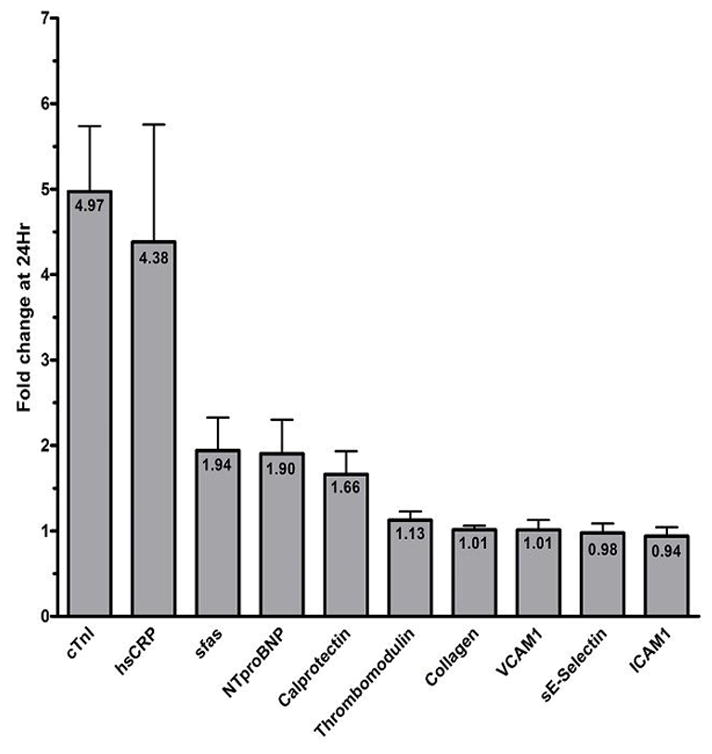
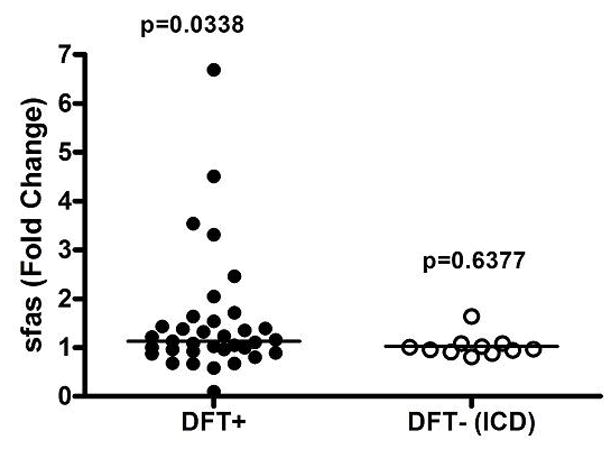
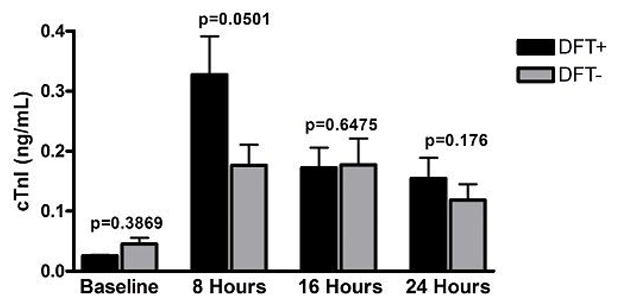
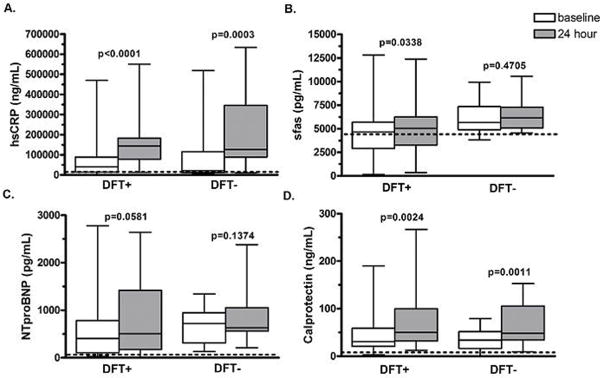
Sixty-three patients were enrolled, 40 in the DFT+ group and 23 in the DFT- group. Average levels of troponin I, hsCRP, Calprotectin, N-terminal pro B-type natriuretic peptide (NTproBNP), and sFas increased by >50% after cardiac device implantation compared to baseline. Increase in troponin never exceeded the 50-fold upper limit of normal (2 ng/mL). Troponin trended higher in the DFT+ group at 8 hours (median 0.18 ng/mL, interquartile range [IQR] 0.11-0.48) versus the DFT- group (0.10 ng/mL, IQR 0.06-0.28, P = 0.0501); NTproBNP had a similar trend (P = 0.0581). sFas significantly increased in the DFT+ group from baseline (median 4663 pg/mL, IQR 2908-5679) to 24 hours (5039 pg/mL, IQR 3274-6261; P = 0.0338) but not in the DFT- group (P = 0.4705).
DFT testing is associated with acutely increased plasma levels of troponin and sFas, a biomarker of apoptosis, along with a trend toward higher NTproBNP.
植入式心脏复律除颤器(ICD)电击可能与心肌损伤、血流动力学改变、细胞凋亡及炎症信号传导有关。在除颤测试(DFT)后,可通过生物标志物探究其对细胞的确切影响。我们评估了DFT期间ICD电击后生物标志物的变化。
我们前瞻性纳入首次植入心脏装置的门诊患者。在植入前后测量指示心肌损伤、炎症及细胞凋亡的生物标志物,并比较接受DFT的患者(DFT+)与未接受DFT的患者(DFT-)。
共纳入63例患者,DFT+组40例,DFT-组23例。与基线相比,心脏装置植入后肌钙蛋白I、超敏C反应蛋白(hsCRP)、钙卫蛋白、N末端B型脑钠肽原(NTproBNP)及可溶性Fas(sFas)的平均水平升高超过50%。肌钙蛋白升高从未超过正常上限的50倍(2 ng/mL)。DFT+组在8小时时肌钙蛋白水平呈上升趋势(中位数0.18 ng/mL,四分位数间距[IQR] 0.11 - 0.48),而DFT-组为(0.10 ng/mL,IQR 0.06 - 0.28,P = 0.0501);NTproBNP有类似趋势(P = 0.0581)。DFT+组sFas从基线(中位数4663 pg/mL,IQR 2908 - 5679)至24小时显著升高(5039 pg/mL,IQR 3274 - 6261;P = 0.0338),而DFT-组未升高(P = 0.4705)。
DFT测试与肌钙蛋白和sFas(一种细胞凋亡生物标志物)的血浆水平急性升高以及NTproBNP升高趋势有关。