Endesfelder Stefanie, Makki Hanan, von Haefen Clarissa, Spies Claudia D, Bührer Christoph, Sifringer Marco
Department of Neonatology, Charité - Universitätsmedizin Berlin, Berlin, Germany.
Department of Anesthesiology and Intensive Care Medicine, Charité - Universitätsmedizin Berlin, Berlin, Germany.
PLoS One. 2017 Feb 3;12(2):e0171498. doi: 10.1371/journal.pone.0171498. eCollection 2017.
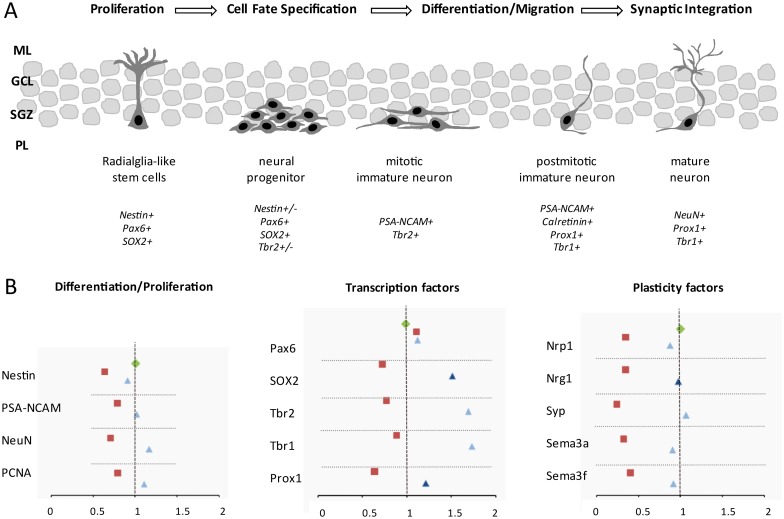
Dexmedetomidine (DEX) is a highly selective agonist of α2-receptors with sedative, anxiolytic, and analgesic properties. Neuroprotective effects of dexmedetomidine have been reported in various brain injury models. In the present study, we investigated the effects of dexmedetomidine on hippocampal neurogenesis, specifically the proliferation capacity and maturation of neurons and neuronal plasticity following the induction of hyperoxia in neonatal rats. Six-day old sex-matched Wistar rats were exposed to 80% oxygen or room air for 24 h and treated with 1, 5 or 10 μg/kg of dexmedetomidine or normal saline. A single pretreatment with DEX attenuated the hyperoxia-induced injury in terms of neurogenesis and plasticity. In detail, both the proliferation capacity (PCNA+ cells) as well as the expression of neuronal markers (Nestin+, PSA-NCAM+, NeuN+ cells) and transcription factors (SOX2, Tbr1/2, Prox1) were significantly reduced under hyperoxia compared to control. Furthermore, regulators of neuronal plasticity (Nrp1, Nrg1, Syp, and Sema3a/f) were also drastically decreased. A single administration of dexmedetomidine prior to oxygen exposure resulted in a significant up-regulation of expression-profiles compared to hyperoxia. Our results suggest that dexmedetomidine may have neuroprotective effects in an acute hyperoxic model of the neonatal rat.
右美托咪定(DEX)是一种α2受体的高选择性激动剂,具有镇静、抗焦虑和镇痛特性。右美托咪定的神经保护作用已在各种脑损伤模型中有所报道。在本研究中,我们研究了右美托咪定对新生大鼠海马神经发生的影响,特别是在诱导高氧后神经元的增殖能力、成熟情况以及神经元可塑性。将6日龄性别匹配的Wistar大鼠暴露于80%氧气或室内空气中24小时,并用1、5或10μg/kg的右美托咪定或生理盐水进行处理。右美托咪定单次预处理在神经发生和可塑性方面减轻了高氧诱导的损伤。具体而言,与对照组相比,在高氧条件下,增殖能力(增殖细胞核抗原阳性细胞)以及神经元标志物(巢蛋白阳性、多唾液酸神经细胞黏附分子阳性、神经元核抗原阳性细胞)和转录因子(SRY-box转录因子2、T-box脑蛋白1/2、Prospero同源物1)的表达均显著降低。此外,神经元可塑性调节因子(神经纤毛蛋白1、神经调节蛋白1、突触素、信号素3a/f)也大幅减少。在氧气暴露前单次给予右美托咪定导致与高氧组相比表达谱显著上调。我们的结果表明,右美托咪定在新生大鼠急性高氧模型中可能具有神经保护作用。