Pérez Vanessa, López Dolores, Boixadera Ester, Ibernón Meritxell, Espinal Anna, Bonet Josep, Romero Ramón
Laboratory of Experimental Nephrology, Institut d'Investigació en Ciències de la Salut Germans Trias i Pujol, Universitat Autònoma de Barcelona, Badalona, Spain.
Department of Nephrology, Hospital Universitari Germans Trias i Pujol, Universitat Autònoma de Barcelona, Carretera del Canyet s/n, ES-08916, Badalona, Barcelona, Spain.
BMC Nephrol. 2017 Feb 3;18(1):49. doi: 10.1186/s12882-017-0452-6.
Minimal change disease (MCD) and primary focal segmental glomerulosclerosis (FSGS) are glomerular diseases characterized by nephrotic syndrome. Their diagnosis requires a renal biopsy, but it is an invasive procedure with potential complications. In a small biopsy sample, where only normal glomeruli are observed, FSGS cannot be differentiated from MCD. The correct diagnosis is crucial to an effective treatment, as MCD is normally responsive to steroid therapy, whereas FSGS is usually resistant. The purpose of our study was to discover and validate novel early urinary biomarkers capable to differentiate between MCD and FSGS.
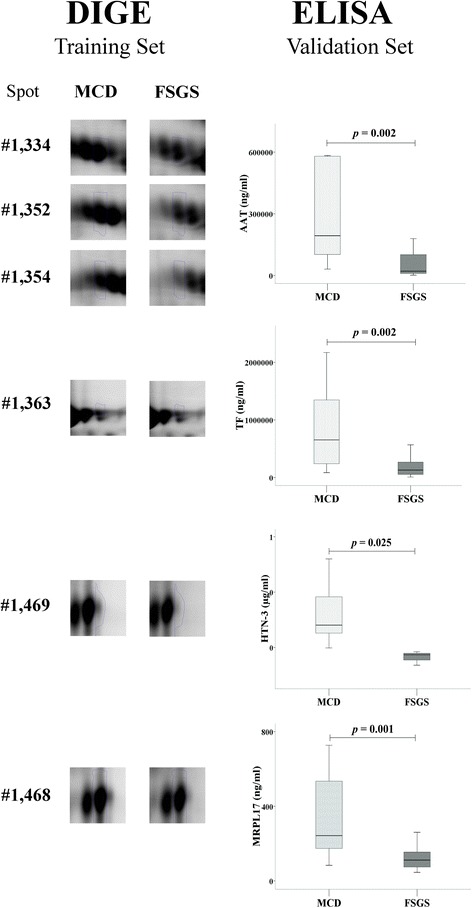
Forty-nine patients biopsy-diagnosed of MCD and primary FSGS were randomly subdivided into a training set (10 MCD, 11 FSGS) and a validation set (14 MCD, 14 FSGS). The urinary proteome of the training set was analyzed by two-dimensional differential gel electrophoresis coupled with mass spectrometry. The proteins identified were quantified by enzyme-linked immunosorbent assay in urine samples from the validation set.
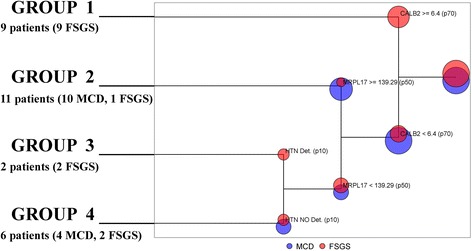
Urinary concentration of alpha-1 antitrypsin, transferrin, histatin-3 and 39S ribosomal protein L17 was decreased and calretinin was increased in FSGS compared to MCD. These proteins were used to build a decision tree capable to predict patient's pathology.
This preliminary study suggests a group of urinary proteins as possible non-invasive biomarkers with potential value in the differential diagnosis of MCD and FSGS. These biomarkers would reduce the number of misdiagnoses, avoiding unnecessary or inadequate treatments.
微小病变病(MCD)和原发性局灶节段性肾小球硬化症(FSGS)是伴有肾病综合征的肾小球疾病。它们的诊断需要进行肾活检,但这是一种具有潜在并发症的侵入性操作。在仅观察到正常肾小球的小活检样本中,无法将FSGS与MCD区分开来。正确的诊断对于有效治疗至关重要,因为MCD通常对类固醇治疗有反应,而FSGS通常具有抗性。我们研究的目的是发现并验证能够区分MCD和FSGS的新型早期尿液生物标志物。
49例经活检诊断为MCD和原发性FSGS的患者被随机分为训练组(10例MCD,11例FSGS)和验证组(14例MCD,14例FSGS)。通过二维差异凝胶电泳结合质谱分析训练组的尿液蛋白质组。通过酶联免疫吸附测定法对验证组尿液样本中鉴定出的蛋白质进行定量。
与MCD相比,FSGS患者尿液中α-1抗胰蛋白酶、转铁蛋白、组蛋白-3和39S核糖体蛋白L17的浓度降低,而钙视网膜蛋白浓度升高。这些蛋白质被用于构建一个能够预测患者病理情况的决策树。
这项初步研究表明,一组尿液蛋白质可能是具有潜在价值的非侵入性生物标志物,可用于MCD和FSGS的鉴别诊断。这些生物标志物将减少误诊数量,避免不必要或不充分的治疗。