Prangnell Amy, Dong Huiru, Daly Patricia, Milloy M J, Kerr Thomas, Hayashi Kanna
British Columbia Centre for Excellence in HIV/AIDS, St. Paul's Hospital, Urban Health Research Initiative, 608-1081 Burrard Street, Vancouver, BC, V6Z 1Y6, Canada.
School of Population and Public Health, University of British Columbia, 206 E Mall, Vancouver, BC, V6T 1Z9, Canada.
BMC Public Health. 2017 Feb 3;17(1):163. doi: 10.1186/s12889-017-4099-9.
Crack cocaine smoking is associated with an array of negative health consequences, including cuts and burns from unsafe pipes, and infectious diseases such as HIV. Despite the well-established and researched harm reduction programs for injection drug users, little is known regarding the potential for harm reduction programs targeting crack smoking to reduce health problems from crack smoking. In the wake of recent crack pipe distribution services expansion, we utilized data from long running cohort studies to estimate the impact of crack pipe distribution services on the rates of health problems associated with crack smoking in Vancouver, Canada.
Data were derived from two prospective cohort studies of community-recruited people who inject drugs in Vancouver between December 2005 and November 2014. We employed multivariable generalized estimating equations to examine the relationship between crack pipe acquisition sources and self-reported health problems associated with crack smoking (e.g., cut fingers/sores, coughing blood) among people reported smoking crack.
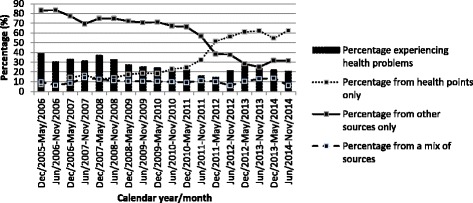
Among 1718 eligible participants, proportions of those obtaining crack pipes only through health service points have significantly increased from 7.2% in 2005 to 62.3% in 2014 (p < 0.001), while the rates of reporting health problems associated with crack smoking have significantly declined (p < 0.001). In multivariable analysis, compared to those obtaining pipes only through other sources (e.g., on the street, self-made), those acquiring pipes through health service points only were significantly less likely to report health problems from smoking crack (adjusted odds ratio: 0.82; 95% confidence interval: 0.73-0.93).
These findings suggest that the expansion of crack pipe distribution services has likely served to reduce health problems from smoking crack in this setting. They provide evidence supporting crack pipe distribution programs as a harm reduction service for crack smokers.
吸食快克可卡因会带来一系列负面健康后果,包括因不安全吸食工具导致的割伤和烧伤,以及诸如感染艾滋病毒等传染病。尽管针对注射吸毒者的减少伤害项目已得到充分确立和研究,但对于针对吸食快克行为的减少伤害项目能否降低吸食快克所致健康问题,人们了解甚少。随着近期快克吸食工具分发服务的扩大,我们利用长期队列研究的数据来估计快克吸食工具分发服务对加拿大温哥华与吸食快克相关的健康问题发生率的影响。
数据来自2005年12月至