Kirsh Susan R, Aron David C, Johnson Kimberly D, Santurri Laura E, Stevenson Lauren D, Jones Katherine R, Jagosh Justin
Louis Stokes Cleveland VA Medical Center, Cleveland, OH, USA.
School of Medicine, Case Western Reserve University, Cleveland, OH, USA.
BMC Health Serv Res. 2017 Feb 4;17(1):113. doi: 10.1186/s12913-017-2064-z.
Shared medical appointments (SMAs) are doctor-patient visits in which groups of patients are seen by one or more health care providers in a concurrent session. There is a growing interest in understanding the potential benefits of SMAs in various contexts to improve clinical outcomes and reduce healthcare costs. This study builds upon the existing evidence base that suggests SMAs are indeed effective. In this study, we explored how they are effective in terms of the underlying mechanisms of action and under what circumstances.
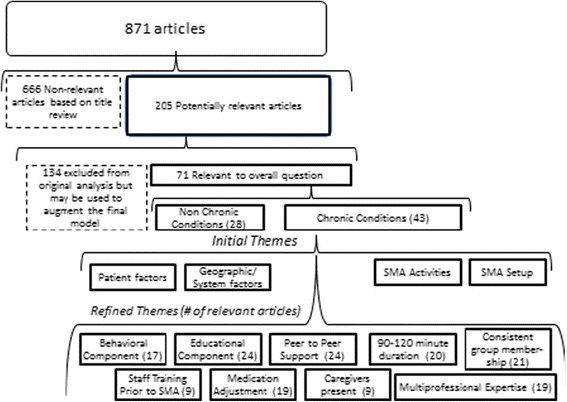
Realist review methodology was used to synthesize the literature on SMAs, which included a broad search of 800+ published articles. 71 high quality primary research articles were retained to build a conceptual model of SMAs and 20 of those were selected for an in depth analysis using realist methodology (i.e.,middle-range theories and and context-mechanism-outcome configurations).
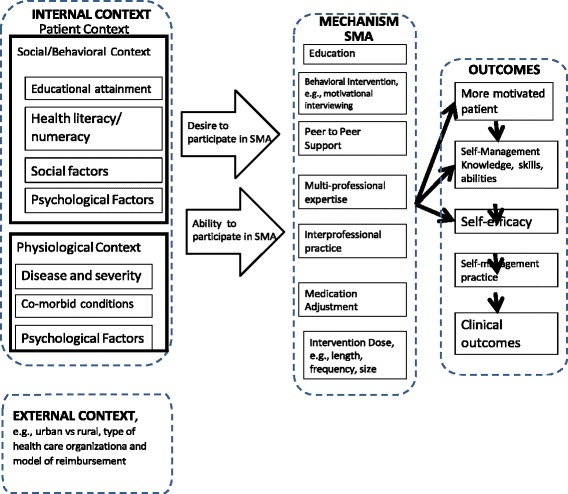
Nine main mechanisms that serve to explain how SMAs work were theorized from the data immersion process and configured in a series of context-mechanism-outcome configurations (CMOs). These are: (1) Group exposure in SMAs combats isolation, which in turn helps to remove doubts about one's ability to manage illness; (2) Patients learn about disease self-management vicariously by witnessing others' illness experiences; (3) Patients feel inspired by seeing others who are coping well; (4) Group dynamics lead patients and providers to developing more equitable relationships; (5) Providers feel increased appreciation and rapport toward colleagues leading to increased efficiency; (6) Providers learn from the patients how better to meet their patients' needs; (7) Adequate time allotment of the SMA leads patients to feel supported; (8) Patients receive professional expertise from the provider in combination with first-hand information from peers, resulting in more robust health knowledge; and (9) Patients have the opportunity to see how the physicians interact with fellow patients, which allows them to get to know the physician and better determine their level of trust.
Nine overarching mechanisms were configured in CMO configurations and discussed as a set of complementary middle-range programme theories to explain how SMAs work. It is anticipated that this innovative work in theorizing SMAs using realist review methodology will provide policy makers and SMA program planners adequate conceptual grounding to design contextually sensitive SMA programs in a wide variety of settings and advance an SMA research agenda for varied contexts.
共享医疗预约(SMA)是指在同一时段内,一组患者由一名或多名医疗服务提供者进行诊治。人们越来越关注了解SMA在各种情况下的潜在益处,以改善临床结果并降低医疗成本。本研究建立在现有证据基础之上,这些证据表明SMA确实有效。在本研究中,我们探讨了SMA在作用机制方面是如何有效的,以及在何种情况下有效。
采用实在论综述方法对有关SMA的文献进行综合分析,其中包括广泛检索800多篇已发表的文章。保留了71篇高质量的原始研究文章,以构建SMA的概念模型,并从中选择20篇使用实在论方法进行深入分析(即中程理论以及背景-机制-结果配置)。
通过数据沉浸过程,从理论上推导出九个主要机制,这些机制用于解释SMA的工作原理,并配置在一系列背景-机制-结果配置(CMO)中。它们分别是:(1)SMA中的群体接触可对抗孤立感,这反过来有助于消除对自身疾病管理能力的疑虑;(2)患者通过目睹他人的患病经历间接学习疾病自我管理;(3)看到应对良好的他人会激励患者;(4)群体动态促使患者和提供者建立更公平的关系;(5)提供者对同事的认可度和融洽度提高,从而提高效率;(6)提供者从患者那里学习如何更好地满足患者需求;(7)SMA有足够的时间分配,使患者感到得到支持;(8)患者从提供者那里获得专业知识,并结合来自同伴的第一手信息,从而获得更丰富的健康知识;(9)患者有机会看到医生与其他患者的互动方式,这使他们能够了解医生并更好地确定对医生的信任程度。
九个总体机制在CMO配置中进行了构建,并作为一组互补的中程项目理论进行了讨论,以解释SMA的工作原理。预计这项使用实在论综述方法对SMA进行理论化的创新性工作,将为政策制定者和SMA项目规划者提供充分的概念基础,以便在各种环境中设计因地制宜的SMA项目,并推进针对不同环境的SMA研究议程。