Stiermaier Thomas, Graf Tobias, Möller Christian, Eitel Charlotte, Ledwoch Jakob, Desch Steffen, Gutberlet Matthias, Schuler Gerhard, Thiele Holger, Eitel Ingo
University Heart Center Lübeck, Medical Clinic II (Cardiology/Angiology/Intensive Care Medicine), University Hospital Schleswig-Holstein, Ratzeburger Allee 160, 23538, Lübeck, Germany.
German Center for Cardiovascular Research (DZHK), Partner Site Hamburg/Kiel/Lübeck, Lübeck, Germany.
J Cardiovasc Magn Reson. 2017 Feb 6;19(1):15. doi: 10.1186/s12968-017-0328-8.
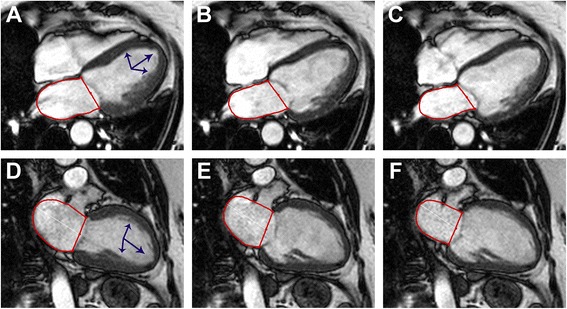
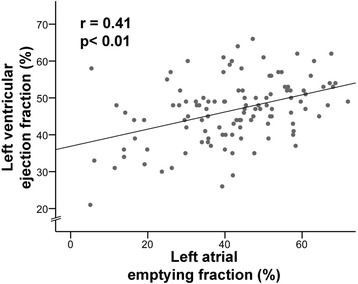
Takotsubo syndrome (TTS) is characterized by a transient left and/or right ventricular dysfunction as a consequence of a distinctive pattern of regional wall motion abnormalities. However, a systematic evaluation of the left atrial (LA) function in patients with TTS is lacking. The aim of the present study was therefore to comprehensively assess LA performance indexes and function in patients with TTS.
We compared LA function assessed by volumetric indexes derived from fractional volume changes in cardiovascular magnetic resonance (CMR) between 125 TTS patients and 125 patients with anterior ST-segment elevation myocardial infarction (STEMI). Furthermore, recovery of LA performance was evaluated in a subgroup of 20 TTS patients with follow-up CMR data.
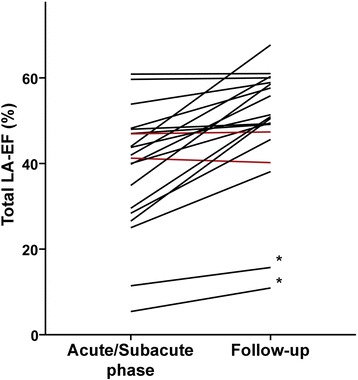
Patients with TTS demonstrated a significantly lower total LA emptying fraction (EF) [44% (interquartile range (IQR) 34-53%) versus 51% (IQR 42-56%); p < 0.01], passive LA-EF [21% (IQR 14-30%) versus 24% (IQR 20-29%); p = 0.03] and active LA-EF [29% (IQR 20-38%) versus 35% (28-42%); p < 0.01] compared to patients with anterior STEMI. Among the 20 TTS patients with serial CMR data, the total LA-EF significantly improved from 42% (IQR 29-48%) at the acute stage to 51% (IQR 46-59%) at follow-up (p < 0.01). Similarly, active LA-EF (p < 0.01) and passive LA-EF (p = 0.02) improved significantly as well.
Compared to anterior STEMI, TTS patients demonstrated a significantly decreased LA function during the acute/subacute phase of the disease. However, impairment of LA performance seems to be transient in TTS with recovery during follow-up.
应激性心肌病(TTS)的特征是由于独特的室壁运动异常模式导致短暂的左心室和/或右心室功能障碍。然而,目前缺乏对TTS患者左心房(LA)功能的系统评估。因此,本研究的目的是全面评估TTS患者的LA性能指标和功能。
我们比较了125例TTS患者和125例前壁ST段抬高型心肌梗死(STEMI)患者通过心血管磁共振(CMR)中分数容积变化得出的容积指标评估的LA功能。此外,在20例有CMR随访数据的TTS患者亚组中评估了LA性能的恢复情况。
与前壁STEMI患者相比,TTS患者的总LA排空分数(EF)显著降低[44%(四分位间距(IQR)34 - 53%)对51%(IQR 42 - 56%);p < 0.01],被动LA-EF[21%(IQR 14 - 30%)对24%(IQR 20 - 29%);p = 0.03]和主动LA-EF[29%(IQR 20 - 38%)对35%(28 - 42%);p < 0.01]。在20例有连续CMR数据的TTS患者中,总LA-EF从急性期的42%(IQR 29 - 48%)显著提高到随访时的51%(IQR 46 - 59%)(p < 0.01)。同样,主动LA-EF(p < 0.01)和被动LA-EF(p = 0.02)也显著改善。
与前壁STEMI相比,TTS患者在疾病的急性/亚急性期LA功能显著降低。然而,TTS患者的LA性能损害似乎是短暂的,随访期间会恢复。