Manzat Saplacan Roberta M, Balacescu Loredana, Gherman Claudia, Chira Romeo I, Craiu Anca, Mircea Petru A, Lisencu Cosmin, Balacescu Ovidiu
First Medical Clinic, University of Medicine and Pharmacy "Iuliu Hatieganu" Cluj-Napoca, 3-5 Clinicilor Street, 400006 Cluj-Napoca, Romania.
Department of Functional Genomics, Proteomics and Experimental Pathology, The Oncology Institute "Prof. Dr. Ion Chiricuta", 34-36 Republicii Street, 400015 Cluj-Napoca, Romania.
Mediators Inflamm. 2017;2017:4708076. doi: 10.1155/2017/4708076. Epub 2017 Jan 10.
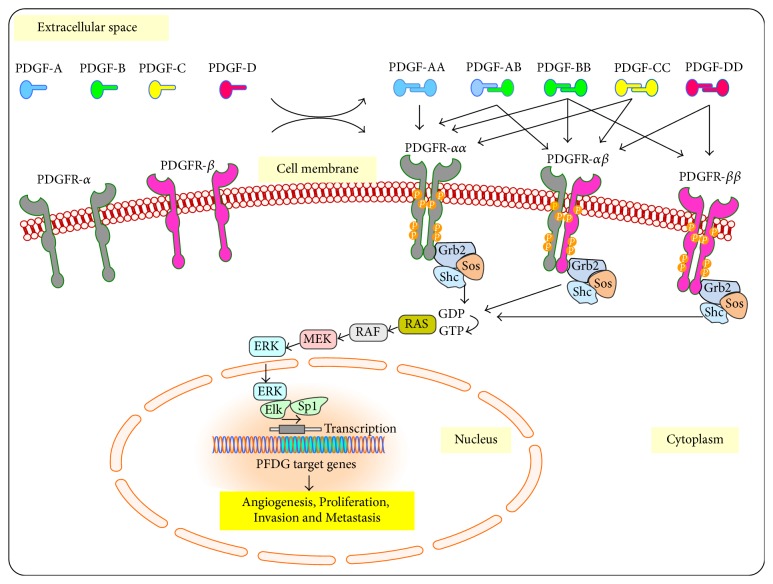
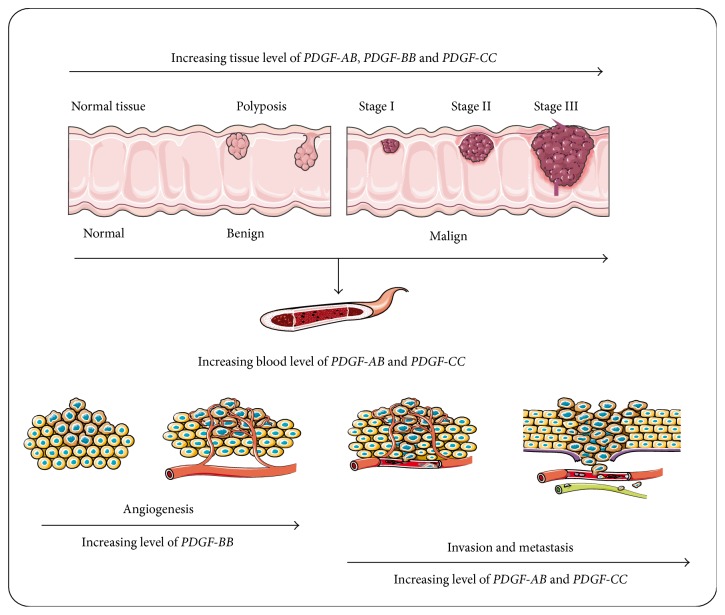
Colorectal cancer (CRC) is an important cause of morbidity and mortality worldwide. Angiogenesis was reported as one important mechanism activated in colorectal carcinogenesis. Tumor microenvironment associated angiogenesis involves a large spectrum of signaling molecules and deciphering their role in colorectal carcinogenesis still represents a major challenge. The aim of our study is to point out the diagnosis and prediction role of PDGF family and their receptors in colorectal carcinogenesis. A systematic search in Medline and PubMed for studies reporting the role of platelet-derived growth factors (PDGFs) and their receptors (PDGFRs) in tumor biology related to CRC was made. PDGFs are important growth factors for normal tissue growth and division, with an important role in blood vessel formation. PDGFs/PDGFRs signaling pathway has been demonstrated to be involved in angiogenesis mainly by targeting pericytes and vascular smooth muscle cells. High levels of PDGF-BB were reported in CRC patients compared to those with adenomas, while elevated levels of PDGFR / in the stroma of CRC patients were correlated with invasion and metastasis. Moreover, PDGF-AB and PDGF-C were correlated with early diagnosis, cancer grading, and metastatic disease. Both PDGFs and PDGFRs families play an important role in colorectal carcinogenesis and could be considered to be investigated as useful biomarkers both for diagnosis and treatment of CRC.
结直肠癌(CRC)是全球发病和死亡的重要原因。血管生成被报道为在结直肠癌发生过程中激活的一种重要机制。肿瘤微环境相关的血管生成涉及大量信号分子,解读它们在结直肠癌发生中的作用仍然是一项重大挑战。我们研究的目的是指出血小板衍生生长因子(PDGF)家族及其受体在结直肠癌发生中的诊断和预测作用。我们在Medline和PubMed中系统检索了报道血小板衍生生长因子(PDGFs)及其受体(PDGFRs)在与CRC相关的肿瘤生物学中的作用的研究。PDGFs是正常组织生长和分裂的重要生长因子,在血管形成中起重要作用。PDGFs/PDGFRs信号通路已被证明主要通过靶向周细胞和血管平滑肌细胞参与血管生成。与腺瘤患者相比,CRC患者中PDGF-BB水平较高,而CRC患者基质中PDGFRβ水平升高与侵袭和转移相关。此外,PDGF-AB和PDGF-C与早期诊断、癌症分级和转移性疾病相关。PDGFs和PDGFRs家族在结直肠癌发生中都起重要作用,可被视为用于CRC诊断和治疗的有用生物标志物进行研究。