Leegwater Nick C, Bakker Astrid D, Hogervorst Jolanda M A, Nolte Peter A, Klein-Nulend Jenneke
Department of Orthopaedics, Spaarne Hospital, Hoofddorp, The Netherlands.
Department of Oral Cell Biology, Academic Centre for Dentistry Amsterdam (ACTA), University of Amsterdam and VU University Amsterdam, MOVE Research Institute Amsterdam, Amsterdam, The Netherlands.
PLoS One. 2017 Feb 6;12(2):e0171492. doi: 10.1371/journal.pone.0171492. eCollection 2017.
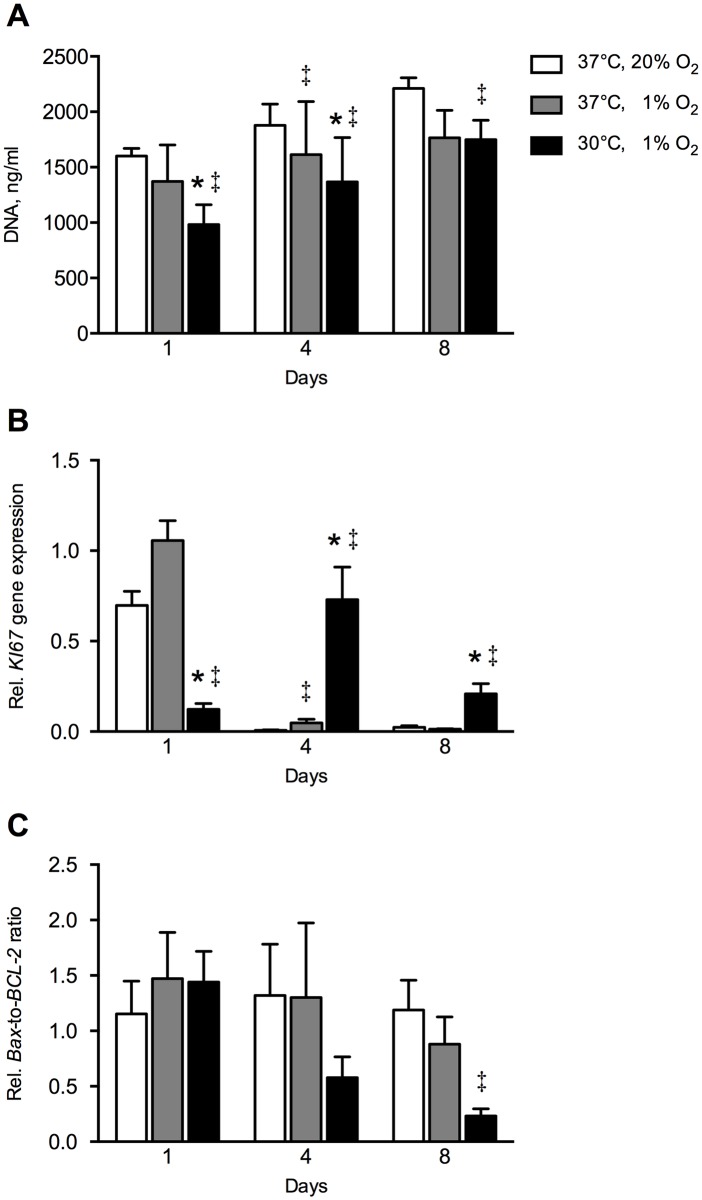
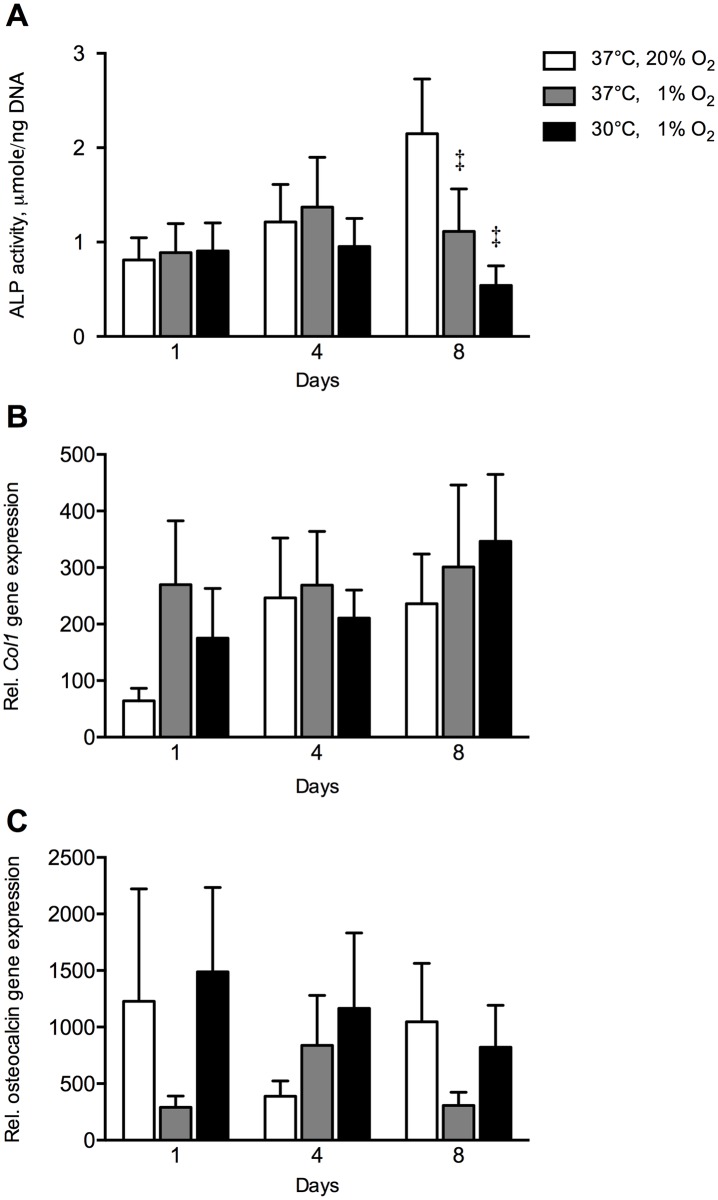
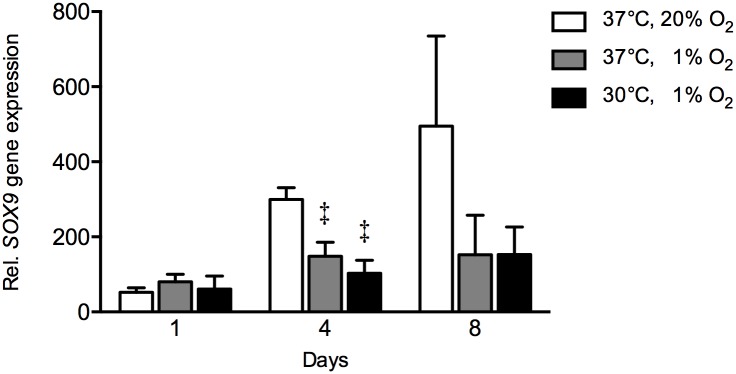
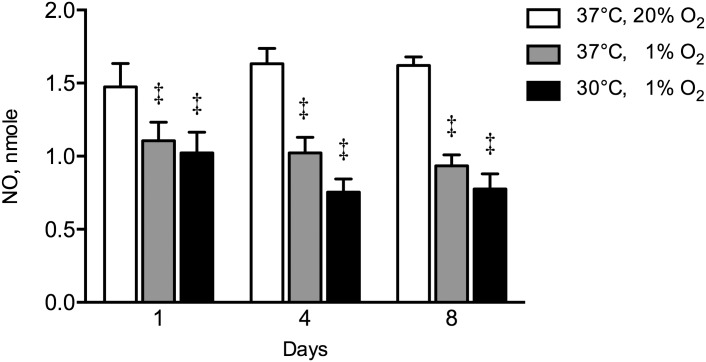
Cryotherapy is successfully used in the clinic to reduce pain and inflammation after musculoskeletal damage, and might prevent secondary tissue damage under the prevalent hypoxic conditions. Whether cryotherapy reduces mesenchymal stem cell (MSC) number and differentiation under hypoxic conditions, causing impaired callus formation is unknown. We aimed to determine whether hypothermia modulates proliferation, apoptosis, nitric oxide production, VEGF gene and protein expression, and osteogenic/chondrogenic differentiation of human MSCs under hypoxia. Human adipose MSCs were cultured under hypoxia (37°C, 1% O2), hypothermia and hypoxia (30°C, 1% O2), or control conditions (37°C, 20% O2). Total DNA, protein, nitric oxide production, alkaline phosphatase activity, gene expression, and VEGF protein concentration were measured up to day 8. Hypoxia enhanced KI67 expression at day 4. The combination of hypothermia and hypoxia further enhanced KI67 gene expression compared to hypoxia alone, but was unable to prevent the 1.2-fold reduction in DNA amount caused by hypoxia at day 4. Addition of hypothermia to hypoxic cells did not alter the effect of hypoxia alone on BAX-to-BCL-2 ratio, alkaline phosphatase activity, gene expression of SOX9, COL1, or osteocalcin, or nitric oxide production. Hypothermia decreased the stimulating effect of hypoxia on VEGF-165 gene expression by 6-fold at day 4 and by 2-fold at day 8. Hypothermia also decreased VEGF protein expression under hypoxia by 2.9-fold at day 8. In conclusion, hypothermia decreased VEGF-165 gene and protein expression, but did not affect differentiation, or apoptosis of MSCs cultured under hypoxia. These in vitro results implicate that hypothermia treatment in vivo, applied to alleviate pain and inflammation, is not likely to harm early stages of callus formation.
冷冻疗法在临床上已成功用于减轻肌肉骨骼损伤后的疼痛和炎症,并且在普遍存在的缺氧条件下可能预防继发性组织损伤。冷冻疗法是否会减少缺氧条件下间充质干细胞(MSC)的数量和分化,从而导致骨痂形成受损尚不清楚。我们旨在确定低温是否会调节缺氧条件下人MSC的增殖、凋亡、一氧化氮产生、VEGF基因和蛋白表达以及成骨/软骨分化。人脂肪MSC在缺氧(37°C,1% O2)、低温和缺氧(30°C,1% O2)或对照条件(37°C,20% O2)下培养。直至第8天测量总DNA、蛋白质、一氧化氮产生、碱性磷酸酶活性、基因表达和VEGF蛋白浓度。缺氧在第4天增强了KI67表达。与单独缺氧相比,低温和缺氧的组合进一步增强了KI67基因表达,但无法防止第4天缺氧导致的DNA量减少1.2倍。向缺氧细胞中添加低温并未改变单独缺氧对BAX与BCL-2比率、碱性磷酸酶活性、SOX9、COL1或骨钙素基因表达或一氧化氮产生的影响。低温在第4天将缺氧对VEGF-165基因表达的刺激作用降低了6倍,在第8天降低了2倍。低温在第8天也使缺氧条件下的VEGF蛋白表达降低了2.9倍。总之,低温降低了VEGF-165基因和蛋白表达,但不影响缺氧条件下培养的MSC的分化或凋亡。这些体外结果表明,体内应用于减轻疼痛和炎症的低温治疗不太可能损害骨痂形成的早期阶段。