Campbell Bradley, Schimoler Patrick, Belagaje Sudhir, Miller M C, Conti S F
Department of Mechanical Engineering and Material Science, University of Pittsburgh, 3700 O'Hara Street, Pittsburgh, PA, 15261, USA.
Department of Orthopaedic Surgery, Orthopaedic Biomechanics Laboratory, Allegheny General Hospital, 320 E. North Ave, Pittsburgh, PA, 15212, USA.
J Orthop Surg Res. 2017 Feb 6;12(1):23. doi: 10.1186/s13018-017-0525-z.
This study sought to determine whether several metatarsophalangeal (MTP) fusion techniques require complete immobilization or if some level of weight-bearing could be recommended after surgery. A comparison of synthetic composite to actual bone was included in order to examine the validity of the testing conditions.
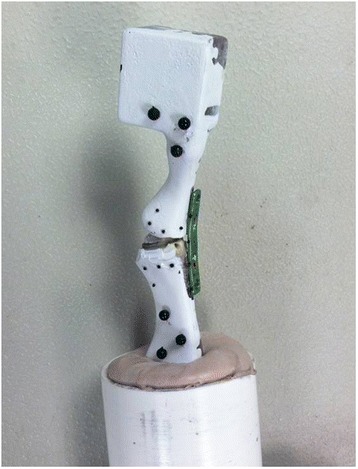
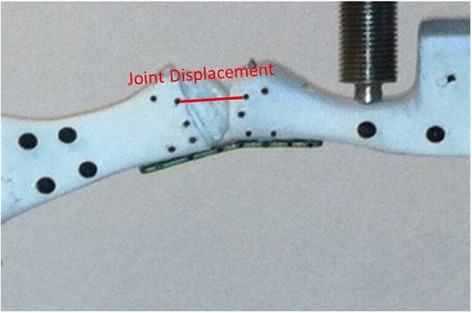
Four MTP fusion modalities were tested in synthetic composite bone models: unlocked plating, locked plating, crossed lag screws, and an unlocked plate with a single lag screw. Stiffness was calculated and then used to find the two most rigid constructs; the load to failure was recorded. Stiffness and load to failure testing for the two more rigid constructs in paired cadaveric bones were followed.
The unlocked plate plus screw and crossed screw constructs were stiffest (p < 0.008). Loads to failure of the unlocked plate plus screw and crossed screws in synthetic bone were 131 and 101 N, respectively and in cadaveric bone were 154 and 94 N, respectively, which are less than the estimated 25% body weight required at the MTP joint. The plate plus screws were statistically more stiff than crossed screws (p = 0.008), but there was no statistical difference between synthetic and cadaveric bone in load to failure (p = 0.296).
The plate plus screw offered the greatest stiffness; the failure test showed that no construct could withstand weight-bearing as tolerated; and, synthetic composite models of the MTP joint did not provide the consistent results in stiffness and failure.
本研究旨在确定几种跖趾关节(MTP)融合技术是否需要完全固定,或者术后是否可以推荐一定程度的负重。为了检验测试条件的有效性,对合成复合材料与实际骨骼进行了比较。
在合成复合骨模型中测试了四种MTP融合方式:非锁定钢板、锁定钢板、交叉拉力螺钉以及带有单个拉力螺钉的非锁定钢板。计算刚度,然后找出两种最坚固的结构;记录破坏载荷。随后对成对尸体骨骼中两种更坚固结构进行刚度和破坏载荷测试。
非锁定钢板加螺钉和交叉螺钉结构刚度最大(p < 0.008)。合成骨中非锁定钢板加螺钉和交叉螺钉的破坏载荷分别为131 N和101 N,尸体骨中分别为154 N和94 N,均低于MTP关节所需的估计体重的25%。钢板加螺钉在统计学上比交叉螺钉更坚固(p = 0.008),但合成骨和尸体骨在破坏载荷方面无统计学差异(p = 0.296)。
钢板加螺钉提供了最大的刚度;破坏试验表明,没有一种结构能够承受可耐受的负重;并且,MTP关节的合成复合模型在刚度和破坏方面未提供一致的结果。