Rodríguez-Carrio Javier, López Patricia, Sánchez Borja, González Sonia, Gueimonde Miguel, Margolles Abelardo, de Los Reyes-Gavilán Clara G, Suárez Ana
Department of Microbiology and Biochemistry of Dairy Products, Instituto de Productos Lácteos de Asturias (IPLA-CSIC) , Villaviciosa, Asturias , Spain.
Area of Immunology, Department of Functional Biology, University of Oviedo , Oviedo, Asturias , Spain.
Front Immunol. 2017 Jan 23;8:23. doi: 10.3389/fimmu.2017.00023. eCollection 2017.
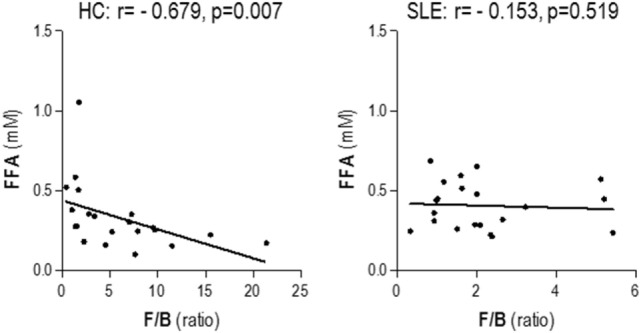
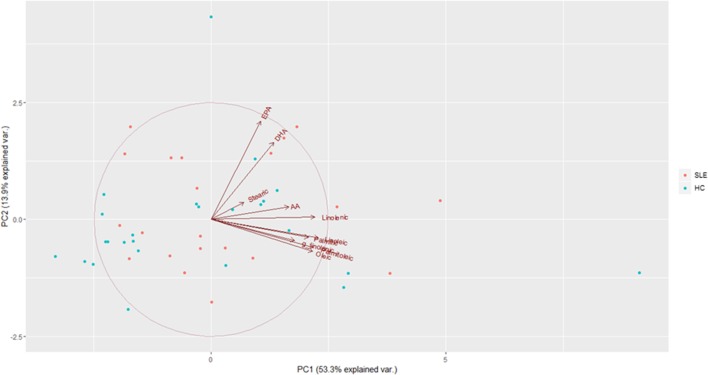
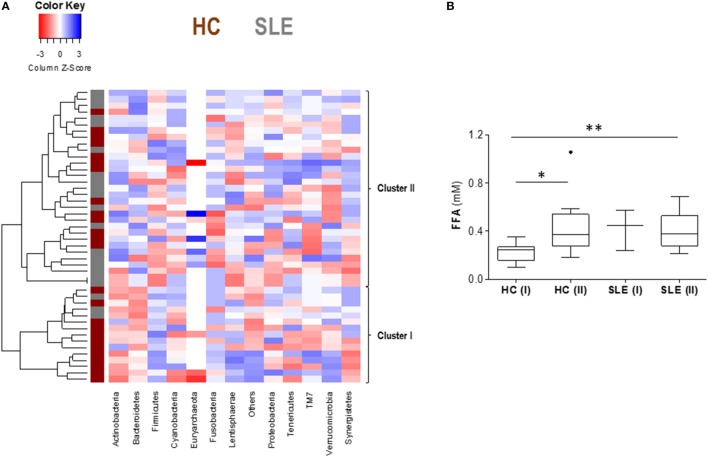
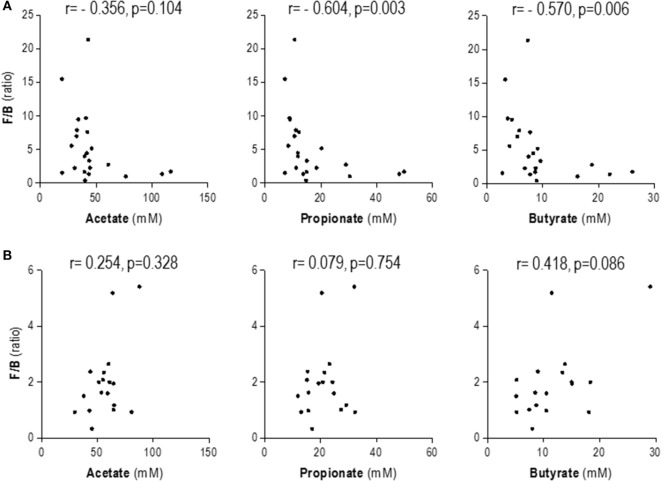
Metabolic impairments are a frequent hallmark of systemic lupus erythematosus (SLE). Increased serum levels of free fatty acids (FFA) are commonly found in these patients, although the underlying causes remain elusive. Recently, it has been suggested that factors other than inflammation or clinical features may be involved. The gut microbiota is known to influence the host metabolism, the production of short-chain fatty acids (SCFA) playing a potential role. Taking into account that lupus patients exhibit an intestinal dysbiosis, we wondered whether altered FFA levels may be associated with the intestinal microbial composition in lupus patients. To this aim, total and specific serum FFA levels, fecal SCFA levels, and gut microbiota composition were determined in 21 SLE patients and 25 healthy individuals. The to (F/B) ratio was strongly associated with serum FFA levels in healthy controls (HC), even after controlling for confounders. However, this association was not found in lupus patients, where a decreased F/B ratio and increased FFA serum levels were noted. An altered production of SCFA was related to the intestinal dysbiosis in lupus, while SCFA levels paralleled those of serum FFA in HC. Although a different serum FFA profile was not found in SLE, specific FFA showed distinct patterns on a principal component analysis. Immunomodulatory omega-3 FFA were positively correlated to the F/B ratio in HC, but not in SLE. Furthermore, divergent associations were observed for pro- and anti-inflammatory FFA with endothelial activation biomarkers in lupus patients. Overall, these findings support a link between the gut microbial ecology and the host metabolism in the pathological framework of SLE. A potential link between intestinal dysbiosis and surrogate markers of endothelial activation in lupus patients is supported, FFA species having a pivotal role.
代谢障碍是系统性红斑狼疮(SLE)的常见特征。这些患者中通常会发现血清游离脂肪酸(FFA)水平升高,但其潜在原因仍不清楚。最近,有人提出可能涉及炎症或临床特征以外的因素。已知肠道微生物群会影响宿主代谢,短链脂肪酸(SCFA)的产生可能发挥潜在作用。考虑到狼疮患者存在肠道生态失调,我们想知道FFA水平的改变是否可能与狼疮患者的肠道微生物组成有关。为此,我们测定了21例SLE患者和25例健康个体的总血清FFA水平、特定血清FFA水平、粪便SCFA水平和肠道微生物群组成。在健康对照(HC)中,即使在控制混杂因素后,拟杆菌属与厚壁菌属的比例(F/B)与血清FFA水平也密切相关。然而,在狼疮患者中未发现这种关联,狼疮患者的F/B比例降低且血清FFA水平升高。SCFA产生的改变与狼疮患者的肠道生态失调有关,而在HC中SCFA水平与血清FFA水平平行。虽然在SLE中未发现不同的血清FFA谱,但特定的FFA在主成分分析中显示出不同的模式。免疫调节性ω-3 FFA在HC中与F/B比例呈正相关,但在SLE中则不然。此外,在狼疮患者中,促炎和抗炎FFA与内皮激活生物标志物之间存在不同的关联。总体而言,这些发现支持了在SLE的病理框架中肠道微生物生态与宿主代谢之间的联系。支持狼疮患者肠道生态失调与内皮激活替代标志物之间存在潜在联系,FFA种类起关键作用。