Coccia Carmela, Bonomi Francesco, Lo Cricchio Anna, Russo Edda, Peretti Silvia, Bandini Giulia, Lepri Gemma, Bartoli Francesca, Moggi-Pignone Alberto, Guiducci Serena, Del Galdo Francesco, Furst Daniel E, Matucci Cerinic Marco, Bellando-Randone Silvia
Department of Experimental and Clinical Medicine, Division of Rheumatology, Scleroderma Unit, AOU Careggi, University of Florence, 50139 Florence, Italy.
Department of Experimental and Clinical Medicine, Division of Internal Medicine AOUC, University of Florence, 50134 Florence, Italy.
Biomedicines. 2024 Aug 5;12(8):1760. doi: 10.3390/biomedicines12081760.
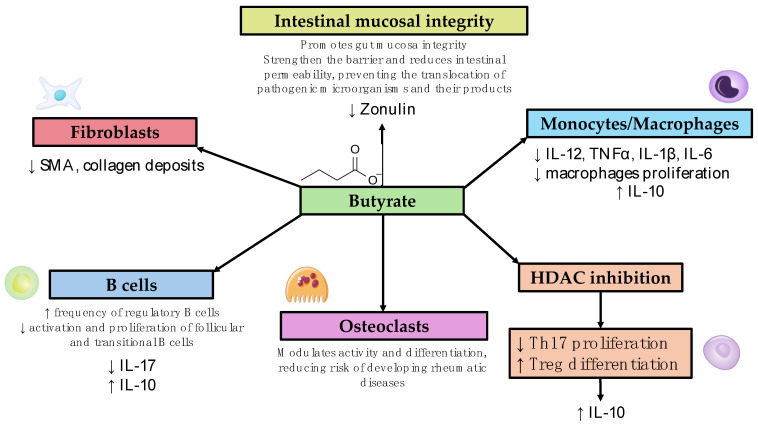
The gut microbiota is a complex ecosystem of microorganisms residing in the human gastrointestinal tract, playing a crucial role in various biological processes and overall health maintenance. Dysbiosis, an imbalance in the composition and function of the gut microbiota, is linked to systemic autoimmune diseases (SAD). Short-chain fatty acids (SCFAs), especially butyrate, produced by the gut microbiota through the fermentation of dietary fibers, play a significant role in immunomodulation and maintaining intestinal homeostasis. Butyrate is essential for colonocyte energy, anti-inflammatory responses, and maintaining intestinal barrier integrity. Studies show reduced butyrate-producing bacteria in SAD patients, suggesting that increasing butyrate levels could have therapeutic benefits. Butyrate's anti-inflammatory effects and its potential therapeutic role have been studied in rheumatoid arthritis, Sjogren's syndrome, systemic lupus erythematosus, systemic sclerosis, and Behçet's disease. Despite promising in vitro and animal model results, human studies are limited, and the optimal strategies for modulating dysbiosis in SADs remain elusive. This review explores the current evidence on the immunoregulatory role of butyrate and its potential therapeutic effects in SAD.
肠道微生物群是存在于人类胃肠道中的一个复杂的微生物生态系统,在各种生物过程和整体健康维持中发挥着关键作用。肠道微生物群失调,即肠道微生物群的组成和功能失衡,与系统性自身免疫性疾病(SAD)有关。肠道微生物群通过膳食纤维发酵产生的短链脂肪酸(SCFA),尤其是丁酸盐,在免疫调节和维持肠道内环境稳定方面发挥着重要作用。丁酸盐对结肠细胞能量、抗炎反应以及维持肠道屏障完整性至关重要。研究表明,SAD患者中产生丁酸盐的细菌减少,这表明提高丁酸盐水平可能具有治疗益处。丁酸盐的抗炎作用及其潜在治疗作用已在类风湿性关节炎、干燥综合征、系统性红斑狼疮、系统性硬化症和白塞病中得到研究。尽管体外和动物模型研究结果很有前景,但人体研究有限,且调节SAD中微生物群失调的最佳策略仍不明确。本综述探讨了关于丁酸盐免疫调节作用及其在SAD中潜在治疗效果的现有证据。