Mendes Pedro Vitale, de Albuquerque Gallo Cesar, Besen Bruno Adler Maccagnan Pinheiro, Hirota Adriana Sayuri, de Oliveira Nardi Raquel, Dos Santos Edzangela Vasconcelos, Li Ho Yeh, Joelsons Daniel, Costa Eduardo Leite Vieira, Foronda Flavia Krepel, Azevedo Luciano Cesar Pontes, Park Marcelo
Intensive Care Unit, Hospital das Clinicas, University of São Paulo School of Medicine, Rua Dr. Enéas Carvalho de Aguiar, 255, Sala 5023, São Paulo, SP, 05403000, Brazil.
Research and Education Institute, Hospital Sírio-Libanês, São Paulo, Brazil.
Ann Intensive Care. 2017 Dec;7(1):14. doi: 10.1186/s13613-016-0232-7. Epub 2017 Feb 7.
Utilization of extracorporeal membrane oxygenation (ECMO) has increased worldwide, but its use remains restricted to severely ill patients, and few referral centers are properly structured to offer this support. Inter-hospital transfer of patients on ECMO support can be life-threatening. In this study, we report a single-center experience and a systematic review of the available published data on complications and mortality associated with ECMO transportation.
We reported single-center data regarding complications and mortality associated with the transportation of patients on ECMO support. Additionally, we searched multiple databases for case series, observational studies, and randomized controlled trials regarding mortality of patients transferred on ECMO support. Results were analyzed independently for pediatric (under 12 years old) and adult populations. We pooled mortality rates using a random-effects model. Complications and transportation data were also described.
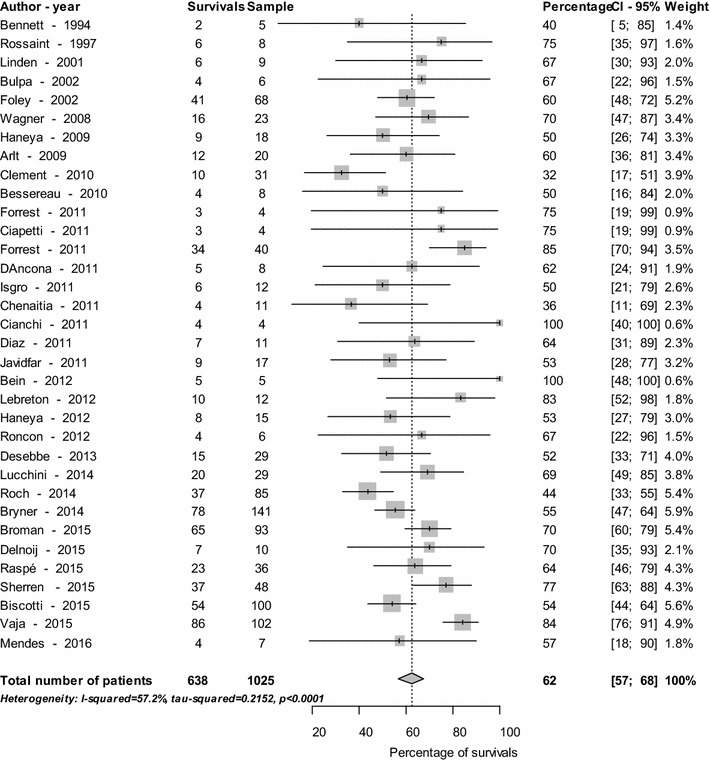
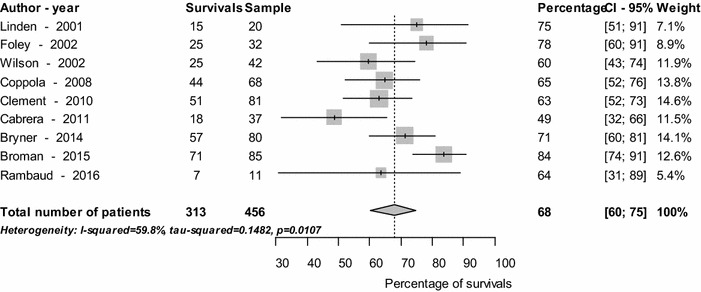
A total of 38 manuscripts, including our series, were included in the final analysis, totaling 1481 patients transported on ECMO support. A total of 951 patients survived to hospital discharge. The pooled survival rates for adult and pediatric patients were 62% (95% CI 57-68) and 68% (95% CI 60-75), respectively. Two deaths occurred during patient transportation. No other complication resulting in adverse outcome was reported.
Using the available pooled data, we found that patient transfer to a referral institution while on ECMO support seems to be safe and adds no significant risk of mortality to ECMO patients.
体外膜肺氧合(ECMO)的应用在全球范围内有所增加,但其使用仍局限于重症患者,且很少有转诊中心具备提供这种支持的完善架构。接受ECMO支持的患者在院际转运过程中可能危及生命。在本研究中,我们报告了单中心经验以及对已发表的关于ECMO转运相关并发症和死亡率的可用数据的系统评价。
我们报告了关于接受ECMO支持的患者转运相关并发症和死亡率的单中心数据。此外,我们在多个数据库中检索了关于接受ECMO支持转运患者死亡率的病例系列、观察性研究和随机对照试验。对儿科(12岁以下)和成人人群的结果进行独立分析。我们使用随机效应模型汇总死亡率。还描述了并发症和转运数据。
最终分析纳入了包括我们系列在内的38篇手稿,共有1481例接受ECMO支持转运的患者。共有951例患者存活至出院。成人和儿科患者的汇总生存率分别为62%(95%CI 57 - 68)和68%(95%CI 60 - 75)。患者转运期间发生了两例死亡。未报告其他导致不良后果的并发症。
利用现有的汇总数据,我们发现接受ECMO支持的患者转至转诊机构似乎是安全的,且不会给ECMO患者增加显著的死亡风险。