Yang Zhongjun, Wang Mingguo, Ma Yingwei, Lai Qingguo, Tong Dongdong, Zhang Fenghe, Dong Lili
Department of Stomatology, The Second Hospital of Shandong University, Jinan, Shandong, China (mainland).
Department of Stomatology, Jinan Central Hospital Affiliated to Shandong University, Jinan, Shandong, China (mainland).
Med Sci Monit. 2017 Feb 8;23:712-718. doi: 10.12659/msm.899230.
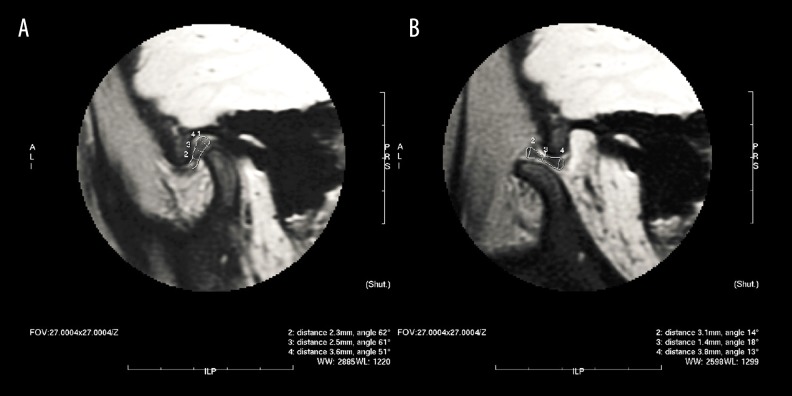
BACKGROUND Magnetic resonance imaging (MRI) is the criterion standard imaging technique for visualization of the temporomandibular joint (TMJ) region, and is currently considered the optimum modality for comprehensive evaluation in patients with temporomandibular joint disorder (TMD). This study was aimed at finding the value of MRI in pre-clinical diagnosis of TMJ disc displacement. MATERIAL AND METHODS Patients primarily diagnosed as having anterior disc displacement by clinical symptoms and X-ray were selected in the present study. MRI was used to evaluate surrounding anatomical structures and position, as well as morphological and signal intensity change between patients and normal controls. RESULTS Posterior band position was significantly different between the patient group and control group. At the maximum opened-mouth position, the location of disc intermediate zone returned to normal. At closed-mouth position, the thickness of anterior and middle, but not posterior, band increased. The motion range of the condyle in the anterior disc displacement without reduction (ADDWR) patient group was significantly less than the value in the anterior disc displacement with reduction (ADDR) patient group and the control group. Whether at closed-mouth position or maximum opened-mouth position, the exudate volume in the patient group was greater than in the normal group. CONCLUSIONS MRI can be successfully used to evaluate multiple morphological changes at different mouth positions of normal volunteers and patients. The disc-condyle relationship can serve as an important indicator in assessing anterior disc displacement, and can be used to distinguish disc displacement with or without reduction.
背景 磁共振成像(MRI)是颞下颌关节(TMJ)区域可视化的标准成像技术,目前被认为是颞下颌关节紊乱病(TMD)患者综合评估的最佳方式。本研究旨在探讨MRI在TMJ盘移位临床前期诊断中的价值。材料与方法 本研究选取主要通过临床症状和X线诊断为盘前移位的患者。采用MRI评估患者与正常对照者周围解剖结构和位置,以及形态和信号强度变化。结果 患者组与对照组之间后带位置存在显著差异。在最大开口位时,盘中间带位置恢复正常。在闭口位时,前带和中间带厚度增加,而后带厚度未增加。不可复性盘前移位(ADDWR)患者组髁突运动范围明显小于可复性盘前移位(ADDR)患者组和对照组。无论在闭口位还是最大开口位,患者组渗出液量均大于正常组。结论 MRI可成功用于评估正常志愿者和患者在不同口位的多种形态变化。盘 - 髁关系可作为评估盘前移位的重要指标,并可用于区分可复性与不可复性盘移位。