Eli Lilly and Company, Lilly Corporate Center, Indianapolis, Indiana.
Lilly USA, LLC, Lilly Corporate Center, Indianapolis, Indiana.
Diabetes Obes Metab. 2017 Jul;19(7):953-961. doi: 10.1111/dom.12902. Epub 2017 Mar 16.
To compare adherence (proportion of days covered [PDC]), persistence, and treatment patterns among patients with type 2 diabetes mellitus (T2DM) newly initiating glucagon-like peptide-1 receptor agonists (GLP-1RAs). More specifically, the main objectives were to compare dulaglutide vs exenatide once weekly and dulaglutide vs liraglutide.
Patients with T2DM newly initiating dulaglutide, albiglutide, exenatide once weekly, exenatide twice daily and liraglutide between November 2014 and April 2015 were hierarchically selected from Truven Health's MarketScan Research Databases. Propensity score matching was used to account for selection bias. Adherence to and persistence with the index GLP-1RA, and switching and augmentation patterns were assessed during the 6-month post-index period.
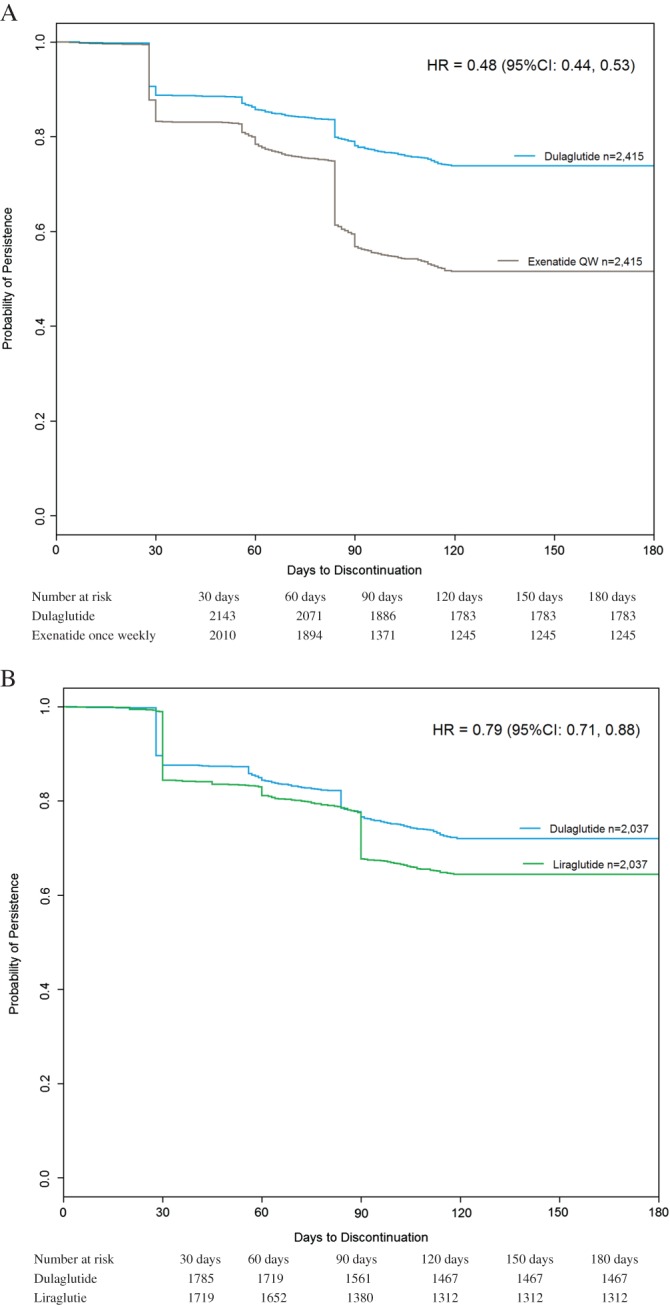
Mean adherence for the matched cohorts was significantly higher for dulaglutide than for exenatide once weekly (0.72 vs 0.61; P < .0001) and liraglutide (0.71 vs 0.67; P < .0001). The percentage of patients achieving PDC ≥ 0.80 was significantly higher for dulaglutide compared with exenatide once weekly (54.2% vs 37.9%; P < .0001) and liraglutide (53.5% vs 44.3%; P < .0001). The mean (standard deviation) days on treatment for all matched patients was significantly higher for patients in the dulaglutide cohort compared with those in the exenatide once-weekly (148.4 [55.4] vs 123.6 [61.6]; P < .0001) and liraglutide cohorts (146.0 [56.9] vs 137.4 [60.1]; P < .0001). A significantly lower proportion of patients on dulaglutide discontinued treatment compared with those on exenatide once weekly (26.2% vs 48.4%; P < .0001) and those on liraglutide (28.0% vs 35.6%; P < .0001).
Dulaglutide initiators had significantly higher adherence, were more persistent, and had lower discontinuation rates compared with initiators of exenatide once weekly or liraglutide during the 6-month follow-up period.
比较 2 型糖尿病(T2DM)新起始使用胰高血糖素样肽-1 受体激动剂(GLP-1RA)的患者的依从性(覆盖率天数[PDC])、持续性和治疗模式。更具体地说,主要目标是比较度拉鲁肽与每周一次的艾塞那肽和度拉鲁肽与利拉鲁肽。
2014 年 11 月至 2015 年 4 月,从 Truven Health 的 MarketScan Research Databases 中按等级选择 T2DM 新起始使用度拉鲁肽、阿必鲁肽、每周一次的艾塞那肽、每日两次的艾塞那肽和利拉鲁肽的患者。采用倾向评分匹配来校正选择偏倚。在索引 GLP-1RA 后的 6 个月内评估依从性和持续性以及转换和增强模式。
匹配队列的平均依从性显著高于每周一次的艾塞那肽(0.72 对 0.61;P<0.0001)和利拉鲁肽(0.71 对 0.67;P<0.0001)。与每周一次的艾塞那肽相比,度拉鲁肽达到 PDC≥0.80 的患者比例显著更高(54.2%比 37.9%;P<0.0001),与利拉鲁肽相比(53.5%比 44.3%;P<0.0001)。所有匹配患者的平均(标准差)治疗天数在度拉鲁肽组显著高于每周一次的艾塞那肽组(148.4[55.4]对 123.6[61.6];P<0.0001)和利拉鲁肽组(146.0[56.9]对 137.4[60.1];P<0.0001)。与每周一次的艾塞那肽相比,度拉鲁肽组停药的患者比例显著更低(26.2%比 48.4%;P<0.0001),与利拉鲁肽相比(28.0%比 35.6%;P<0.0001)。
在 6 个月的随访期间,与每周一次的艾塞那肽或利拉鲁肽相比,度拉鲁肽的起始患者具有更高的依从性、更持久和更低的停药率。