Li Zhihong, Li Yuqian, Xu Feifei, Zhang Xi, Tian Qiang, Li Lihong
Department of Neurosurgery, Tangdu Hospital.
Department of Foreign Languages.
Neuropsychiatr Dis Treat. 2017 Jan 25;13:213-219. doi: 10.2147/NDT.S120368. eCollection 2017.
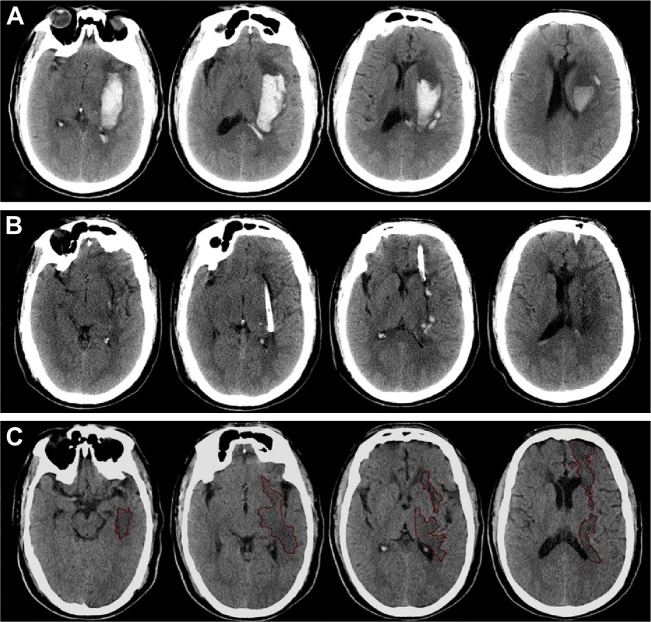
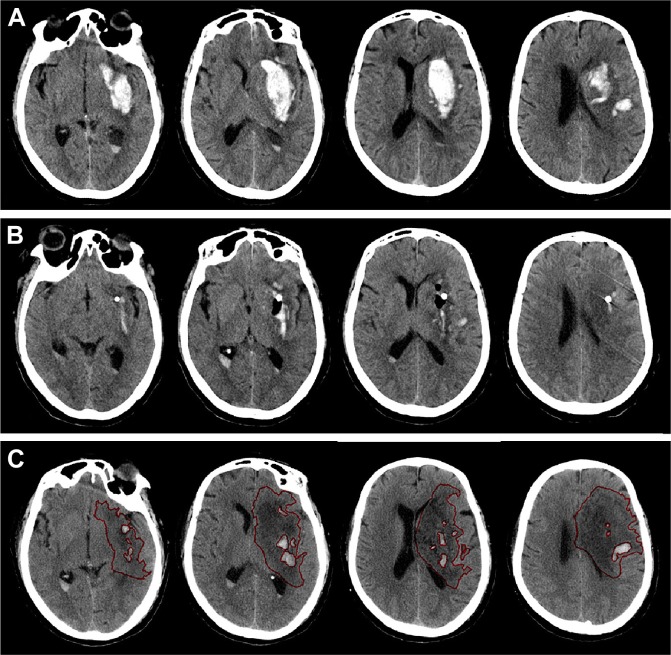
Two prevalent therapies for the treatment of spontaneous intracerebral hemorrhage (ICH) in basal ganglia are, minimally invasive puncture and drainage (MIPD), and endoscopic surgery (ES). Because both surgical techniques are of a minimally invasive nature, they have attracted greater attention in recent years. However, evidence comparing the curative effect of MIPD and ES has been uncertain. The indication for MIPD or ES has been uncertain till now. In the present study, 112 patients with spontaneous ICH in basal ganglia who received MIPD or ES were reviewed retrospectively. Baseline parameters prior to the operation, evacuation rate (ER), perihematoma edema, postoperative complications, and rebleeding incidences were collected. Moreover, 1-year postictus, the long-term functional outcomes of patients with regard to hematoma volume (HV) or Glasgow Coma Scale (GCS) score were judged, respectively, by the case fatality, Glasgow Outcome Scale (GOS), Barthel Index (BI), and modified Rankin Scale (mRS). The ES group had a higher ER than the MIPD group on postoperative day 1. The MIPD group had fewer adverse outcomes, which included less perihematoma edema, anesthetic time, and blood loss, than the ES group. The functional outcomes represented by GOS, BI, and mRS were better in the MIPD group than in the ES group for patients with HV 30-60 mL or GCS score 9-14. These results indicate that ES is more effective in evacuating hematoma in basal ganglia, while MIPD is less invasive than ES. Patients with HV 30-60 mL or GCS score 9-14 may benefit more from the MIPD procedure than from ES.
基底节区自发性脑出血(ICH)的两种常见治疗方法是微创穿刺引流术(MIPD)和内镜手术(ES)。由于这两种手术技术均具有微创性质,近年来它们受到了更多关注。然而,比较MIPD和ES疗效的证据尚不明确。迄今为止,MIPD或ES的适应症也不明确。在本研究中,对112例接受MIPD或ES治疗的基底节区自发性ICH患者进行了回顾性分析。收集了手术前的基线参数、血肿清除率(ER)、血肿周围水肿、术后并发症和再出血发生率。此外,在发病1年后,分别通过病死率、格拉斯哥预后量表(GOS)、巴氏指数(BI)和改良Rankin量表(mRS)来判断患者血肿体积(HV)或格拉斯哥昏迷量表(GCS)评分方面的长期功能结局。术后第1天,ES组的ER高于MIPD组。MIPD组的不良结局较少,包括血肿周围水肿、麻醉时间和失血量均少于ES组。对于HV为30 - 60 mL或GCS评分为9 - 14的患者,MIPD组以GOS、BI和mRS表示的功能结局优于ES组。这些结果表明,ES在清除基底节区血肿方面更有效,而MIPD的侵入性低于ES。HV为30 - 60 mL或GCS评分为9 - 14的患者可能从MIPD手术中比从ES中获益更多。