Malinova Vesna, Psychogios Marios N, Tsogkas Ioannis, Koennecke Birte, Bleuel Kim, Iliev Bogdan, Rohde Veit, Mielke Dorothee
Department of Neurosurgery, Georg August University Göttingen, Germany.
Department of Neuroradiology, Georg August University Göttingen, Germany.
PLoS One. 2017 Feb 9;12(2):e0171121. doi: 10.1371/journal.pone.0171121. eCollection 2017.
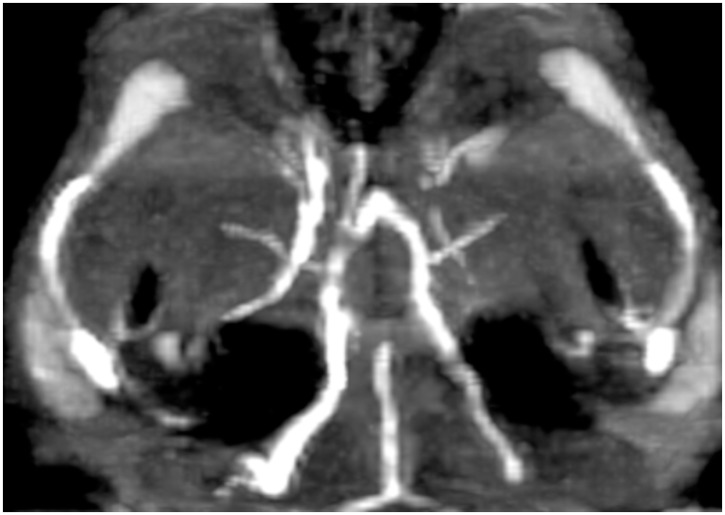
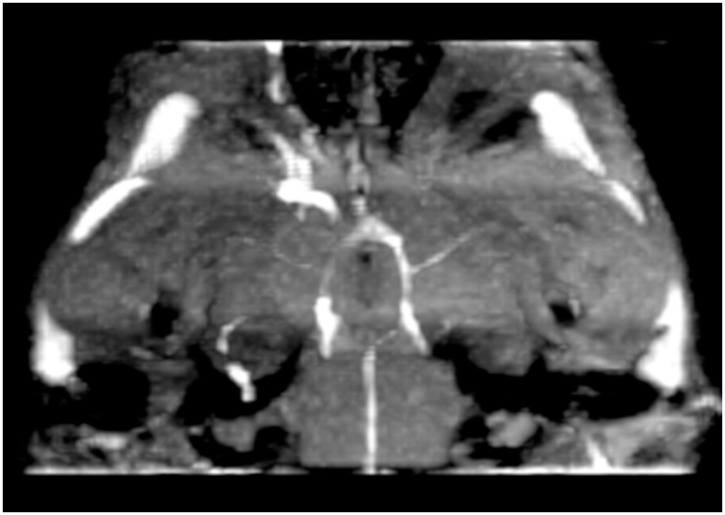
Magnetic resonance (MR) imaging has been used for the detection of cerebral vasospasm (VSP) related infarction in experimental subarachnoid hemorrhage (eSAH) in rats. Conventional angiography is generally used to visualize VSP, which is an invasive technique with a possible increase in morbidity and mortality. In this study we evaluated the validity of MR-angiography (MRA) in detecting VSP and its feasibility to define VSP severity grades after eSAH in rats.
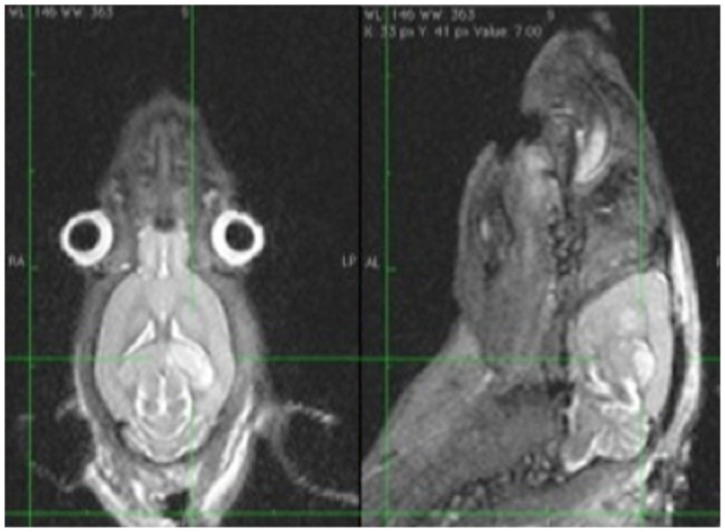
SAH was induced using the double-hemorrhage model in 12 rats. In two rats, saline solution was injected instead of blood (sham group). MR was performed on day 1, 2 and on day 5. T1-, T2-, T2*-weighted and time-of-flight MR sequences were applied, which were analyzed by two blinded neuroradiologists. Vessel narrowing of 25-50% was defined as mild, 50-75% as moderate and >75% as severe VSP.
We performed a total of 34 MRAs in 14 rats. In 14 rats, MRA was performed on day 2 and day 5. In six rats MRA was additionally performed on day1 before the blood injection. A good visualization of cerebral vessels was possible in all cases. No VSP was seen in the sham group neither on day 2 nor on day 5. We found vasospasm on day 2 in 7 of the 14 rats (50%) whereas all 7 rats had mild and one rat had additionally moderate and severe vasospasm in one vessel, respectively. On day 5 we found vasospasm in 8 of the 14 rats (60%) whereas 4 rats had severe vasospasm, 1 rat had moderate vasospasm and 3 rats demonstrated mild vasospasm. In 4 of the 14 rats (30%) an ischemic lesion was detected on day 5. Three of these rats had severe vasospasm and one rat had mild vasospasm. Severe vasospasm on day 5 was statistically significant correlated with the occurrence of ischemic lesions (Fisher's Exact test, OR 19.5, p = 0.03).
MRA is a noninvasive diagnostic tool, which allows a good visualization of the cerebral vasculature and provides reproducible results concerning the detection of VSP and the differentiation into three severity grades in rats. Future studies are needed to directly compare MRA with conventional angiography.
磁共振(MR)成像已用于检测大鼠实验性蛛网膜下腔出血(eSAH)相关的脑血管痉挛(VSP)梗死。传统血管造影术通常用于观察VSP,这是一种侵入性技术,可能会增加发病率和死亡率。在本研究中,我们评估了磁共振血管造影(MRA)在检测大鼠eSAH后VSP的有效性及其定义VSP严重程度分级的可行性。
采用双次出血模型诱导12只大鼠发生SAH。在2只大鼠中,注射生理盐水而非血液(假手术组)。在第1天、第2天和第5天进行MR检查。应用T1加权、T2加权、T2*加权和飞行时间MR序列,由两名不知情的神经放射科医生进行分析。血管狭窄25%-50%定义为轻度VSP,50%-75%为中度VSP,>75%为重度VSP。
我们对14只大鼠共进行了34次MRA检查。14只大鼠在第2天和第5天进行了MRA检查。6只大鼠在注射血液前的第1天额外进行了MRA检查。所有病例均能很好地显示脑血管。假手术组在第2天和第5天均未发现VSP。我们发现14只大鼠中有7只(50%)在第2天出现血管痉挛,其中所有7只大鼠均为轻度血管痉挛,1只大鼠在一根血管中还出现了中度和重度血管痉挛。在第5天,我们发现14只大鼠中有8只(60%)出现血管痉挛,其中4只大鼠为重度血管痉挛,1只大鼠为中度血管痉挛,3只大鼠为轻度血管痉挛。14只大鼠中有4只(30%)在第5天检测到缺血性病变。其中3只大鼠有重度血管痉挛,1只大鼠有轻度血管痉挛。第5天的重度血管痉挛与缺血性病变的发生在统计学上有显著相关性(Fisher精确检验,OR 19.5,p = 0.03)。
MRA是一种非侵入性诊断工具,能够很好地显示脑血管系统,并在检测大鼠VSP及将其分为三个严重程度等级方面提供可重复的结果。未来需要进行研究以直接比较MRA与传统血管造影术。