Luo Fei, Wang Ya-Shen, Su Yan-Hui, Zhang Zhi-Hua, Sun Hong-Hong, Li Jian
Department of Urology, Tianjin Union Medical Center, Tianjin, China.
PLoS One. 2017 Feb 9;12(2):e0171701. doi: 10.1371/journal.pone.0171701. eCollection 2017.
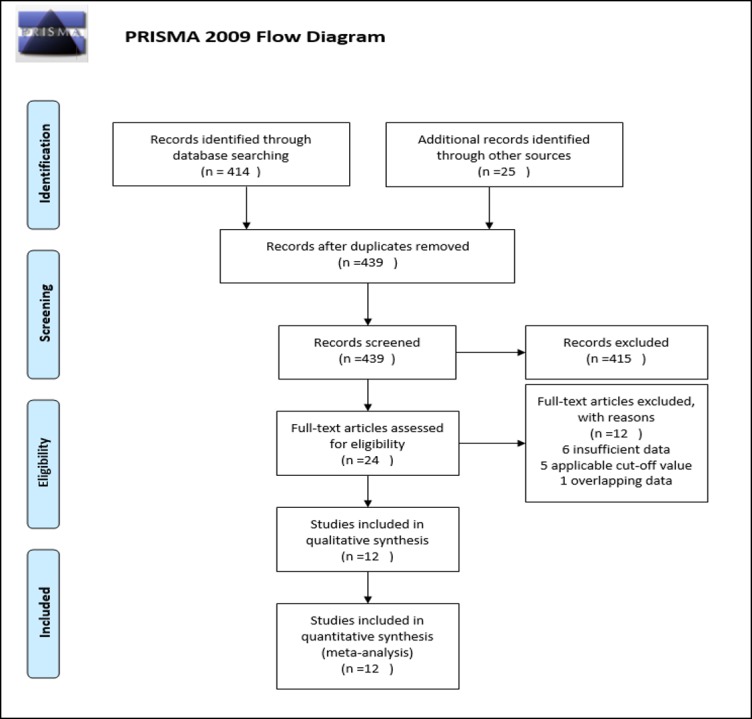
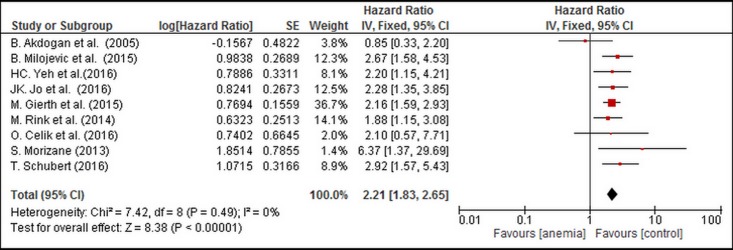
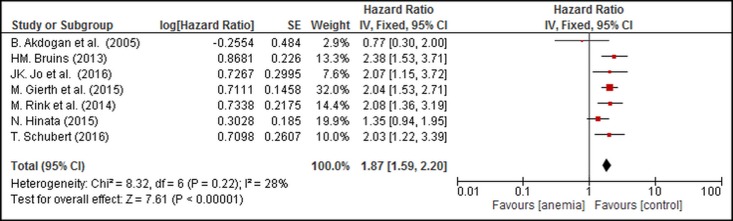
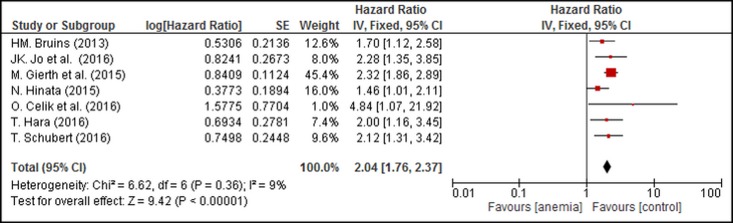
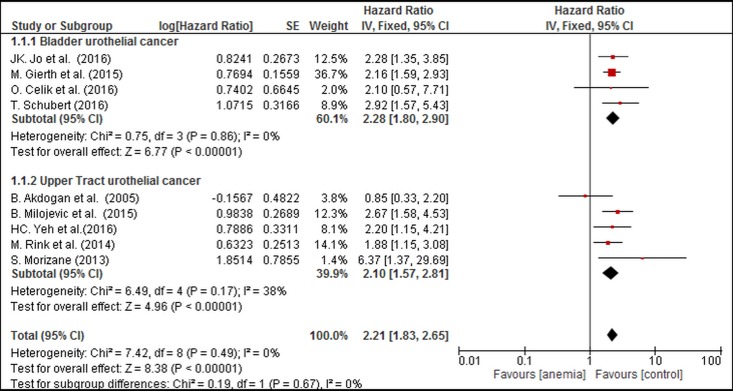
The prognostic significance of preoperative anemia (PA) has been identified in various malignancies. However, its predictive role in urothelial carcinoma (UC) remains controversial. The aim of this study was to investigate the prognostic value of PA in UC patients. We performed a meta-analysis of the association between PA and survival outcome in UC patients. Electronic databases were searched up to June 30, 2016. Study characteristics and prognostic data were extracted from each included study. Cancer-specific survival (CSS), recurrence-free survival (RFS), and overall survival (OS) were pooled using hazard ratio (HR) with corresponding 95% confidence intervals (CI). Herein, 12 studies comprising 3815 patients were included in the meta-analysis. There were 1593 (41.76%) patients in the PA group and 2222 (58.24%) in the control group. The overall pooled HRs of PA for CSS, RFS, and OS were significant at 2.21, (95% CI: 1.83-2.65, Pheterogeneity = 0.49, I2 = 0%), 1.87 (95% CI: 1.59-2.20, Pheterogeneity = 0.22, I2 = 28%), and 2.04(95% CI: 1.76-2.37, Pheterogeneity = 0.36, I2 = 9%) respectively. Stratified analyses indicated that PA was a predictor of poor prognosis based on ethnicity, sample size, tumor T stage, G grade, lymphovascular invasion (LVI), concomitant carcinoma in situ (CIS), and follow-up values. Our findings show that PA has negative prognostic effects on the survival outcome (CSS, RFS, and OS) in UC patients and can serve as a useful and cost-effective marker to aid prognosis prediction.
术前贫血(PA)在多种恶性肿瘤中的预后意义已得到确认。然而,其在尿路上皮癌(UC)中的预测作用仍存在争议。本研究旨在探讨PA对UC患者的预后价值。我们对PA与UC患者生存结局之间的关联进行了荟萃分析。检索电子数据库至2016年6月30日。从每项纳入研究中提取研究特征和预后数据。使用风险比(HR)及相应的95%置信区间(CI)汇总癌症特异性生存(CSS)、无复发生存(RFS)和总生存(OS)情况。在此,荟萃分析纳入了12项研究,共3815例患者。PA组有1593例(41.76%)患者,对照组有2222例(58.24%)患者。PA对CSS、RFS和OS的总体汇总HR分别为2.21(95%CI:1.83 - 2.65,P异质性 = 0.49,I² = 0%)、1.87(95%CI:1.59 - 2.20,P异质性 = 0.22,I² = 28%)和2.04(95%CI:1.76 - 2.37,P异质性 = 0.36,I² = 9%)。分层分析表明,基于种族、样本量、肿瘤T分期、G分级、淋巴血管侵犯(LVI)、伴发原位癌(CIS)及随访值,PA是预后不良的预测因素。我们的研究结果表明,PA对UC患者的生存结局(CSS、RFS和OS)具有负面预后影响,可作为有助于预后预测的有用且具有成本效益的标志物。