Tan Ping, Xie Nan, Liao Haotian, Zou Liqun, Xu Huan, Yang Lu, Liu Liangren, Wei Qiang
Department of Urology, Institute of Urology Department of Emergency Department of Liver Surgery, Liver Transplantation Division Department of Pathology, West China Hospital, Sichuan University, Chengdu, Sichuan, China.
Medicine (Baltimore). 2018 Sep;97(37):e12300. doi: 10.1097/MD.0000000000012300.
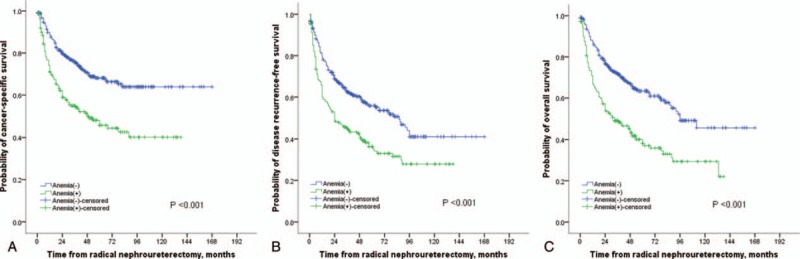
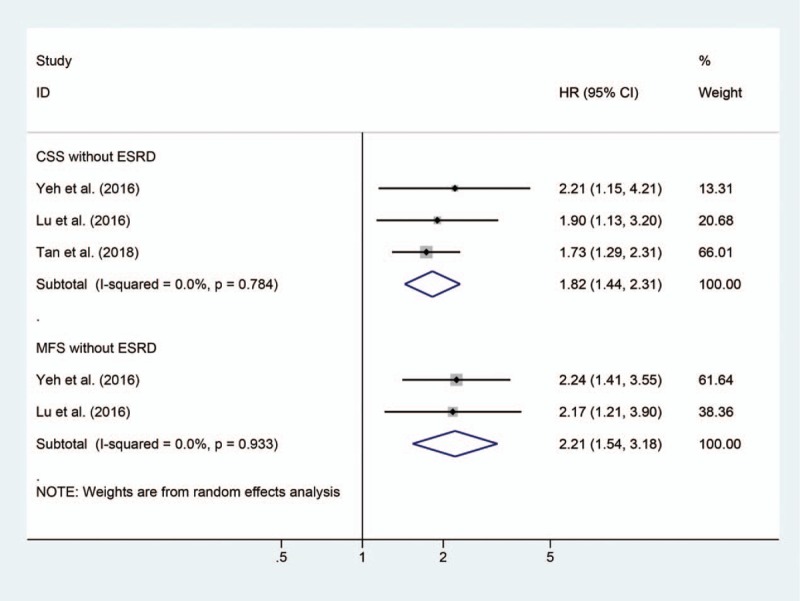
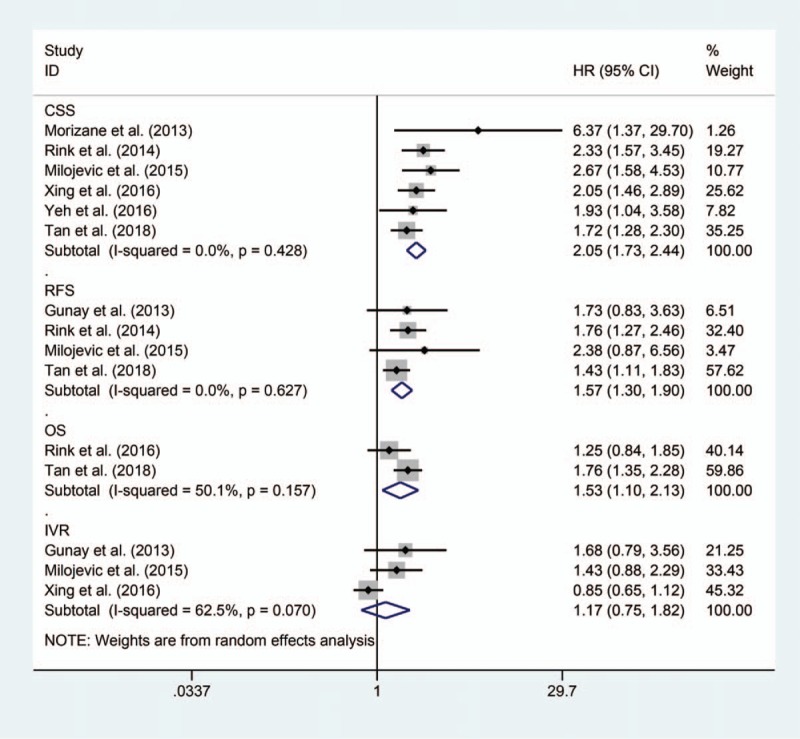
The aim of this study was to investigate the effect of preoperative anemia on the prognosis of patients who underwent radical nephroureterectomy (RNU) for upper tract urothelial carcinoma (UTUC).A total of 620 patients with UTUC were retrospectively analyzed. Anemia was decided by preoperatively measured hemoglobin values based on the World Health Organization (WHO) classification. Kaplan-Meier method and Cox proportional hazards regression models were used to analyze the relationship between anemia and survival outcomes. The meta-analysis part was performed according to PRISMA guidelines.The median follow-up was 51 (range: 1-168) months. A total of 246 patients had preoperative anemia in our cohort. Anemia was found to be related to high-grade (P < .001), sessile architecture (P = .001), advanced T stage (P < .001), lymphovascular invasion (LVI) (P = .006), and worse chronic kidney disease (CKD) stage (P = .012). Kaplan-Meier curves revealed that patients with preoperative anemia had worse overall survival (OS), cancer-specific survival (CSS), and disease recurrence-free survival (RFS) (all P < .001). Multivariable Cox analyses found that anemia was an independent predictor of CSS [hazard ratio (HR) 1.719, 95% confidence interval (95% CI): 1.285-2.300], RFS (HR 1.427, 95% CI: 1.114-1.829) and OS (HR 1.756, 95% CI: 1.353-2.279). Among patients without end-stage renal disease (ESRD, n = 614), the anemia was also proved to be associated with worse outcomes in multivariable Cox analysis (OS, HR 1.759, 95% CI: 1.353-2.287; CSS, HR 1.726, 95% CI: 1.289-2.311, and RFS, HR 1.431, 95% CI: 1.117-1.837). Seven studies were included in the meta-analysis, and the pooled results showed that anemia was also related to worse CSS (HR 2.05, 95% CI: 1.73-2.44), RFS (HR 1.57, 95% CI: 1.30-1.90), and OS (HR 1.53, 95% CI: 1.10-2.13), but not related to intravesical recurrence (HR 1.17, 95% CI: 0.75-1.82).Preoperative anemia was proved to be significantly associated with worse oncologic outcomes in patients with UTUC following RNU.
本研究的目的是调查术前贫血对接受根治性肾输尿管切除术(RNU)治疗上尿路尿路上皮癌(UTUC)患者预后的影响。总共对620例UTUC患者进行了回顾性分析。根据世界卫生组织(WHO)分类,通过术前测量的血红蛋白值确定贫血情况。采用Kaplan-Meier法和Cox比例风险回归模型分析贫血与生存结果之间的关系。荟萃分析部分按照PRISMA指南进行。中位随访时间为51(范围:1 - 168)个月。在我们的队列中,共有246例患者存在术前贫血。发现贫血与高级别(P < 0.001)、无蒂结构(P = 0.001)、晚期T分期(P < 0.001)、淋巴管侵犯(LVI)(P = 0.006)以及更差的慢性肾脏病(CKD)分期(P = 0.012)相关。Kaplan-Meier曲线显示,术前贫血患者的总生存期(OS)、癌症特异性生存期(CSS)和无疾病复发生存期(RFS)更差(所有P < 0.001)。多变量Cox分析发现,贫血是CSS [风险比(HR)1.719,95%置信区间(95%CI):1.285 - 2.300]、RFS(HR 1.427,95%CI:1.114 - 1.829)和OS(HR 1.756,95%CI:1.353 - 2.279)的独立预测因素。在没有终末期肾病(ESRD,n = 614)的患者中,多变量Cox分析也证明贫血与更差的结果相关(OS:HR 1.759,95%CI:1.353 - 2.287;CSS:HR 1.726,95%CI:1.289 - 2.311;RFS:HR 1.431,95%CI:1.117 - 1.837)。荟萃分析纳入了7项研究,汇总结果显示贫血也与更差的CSS(HR 2.05,95%CI:1.73 - 2.44)、RFS(HR 1.57,95%CI:1.30 - 1.90)和OS(HR 1.53,95%CI:1.10 - 2.13)相关,但与膀胱内复发无关(HR 1.17,95%CI:0.75 - 1.82)。事实证明术前贫血与RNU术后UTUC患者更差的肿瘤学结果显著相关。