Jonnalagadda Sivani, Rodríguez Oswaldo, Estrella Bertha, Sabin Lora L, Sempértegui Fernando, Hamer Davidson H
Center for Global Health and Development, Boston University School of Public Health, Boston, Massachusetts, United States of America.
Corporación Ecuatoriana de Biotecnología, Quito, Ecuador.
PLoS One. 2017 Feb 9;12(2):e0171687. doi: 10.1371/journal.pone.0171687. eCollection 2017.
In Latin America, community-acquired pneumonia remains a major cause of morbidity and mortality among children. Few studies have examined the etiology of pneumonia in Ecuador.
This observational study was part of a randomized, double blind, placebo-controlled clinical trial conducted among children aged 2-59 months with severe pneumonia in Quito, Ecuador. Nasopharyngeal and blood samples were tested for bacterial and viral etiology by polymerase chain reaction. Risk factors for specific respiratory pathogens were also evaluated.
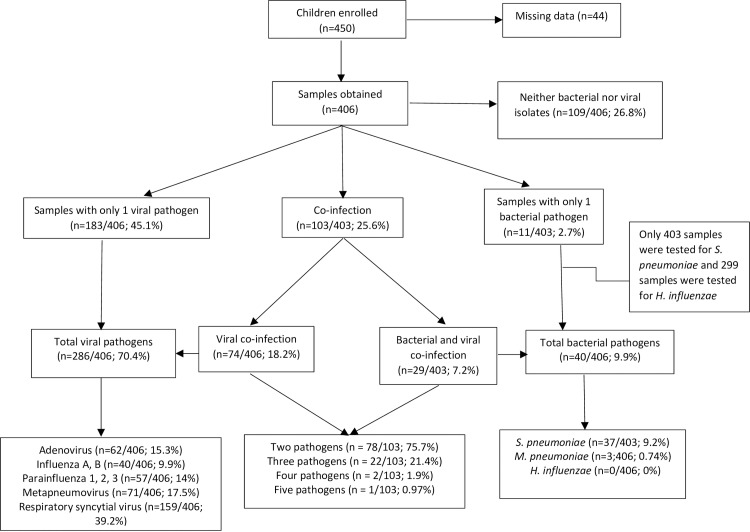
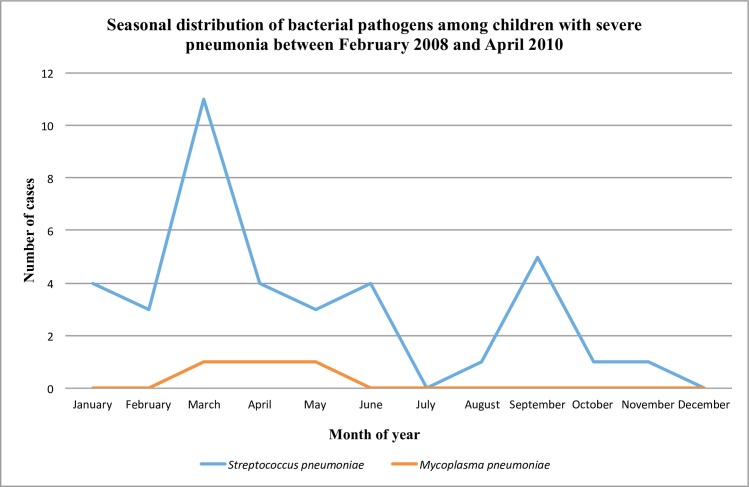
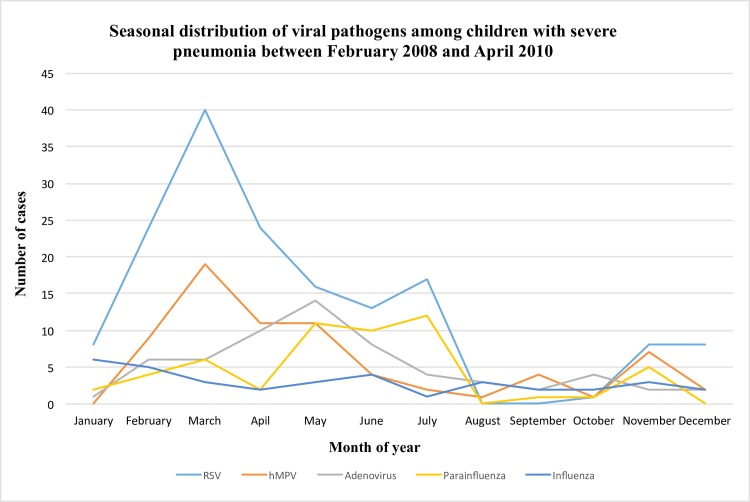
Among 406 children tested, 159 (39.2%) had respiratory syncytial virus (RSV), 71 (17.5%) had human metapneumovirus (hMPV), and 62 (15.3%) had adenovirus. Streptococcus pneumoniae was identified in 37 (9.2%) samples and Mycoplasma pneumoniae in three (0.74%) samples. The yearly circulation pattern of RSV (P = 0.0003) overlapped with S. pneumoniae, (P = 0.03) with most cases occurring in the rainy season. In multivariable analysis, risk factors for RSV included younger age (adjusted odds ratio [aOR] = 1.9, P = 0.01) and being underweight (aOR = 1.8, P = 0.04). Maternal education (aOR = 0.82, P = 0.003), pulse oximetry (aOR = 0.93, P = 0.005), and rales (aOR = 0.25, P = 0.007) were associated with influenza A. Younger age (aOR = 3.5, P = 0.007) and elevated baseline respiratory rate were associated with HPIV-3 infection (aOR = 0.94, P = 0.03).
These results indicate the importance of RSV and influenza, and potentially modifiable risk factors including undernutrition and future use of a RSV vaccine, when an effective vaccine becomes available.
ClinicalTrials.gov NCT 00513929.
在拉丁美洲,社区获得性肺炎仍是儿童发病和死亡的主要原因。很少有研究调查厄瓜多尔肺炎的病因。
这项观察性研究是在厄瓜多尔基多对2至59个月患有重症肺炎的儿童进行的一项随机、双盲、安慰剂对照临床试验的一部分。通过聚合酶链反应对鼻咽和血液样本进行细菌和病毒病因检测。还评估了特定呼吸道病原体的危险因素。
在406名接受检测的儿童中,159名(39.2%)感染了呼吸道合胞病毒(RSV),71名(17.5%)感染了人偏肺病毒(hMPV),62名(15.3%)感染了腺病毒。在37份(9.2%)样本中鉴定出肺炎链球菌,在3份(0.74%)样本中鉴定出肺炎支原体。RSV的年度流行模式(P = 0.0003)与肺炎链球菌重叠(P = 0.03),大多数病例发生在雨季。在多变量分析中,RSV的危险因素包括年龄较小(调整优势比[aOR]=1.9,P = 0.01)和体重不足(aOR = 1.8,P = 0.04)。母亲教育程度(aOR = 0.82,P = 0.003)、脉搏血氧饱和度(aOR = 0.93,P = 0.005)和啰音(aOR = 0.25,P = 0.007)与甲型流感有关。年龄较小(aOR = 3.5,P = 0.007)和基线呼吸频率升高与3型人副流感病毒感染有关(aOR = 0.94,P = 0.03)。
这些结果表明了RSV和流感的重要性,以及潜在的可改变危险因素,包括营养不良,以及在有效疫苗问世后未来使用RSV疫苗的可能性。
ClinicalTrials.gov NCT 00513929。