Ma Xu, Yan Lei, Zhu Qing, Shao Fengmin
Department of Nephrology, People's Hospital of Zhengzhou University, Zhengzhou, People's Republic of China.
PLoS One. 2017 Feb 9;12(2):e0171612. doi: 10.1371/journal.pone.0171612. eCollection 2017.
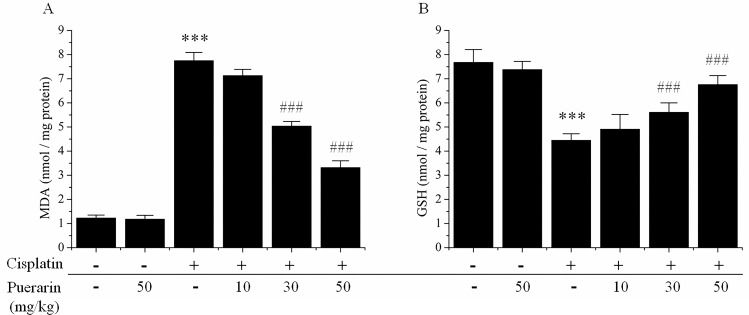
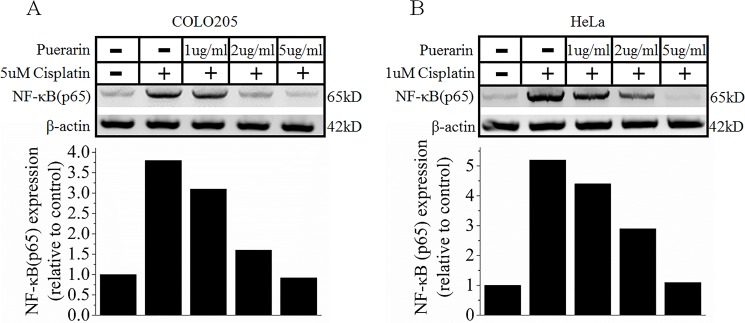
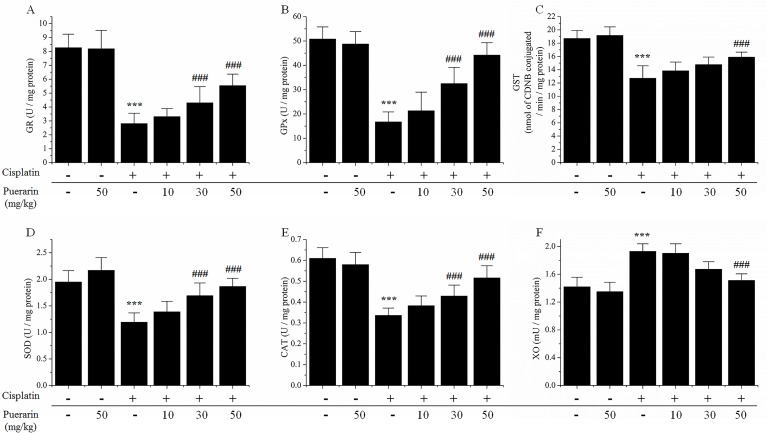
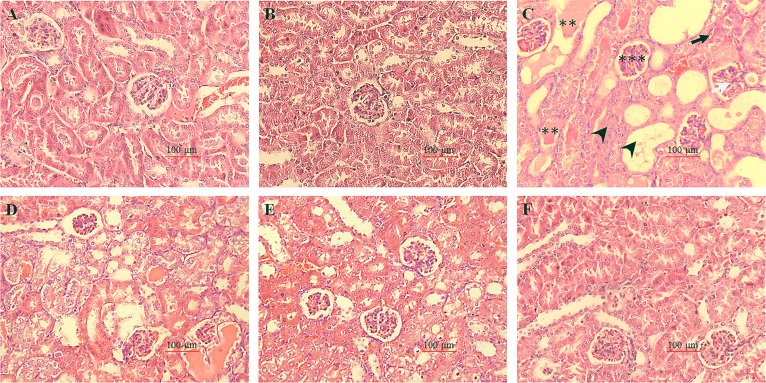
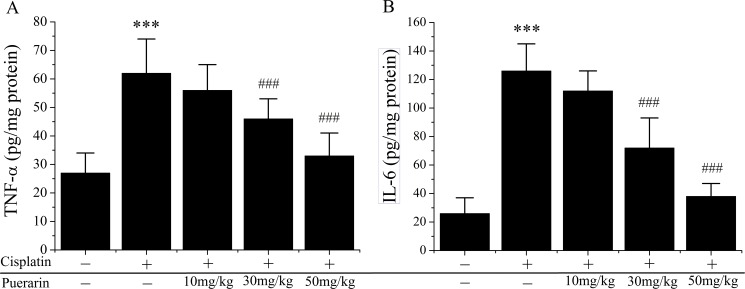
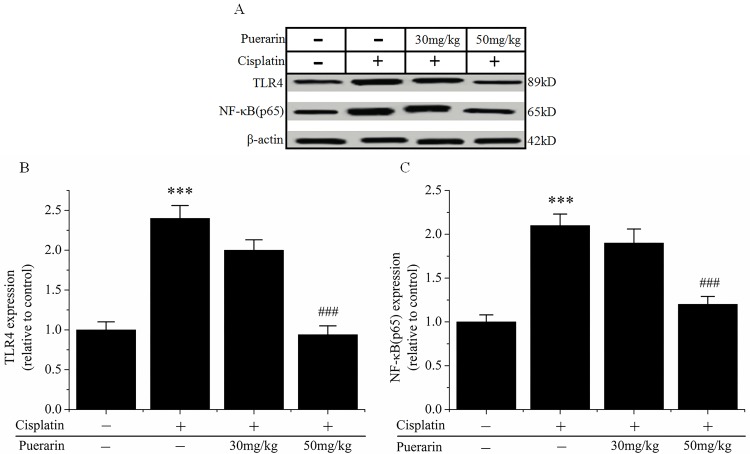
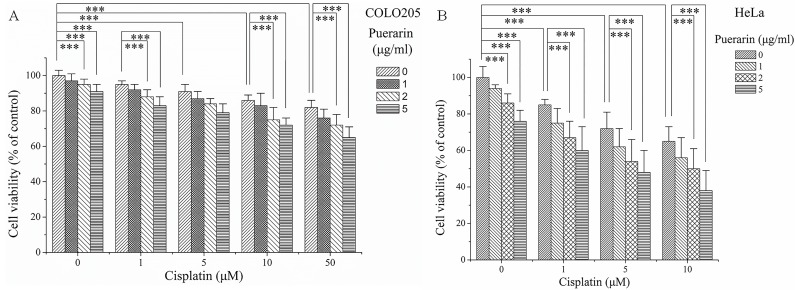
Puerarin was a major isoflavonoid derived from the Chinese medical herb radix puerariae (Gegen). In present study effect of puerarin on cisplatin nephrotoxicity was evaluated. Rat model of nephrotoxicity was established by a single intraperitoneal injection of cisplatin (7mg/kg). Puerarin was administrated through caudal vein injection once per day at the dose of 10mg/kg, 30mg/kg and 50mg/kg. Biochemical assays showed that after cisplatin treatment the serum urea and creatinine increased significantly compared with control (P<0.05). Cisplatin treatment significantly increased xanthine oxidase (XO) activity and malondialdehyde (MDA) formation, and significantly decreased the levels and /or activities of enzymatic and non-enzymatic antioxidants (GSH, GPx, GST, GR, SOD, CAT), in the kidney tissues. Renal levels of TNF-α and IL-6, two important inflammatory cytokines, were also upregulated by cisplatin. Histopathological examination indicated that cisplatin treatment resulted in severe necrosis and degeneration, hyaline casts in the tubules, intertubular hemorrhage, congestion and swelling in glomerulus and leukocytes infiltration in the kidney tissues. Western blot results demonstrated that cisplatin increased TLR4 and NF-κB protein expression in the kidney tissues. However, all these changes induced by cisplatin were significantly attenuated by puerarin treatment in dose-dependent manner, which indicated the renal protective effect of puerarin. Cell culture experiments illustrated that puerarin alone treatment concentration-dependently inhibited COLO205 and HeLa tumor cell growth and dose-dependently promoted the antitumor activity of cisplatin in COLO205 and HeLa tumor cells. The promotion effects might be attributed to suppression of cisplatin-increased NF-κB p65 expression by puerarin. Taken together, findings in this study suggested that puerarin exhibited renal protection against cisplatin nephrotoxicity via inhibiting TLR4/NF-κB signaling, with no inhibition but promotion effect on the antitumor activity of cisplatin. Puerarin might be a promising adjuvant agent for cisplatin chemotherapy.
葛根素是从中药葛根中提取的一种主要异黄酮类化合物。在本研究中,评估了葛根素对顺铂肾毒性的影响。通过单次腹腔注射顺铂(7mg/kg)建立肾毒性大鼠模型。葛根素通过尾静脉注射给药,剂量分别为10mg/kg、30mg/kg和50mg/kg,每日一次。生化分析表明,与对照组相比,顺铂治疗后血清尿素和肌酐显著升高(P<0.05)。顺铂治疗显著增加了肾组织中黄嘌呤氧化酶(XO)的活性和丙二醛(MDA)的生成,并显著降低了酶促和非酶促抗氧化剂(GSH、GPx、GST、GR、SOD、CAT)的水平和/或活性。顺铂还上调了肾组织中两种重要的炎性细胞因子TNF-α和IL-6的水平。组织病理学检查表明,顺铂治疗导致肾组织严重坏死和变性、肾小管透明管型、肾小管间出血、肾小球充血和肿胀以及白细胞浸润。蛋白质印迹结果表明,顺铂增加了肾组织中TLR4和NF-κB蛋白的表达。然而,葛根素治疗以剂量依赖的方式显著减轻了顺铂诱导的所有这些变化,这表明了葛根素的肾脏保护作用。细胞培养实验表明,单独使用葛根素治疗可浓度依赖性地抑制COLO205和HeLa肿瘤细胞的生长,并剂量依赖性地增强顺铂对COLO205和HeLa肿瘤细胞的抗肿瘤活性。这种促进作用可能归因于葛根素对顺铂增加的NF-κB p65表达的抑制。综上所述,本研究结果表明,葛根素通过抑制TLR4/NF-κB信号通路对顺铂肾毒性具有肾脏保护作用,对顺铂的抗肿瘤活性没有抑制作用,反而有促进作用。葛根素可能是一种有前途的顺铂化疗辅助药物。