Miner Jonathan J, Diamond Michael S
Department of Medicine, Washington University School of Medicine, Saint Louis, MO 63110, USA; Department of Pathology & Immunology, Washington University School of Medicine, Saint Louis, MO 63110, USA; Department of Molecular Microbiology, Washington University School of Medicine, Saint Louis, MO 63110, USA.
Department of Medicine, Washington University School of Medicine, Saint Louis, MO 63110, USA; Department of Pathology & Immunology, Washington University School of Medicine, Saint Louis, MO 63110, USA; Department of Molecular Microbiology, Washington University School of Medicine, Saint Louis, MO 63110, USA; The Andrew M. and Jane M. Bursky Center for Human Immunology and Immunotherapy Programs, Washington University School of Medicine, Saint Louis, MO 63110, USA.
Cell Host Microbe. 2017 Feb 8;21(2):134-142. doi: 10.1016/j.chom.2017.01.004.
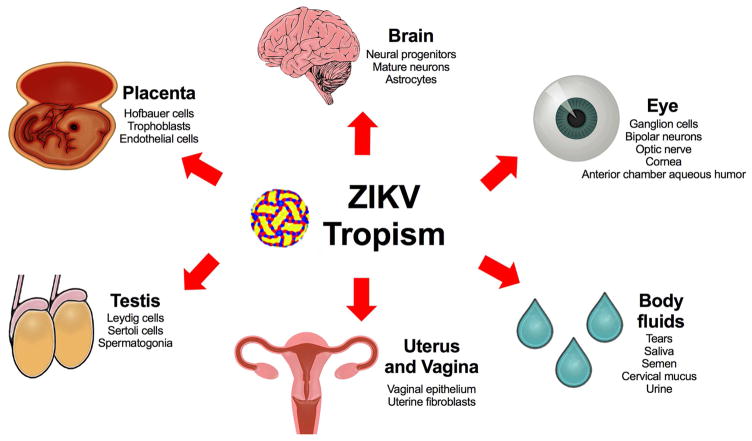
Although Zika virus (ZIKV) was isolated approximately 70 years ago, few experimental studies had been published prior to 2016. The recent spread of ZIKV to countries in the Western Hemisphere is associated with reports of microcephaly, congenital malformations, and Guillain-Barré syndrome. This has resulted in ZIKV being declared a public health emergency and has greatly accelerated the pace of ZIKV research and discovery. Within a short time period, useful mouse and non-human primate disease models have been established, and pre-clinical evaluation of therapeutics and vaccines has begun. Unexpectedly, ZIKV exhibits a broad tropism and persistence in body tissues and fluids, which contributes to the clinical manifestations and epidemiology that have been observed during the current epidemic. In this Review, we highlight recent advances in our understanding of ZIKV pathogenesis, tissue tropism, and the resulting pathology and discuss areas for future investigation.
尽管寨卡病毒(ZIKV)大约在70年前就已分离出来,但在2016年之前几乎没有发表过相关实验研究。最近寨卡病毒在西半球国家的传播与小头畸形、先天性畸形和吉兰 - 巴雷综合征的报告有关。这导致寨卡病毒被宣布为突发公共卫生事件,并极大地加快了寨卡病毒研究和发现的步伐。在短时间内,已经建立了有用的小鼠和非人类灵长类动物疾病模型,并且已经开始对治疗方法和疫苗进行临床前评估。出乎意料的是,寨卡病毒在身体组织和体液中表现出广泛的嗜性和持续性,这导致了在当前疫情期间观察到的临床表现和流行病学情况。在这篇综述中,我们重点介绍了我们对寨卡病毒发病机制、组织嗜性以及由此产生的病理学的最新认识进展,并讨论了未来的研究方向。