Roudijk Bram, Donders Rogier, Stalmeier Peep
Radboud University Medical Center, Radboud Institute for Health Sciences, Nijmegen, The Netherlands.
Qual Life Res. 2017 Jun;26(6):1531-1539. doi: 10.1007/s11136-017-1512-x. Epub 2017 Feb 10.
Self-reported health (SRH) is a measure widely used in health research and population studies. Differences in SRH have been observed between countries and cultural values have been hypothesized to partly explain such differences. Cultural values can be operationalized by two cultural dimensions using the World Values Survey (WVS), namely the traditional/rational-secular and the survival/self-expression dimension. We investigate whether there is an association between the WVS cultural dimensions and SRH, both within and between countries.
Data from 51 countries in the WVS is used and combined with macroeconomic data from the Worldbank database. The association between SRH and the WVS cultural dimensions is tested within each of the 51 countries and multilevel mixed models are used to test differences between these countries. Socio-demographic and macroeconomic variables are used to correct for non-cultural variables related to SRH.
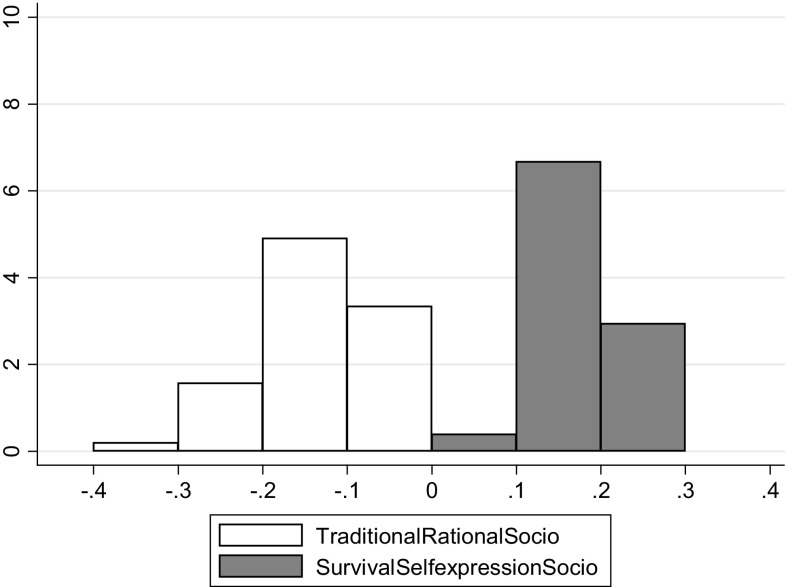
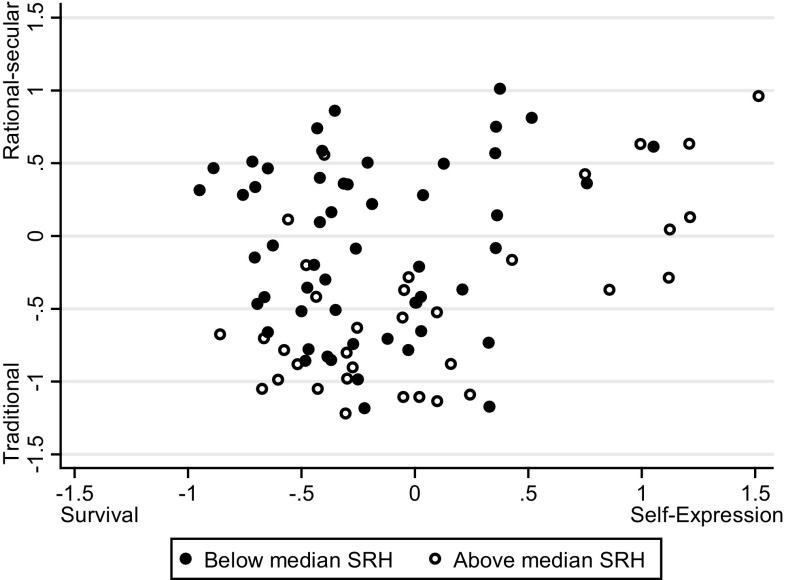
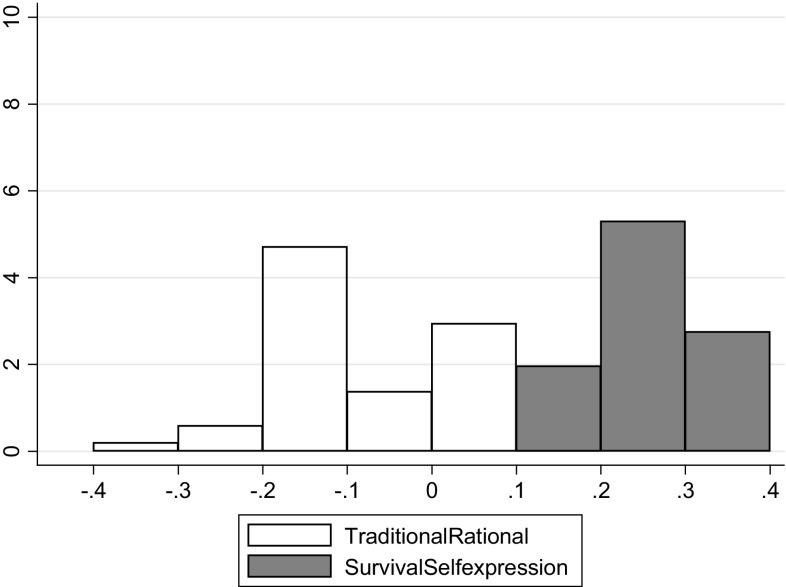
Within countries, the survival/self-expression dimension was positively associated with SRH, while in most countries there was a negative association for the traditional/rational-secular dimension. Values range between 4 and 17% within countries. Further analyses show that the associations within countries and between countries are similar. Controlling for macroeconomic and socio-demographic factors did not change our results.
The WVS cultural dimensions predict SRH within and between countries. Contrary to our expectations, traditional/rational-secular values were negatively associated with SRH. As SRH is associated with cultural values between countries, cultural values could be considered when interpreting SRH between countries.
自我报告健康状况(SRH)是健康研究和人口研究中广泛使用的一项指标。各国之间已观察到SRH存在差异,并且有人假设文化价值观可以部分解释这种差异。文化价值观可以通过世界价值观调查(WVS)的两个文化维度来操作化,即传统/理性世俗维度和生存/自我表达维度。我们研究WVS文化维度与SRH在国家内部和国家之间是否存在关联。
使用来自WVS中51个国家的数据,并将其与世界银行数据库中的宏观经济数据相结合。在这51个国家中的每一个国家内部测试SRH与WVS文化维度之间的关联,并使用多层次混合模型来测试这些国家之间的差异。社会人口统计学和宏观经济变量用于校正与SRH相关的非文化变量。
在国家内部,生存/自我表达维度与SRH呈正相关,而在大多数国家中,传统/理性世俗维度与SRH呈负相关。各国内部的数值范围在4%至17%之间。进一步分析表明,国家内部和国家之间的关联相似。控制宏观经济和社会人口统计学因素并未改变我们的结果。
WVS文化维度在国家内部和国家之间预测SRH。与我们的预期相反,传统/理性世俗价值观与SRH呈负相关。由于SRH在国家之间与文化价值观相关联,因此在解释国家之间的SRH时可以考虑文化价值观。