Zuntini Roberta, Cortesi Laura, Calistri Daniele, Pippucci Tommaso, Martelli Pier Luigi, Casadio Rita, Capizzi Elisa, Santini Donatella, Miccoli Sara, Medici Veronica, Danesi Rita, Marchi Isabella, Zampiga Valentina, Fiorentino Michelangelo, Ferrari Simona, Turchetti Daniela
Dipartimento di Scienze Mediche e Chirurgiche, Centro di Ricerca sui Tumori Ereditari, UO Genetica Medica, Università di Bologna, Bologna, Italy.
Dipartimento di Oncologia ed Ematologia, Azienda Ospedaliero-Universitaria Policlinico di Modena, Modena, Italy.
Oncotarget. 2017 Apr 4;8(14):22640-22648. doi: 10.18632/oncotarget.15151.
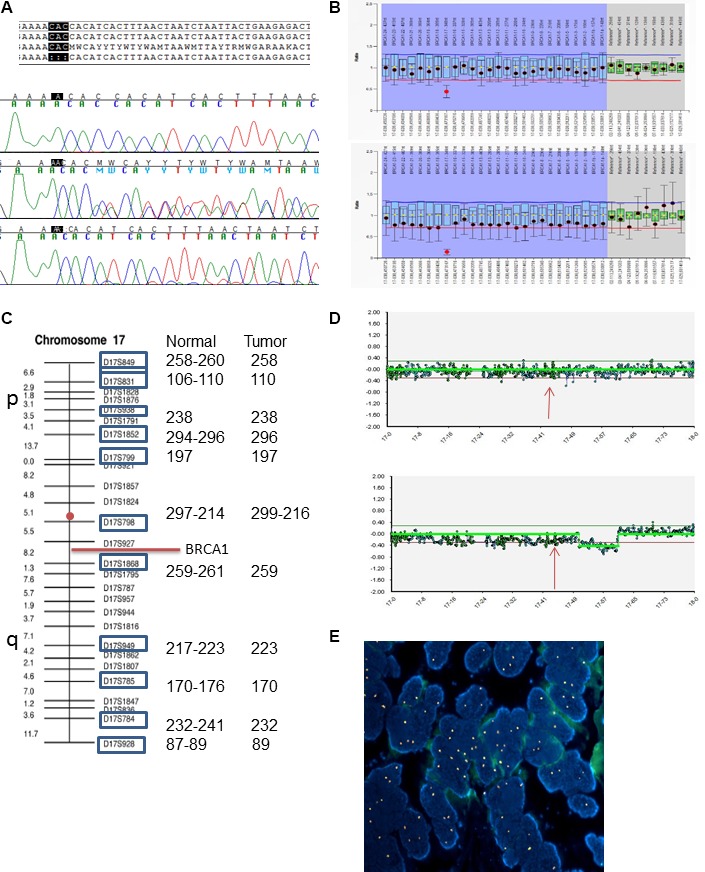
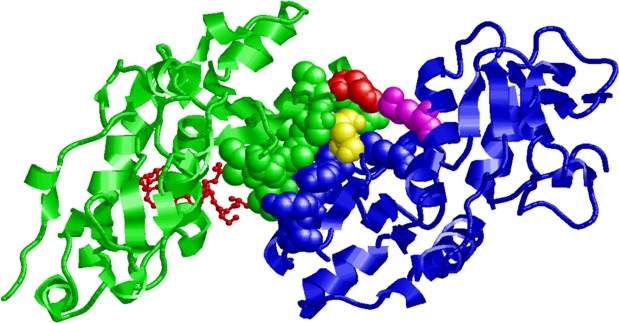
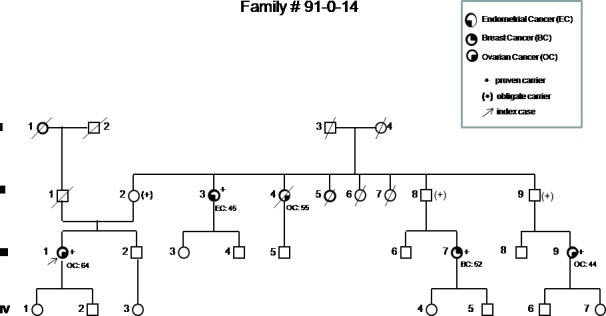
We have investigated the clinical significance of the BRCA1 variant p.His1673del in 14 families from the Emilia-Romagna region of Italy, including 20 breast and 23 ovarian cancer cases; four families displayed site-specific ovarian cancer.The variant, absent in human variation databases, has been reported three times in BRCA1 specific databases; all probands shared the same rare haplotype at the BRCA1 locus, consistent with a common ancestor.The multifactorial likelihood method by Goldgar, used to estimate the probability of the variant being causative, gave a ratio of 2,263,474:1 in favor of causality. Moreover, in silico modeling suggested that His1673-lacking BRCA1 protein may have a decreased ability to bind BARD1 and other related proteins. All six ovarian carcinomas and two out of four breast carcinomas available showed a loss of the BRCA1 wild-type allele, which in three out of four ovarian carcinomas analyzed by FISH was associated with duplication of the chromosome 17 containing the variant. Although the pathogenicity of the allele is strongly supported by the multifactorial ratio,we cannot exclude that p.His1673del is not itself deleterious, but is linked to another undetected mutation on the same ancestral allele.
我们研究了意大利艾米利亚 - 罗马涅地区14个家族中BRCA1基因变异p.His1673del的临床意义,其中包括20例乳腺癌和23例卵巢癌病例;4个家族表现为特定部位的卵巢癌。该变异在人类变异数据库中不存在,在BRCA1特定数据库中已被报道过3次;所有先证者在BRCA1基因座共享相同的罕见单倍型,这与共同祖先一致。采用Goldgar的多因素似然法来估计该变异为致病因素的概率,得出支持因果关系的比例为2,263,474:1。此外,计算机模拟表明,缺乏His1673的BRCA1蛋白可能与BARD1及其他相关蛋白的结合能力下降。所有6例卵巢癌以及4例乳腺癌中的2例显示BRCA1野生型等位基因缺失,在通过荧光原位杂交分析的4例卵巢癌中的3例中,这与包含该变异的17号染色体的重复有关。尽管多因素比例有力支持了该等位基因的致病性,但我们不能排除p.His1673del本身并无有害性,而是与同一祖先等位基因上另一个未检测到的突变相关联的可能性。