Department of Surgery, Yongin Severance Hospital, Yonsei University College of Medicine, Yongin, Gyeonggi, Republic of Korea.
Department of Laboratory Medicine, Keimyung University School of Medicine, Daegu, Republic of Korea.
Sci Rep. 2021 Apr 19;11(1):8485. doi: 10.1038/s41598-021-87792-w.
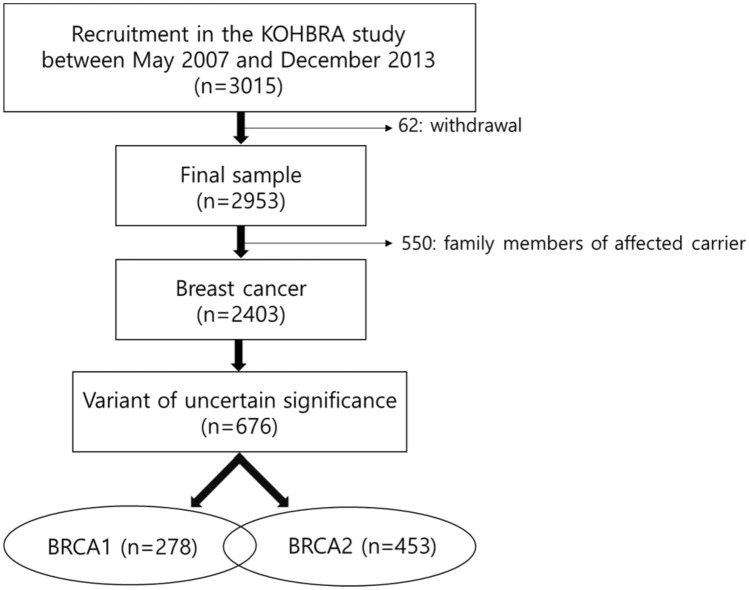
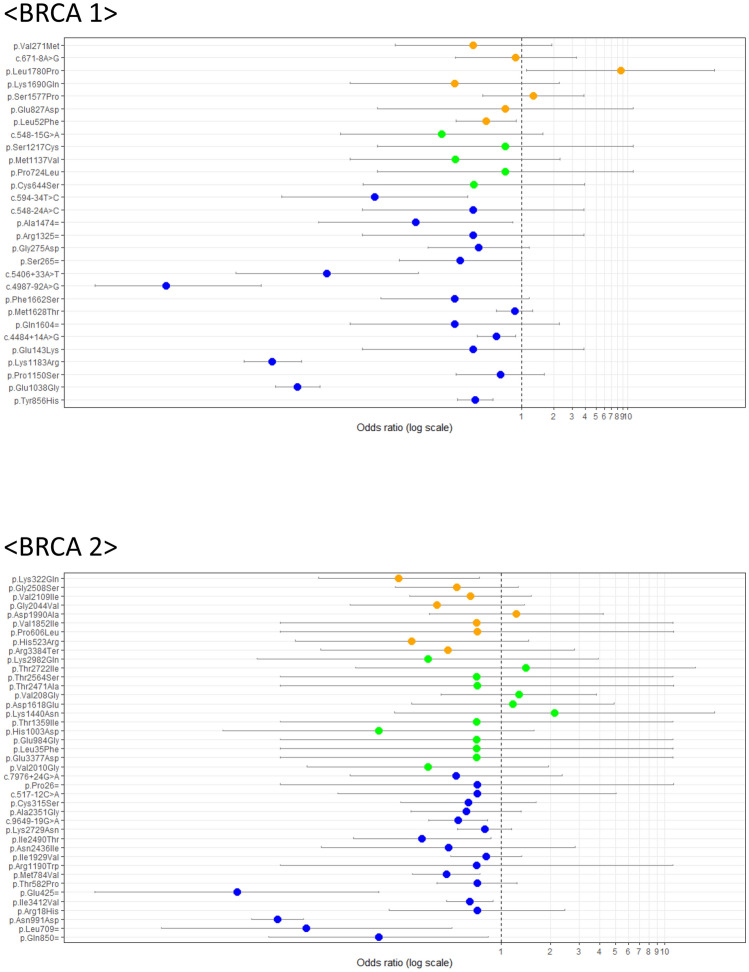
Genetic testing for BRCA1 and BRCA2 is crucial in diagnosing hereditary breast and ovarian cancer syndromes and has increased with the development of multigene panel tests. However, results classified as variants of uncertain significance (VUS) present challenges to clinicians in attempting to choose an appropriate management plans. We reviewed a total of 676 breast cancer patients included in the Korean Hereditary Breast Cancer (KOHBRA) study with a VUS on BRCA mutation tests between November 2007 and April 2013. These results were compared to the ClinVar database. We calculated the incidence and odds ratios for these variants using the Korean Reference Genome Database. A total of 58 and 91 distinct VUS in BRCA1 and BRCA2 were identified in the KOHBRA study (comprising 278 and 453 patients, respectively). A total of 27 variants in the KOHBRA study were not registered in the Single Nucleotide Polymorphism database. Among BRCA1 VUSs, 20 were reclassified as benign or likely benign, four were reclassified as pathogenic or likely pathogenic, and eight remained as VUSs according to the ClinVar database. Of the BRCA2 VUSs, 25 were reclassified as benign or likely benign, two were reclassified as pathogenic or likely pathogenic, and 33 remained as VUS according to the ClinVar database. There were 12 variants with conflicting interpretations of pathogenicity for BRCA1 and 18 for BRCA2. Among them, p.Leu1780Pro showed a particularly high odds ratio. Six pathogenic variants and one conflicting variant identified using ClinVar could be reclassified as pathogenic variants in this study. Using updated ClinVar information and calculating odds ratios can be helpful when reclassifying VUSs in BRCA1/2.
BRCA1 和 BRCA2 的基因检测对于诊断遗传性乳腺癌和卵巢癌综合征至关重要,并且随着多基因面板检测的发展而增加。然而,分类为意义不明的变异(VUS)的结果给试图选择适当管理计划的临床医生带来了挑战。我们回顾了 2007 年 11 月至 2013 年 4 月间在韩国遗传性乳腺癌(KOHBRA)研究中进行 BRCA 突变检测的 676 名乳腺癌患者的 VUS 结果,并与 ClinVar 数据库进行了比较。我们使用韩国参考基因组数据库计算了这些变体的发生率和优势比。在 KOHBRA 研究中,BRCA1 和 BRCA2 分别鉴定出 58 个和 91 个不同的 VUS(分别包含 278 名和 453 名患者)。KOHBRA 研究中有 27 个变体未在单核苷酸多态性数据库中注册。在 BRCA1 的 VUS 中,根据 ClinVar 数据库,有 20 个被重新分类为良性或可能良性,4 个被重新分类为致病性或可能致病性,8 个仍然为 VUS。在 BRCA2 的 VUS 中,根据 ClinVar 数据库,有 25 个被重新分类为良性或可能良性,2 个被重新分类为致病性或可能致病性,33 个仍然为 VUS。BRCA1 中有 12 个变体的致病性解释存在冲突,BRCA2 中有 18 个变体的致病性解释存在冲突。其中,p.Leu1780Pro 显示出特别高的优势比。本研究中,使用 ClinVar 确定的 6 个致病性变体和 1 个冲突变体可重新分类为致病性变体。使用更新的 ClinVar 信息并计算优势比有助于重新分类 BRCA1/2 中的 VUS。