Frishman Natalia, Conway Kristin Caspers, Andrews Jennifer, Oleson Jacob, Mathews Katherine, Ciafaloni Emma, Oleszek Joyce, Lamb Molly, Matthews Dennis, Paramsothy Pangaja, McKirgan Lowell, Romitti Paul
Department of Epidemiology, The University of Iowa, Iowa City, USA.
Present address: General Dynamics Information Technology, Coralville, IA, USA.
Health Qual Life Outcomes. 2017 Feb 10;15(1):33. doi: 10.1186/s12955-017-0612-1.
Duchenne and Becker muscular dystrophies, collectively referred to as dystrophinopathies, are recessive X-linked disorders characterized by progressive muscle weakness and ultimately cardiac and respiratory failure. Immediate family members are often primary caregivers of individuals with a dystrophinopathy.
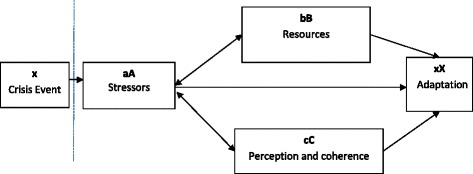
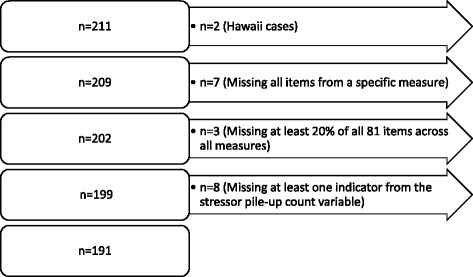
We explored the impact of this role by inviting primary caregivers (n = 209) of males diagnosed with childhood-onset dystrophinopathy who were identified by the Muscular Dystrophy Surveillance, Tracking, and Research Network (MD STARnet) to complete a mailed questionnaire measuring perceived social support and stress, spirituality, and family quality of life (FQoL). Bivariate and multivariate analyses examined associations between study variables using the Double ABCX model as an analytic framework.
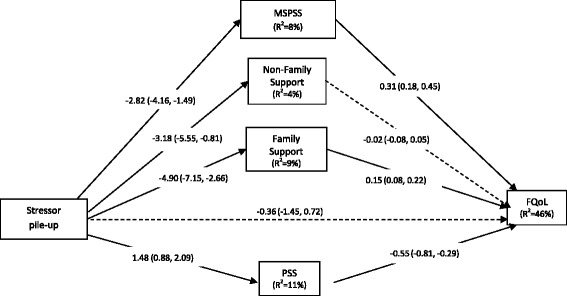
Higher stressor pile-up was associated with lower perceived social support (r = -0.29, p < .001), availability of supportive family (r = -0.30, p < .001) or non-family (r = -0.19, p < .01) relationships, and higher perceived stress (r = 0.33, p < .001); but not with spirituality (r = -0.14, p > 0.05). FQoL was positively associated with all support measures (correlations ranged from: 0.25 to 0.58, p-values 0.01-0.001) and negatively associated with perceived stress and control (r = -0.49, p < .001). The association between stressor pile-up and FQoL was completely mediated through global perceived social support, supportive family relationships, and perceived stress and control; supportive non-family relationships did not remain statistically significant after controlling for other mediators.
Findings suggest caregiver adaptation to a dystrophinopathy diagnosis can be optimized by increased perceived control, supporting family resources, and creation of a healthy family identity. Our findings will help identify areas for family intervention and guide clinicians in identifying resources that minimize stress and maximize family adaptation.
杜兴氏和贝克氏肌营养不良症统称为肌营养不良症,是隐性X连锁疾病,其特征为进行性肌肉无力,最终导致心脏和呼吸衰竭。直系家庭成员通常是患有肌营养不良症患者的主要照料者。
我们邀请了由肌肉萎缩症监测、跟踪和研究网络(MD STARnet)确定的、被诊断患有儿童期起病的肌营养不良症男性患者的主要照料者(n = 209),通过邮寄问卷来测量他们所感受到的社会支持与压力、精神信仰以及家庭生活质量(FQoL),以此探究这一角色的影响。双变量和多变量分析使用双重ABCX模型作为分析框架,检验研究变量之间的关联。
更高的压力源堆积与更低的社会支持感(r = -0.29,p < 0.001)、支持性家庭关系的可得性(r = -0.30,p < 0.001)或非家庭关系的可得性(r = -0.19,p < 0.01)以及更高的压力感(r = 0.33,p < 0.001)相关;但与精神信仰无关(r = -0.14,p > 0.05)。家庭生活质量与所有支持性指标呈正相关(相关性范围为:0.25至0.58,p值为0.01 - 0.001),与压力感和控制感呈负相关(r = -0.49,p < 0.001)。压力源堆积与家庭生活质量之间的关联完全通过总体社会支持感、支持性家庭关系以及压力感和控制感来介导;在控制其他中介变量后,支持性非家庭关系不再具有统计学意义。
研究结果表明,通过增强控制感、支持家庭资源以及塑造健康的家庭身份认同,可以优化照料者对肌营养不良症诊断的适应情况。我们的研究结果将有助于确定家庭干预的领域,并指导临床医生识别能够将压力降至最低并使家庭适应最大化的资源。