Liu Edwin, Dong Fran, Barón Anna E, Taki Iman, Norris Jill M, Frohnert Brigitte I, Hoffenberg Edward J, Rewers Marian
Digestive Health Institute and Colorado Center for Celiac Disease, Children's Hospital Colorado, University of Colorado Denver, Aurora, Colorado; Barbara Davis Center, University of Colorado Denver, Aurora, Colorado.
Barbara Davis Center, University of Colorado Denver, Aurora, Colorado.
Gastroenterology. 2017 May;152(6):1329-1336.e1. doi: 10.1053/j.gastro.2017.02.002. Epub 2017 Feb 7.
BACKGROUND & AIMS: Little is known about the incidence of celiac disease in the general population of children in the United States. We aimed to estimate the cumulative incidence of celiac disease in adolescents born in the Denver metropolitan area.
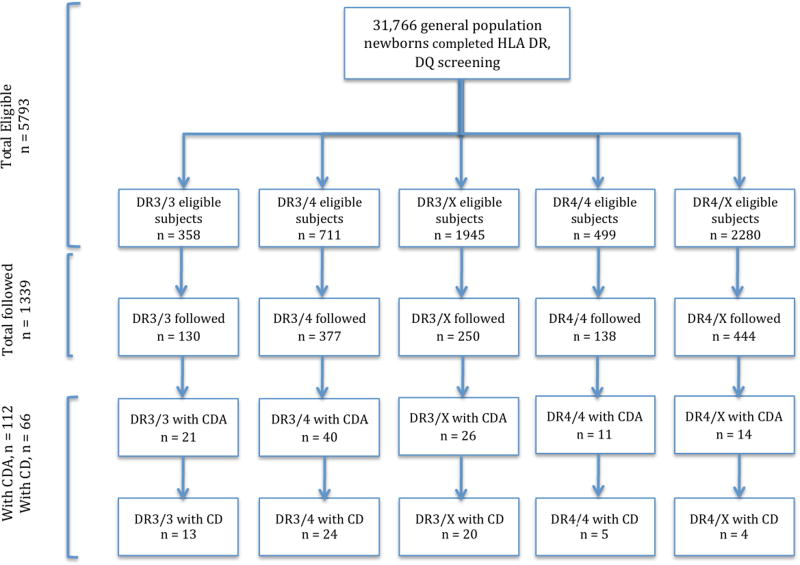
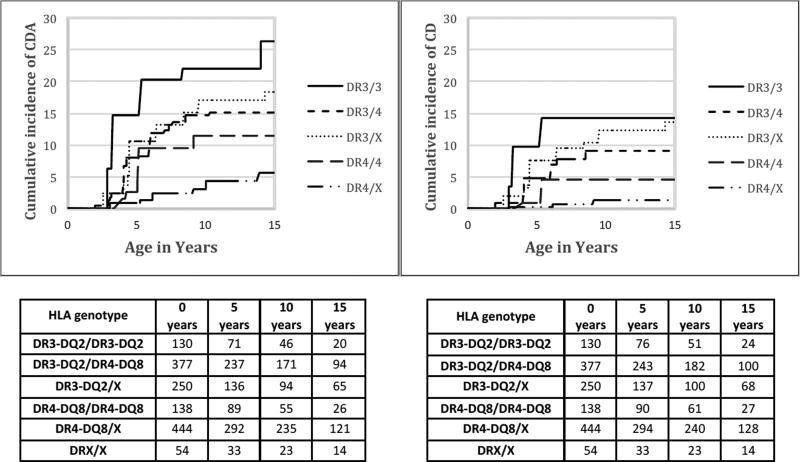
We collected data on HLA-DR, DQ genotypes of 31,766 infants, born from 1993 through 2004 at St. Joseph's Hospital in Denver, from the Diabetes Autoimmunity Study in the Young. Subjects with susceptibility genotypes for celiac disease and type 1 diabetes were followed up for up to 20 years for development of tissue transglutaminase autoantibodies (tTGA). Outcomes were the development of celiac disease autoimmunity (CDA) or celiac disease. CDA was defined as persistence of tTGA for at least 3 months or development of celiac disease. Celiac disease was defined based on detection of Marsh 2 or greater lesions in biopsy specimens or persistent high levels of tTGA. For each genotype, the cumulative incidence of CDA and celiac disease were determined. To estimate the cumulative incidence in the Denver general population, outcomes by each genotype were weighted according to the frequency of each of these genotypes in the general population.
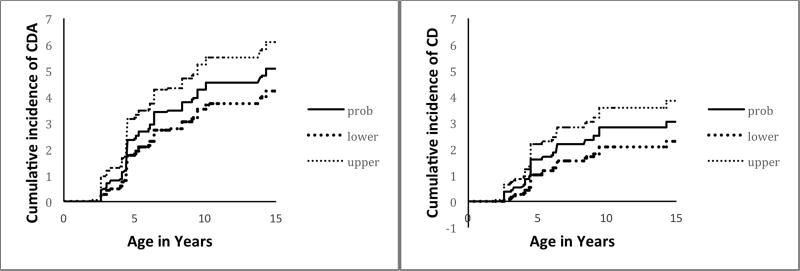
Of 1339 subjects followed up, 66 developed CDA and met criteria for celiac disease and 46 developed only CDA. Seropositivity for tTGA resolved spontaneously, without treatment, in 21 of the 46 subjects with only CDA (46%). The estimated cumulative incidence for CDA in the Denver general population at 5, 10, and 15 years of age was 2.4%, 4.3%, and 5.1%, respectively, and incidence values for celiac disease were 1.6%, 2.8%, and 3.1%, respectively.
In a 20-year prospective study of 1339 children with genetic risk factors for celiac disease, we found the cumulative incidence of CDA and celiac disease to be high within the first 10 years. Although more than 5% of children may experience a period of CDA, not all children develop celiac disease or require gluten-free diets.
在美国儿童普通人群中,乳糜泻的发病率鲜为人知。我们旨在估计丹佛大都会地区出生的青少年中乳糜泻的累积发病率。
我们从青少年糖尿病自身免疫研究中收集了1993年至2004年在丹佛圣约瑟夫医院出生的31766名婴儿的HLA - DR、DQ基因型数据。对具有乳糜泻和1型糖尿病易感基因型的受试者进行长达20年的随访,观察组织转谷氨酰胺酶自身抗体(tTGA)的出现情况。观察结果为乳糜泻自身免疫(CDA)或乳糜泻的发生。CDA定义为tTGA持续至少3个月或出现乳糜泻。乳糜泻根据活检标本中检测到Marsh 2级或更高级别的病变或tTGA持续高水平来定义。对于每种基因型,确定CDA和乳糜泻的累积发病率。为了估计丹佛普通人群中的累积发病率,根据每种基因型在普通人群中的频率对每种基因型的观察结果进行加权。
在随访的1339名受试者中,66人发生了CDA并符合乳糜泻标准,46人仅发生了CDA。在仅发生CDA的46名受试者中,21人(46%)的tTGA血清阳性未经治疗自行消退。丹佛普通人群中5岁、10岁和15岁时CDA的估计累积发病率分别为2.4%、4.3%和5.1%,乳糜泻的发病率分别为1.6%、2.8%和3.1%。
在一项对1339名具有乳糜泻遗传风险因素的儿童进行的20年前瞻性研究中,我们发现CDA和乳糜泻在前10年内的累积发病率很高。虽然超过5%的儿童可能经历一段CDA时期,但并非所有儿童都会发展为乳糜泻或需要无麸质饮食。