van der Horst H J R, de Wall L L
Department of Urology, VUmc, De Boelelaan 1117, P.O. Box 7057, 1007 MB, Amsterdam, The Netherlands.
Department of Urology, Radboudumc, Geert Grooteplein 10, P.O. Box 9101, 6500 HB, Nijmegen, The Netherlands.
Eur J Pediatr. 2017 Apr;176(4):435-441. doi: 10.1007/s00431-017-2864-5. Epub 2017 Feb 11.
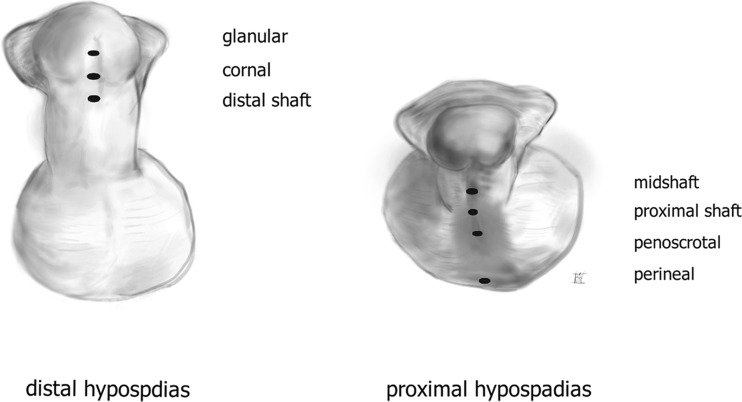
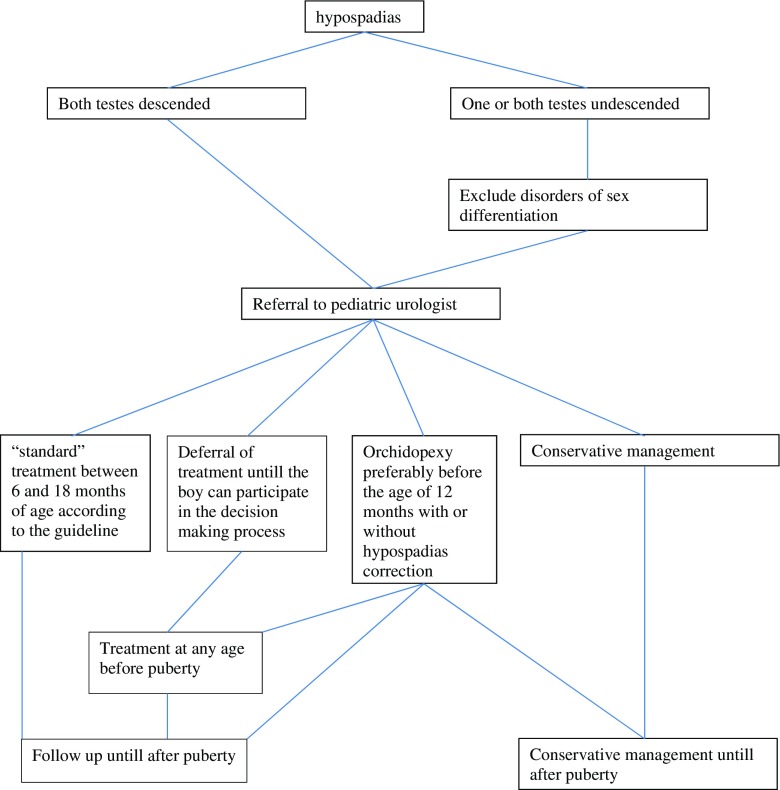
Hypospadias is one of the most common congenital anomalies in men. The condition is typically characterized by proximal displacement of the urethral opening, penile curvature, and a ventrally deficient hooded foreskin. In about 70%, the urethral meatus is located distally on the penile shaft; this is considered a mild form that is not associated with other urogenital deformities. The remaining 30% are proximal and often more complex. In these cases, endocrinological evaluation is advised to exclude disorders of sexual differentiation, especially in case of concomitant unilateral or bilateral undescended testis. Although the etiology of hypospadias is largely unknown, many hypotheses exist about genetic predisposition and hormonal influences. The goal of hypospadias repair is to achieve cosmetic and functional normality, and currently, surgery is recommended between 6 and 18 months of age. Hypospadias can be corrected at any age with comparable complication risk, functional, and cosmetic outcome; however, the optimal age of repair remains conclusive. Although long-term overall outcome concerning cosmetic appearance and sexual function is fairly good, after correction, men may more often be inhibited in seeking sexual contact. Moreover, lower urinary tract symptoms occur twice as often in patients undergoing hypospadias repair and can still occur many years after the initial repair.
This study explores the most recent insights into the management of hypospadias. What is Known: • Guidelines advise referral for treatment between 6 and 18 months of age. • Cosmetic outcome is considered satisfactory in over 70% of all patients. What is New: • Long-term complications include urinary tract symptoms and sexual and cosmetic issues. • New developments allow a more individualized approach, hopefully leading to less complications and more patient satisfaction.
尿道下裂是男性最常见的先天性畸形之一。该病通常的特征是尿道口近端移位、阴茎弯曲以及腹侧包皮缺如呈头巾状。约70%的病例中,尿道口位于阴茎体远端;这被认为是一种轻度形式,不伴有其他泌尿生殖系统畸形。其余30%为近端型,通常更为复杂。在这些病例中,建议进行内分泌学评估以排除性分化异常,尤其是伴有单侧或双侧隐睾的情况。尽管尿道下裂的病因大多不明,但关于遗传易感性和激素影响存在许多假说。尿道下裂修复的目标是实现外观和功能正常,目前建议在6至18个月龄之间进行手术。尿道下裂可在任何年龄矫正,并发症风险、功能及外观结局相近;然而,最佳修复年龄尚无定论。尽管矫正后在外观和性功能方面的长期总体结局相当良好,但男性在寻求性接触时可能更常受到抑制。此外,尿道下裂修复患者出现下尿路症状的频率是正常人的两倍,且在初次修复多年后仍可能出现。
本研究探讨了尿道下裂治疗的最新见解。已知情况:• 指南建议在6至18个月龄之间转诊治疗。• 超过70%的患者外观结局被认为满意。新发现:• 长期并发症包括尿路症状以及性和外观问题。• 新进展允许采用更个体化的方法,有望减少并发症并提高患者满意度。