Sacco Ralph L, Gardener Hannah, Wang Kefeng, Dong Chuanhui, Ciliberti-Vargas Maria A, Gutierrez Carolina M, Asdaghi Negar, Burgin W Scott, Carrasquillo Olveen, Garcia-Rivera Enid J, Nobo Ulises, Oluwole Sofia, Rose David Z, Waters Michael F, Zevallos Juan Carlos, Robichaux Mary, Waddy Salina P, Romano Jose G, Rundek Tatjana
University of Miami Miller School of Medicine, Miami, FL
University of Miami Miller School of Medicine, Miami, FL.
J Am Heart Assoc. 2017 Feb 14;6(2):e004073. doi: 10.1161/JAHA.116.004073.
Racial-ethnic disparities in acute stroke care can contribute to inequality in stroke outcomes. We examined race-ethnic disparities in acute stroke performance metrics in a voluntary stroke registry among Florida and Puerto Rico Get With the Guidelines-Stroke hospitals.
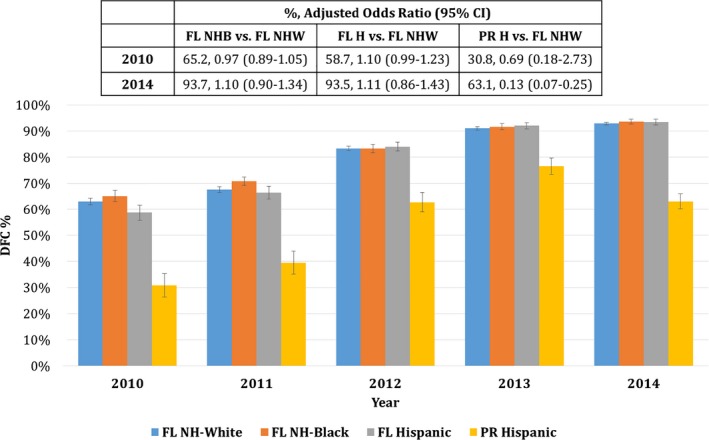
Seventy-five sites in the Florida Puerto Rico Stroke Registry (66 Florida and 9 Puerto Rico) recorded 58 864 ischemic stroke cases (2010-2014). Logistic regression models examined racial-ethnic differences in acute stroke performance measures and defect-free care (intravenous tissue plasminogen activator treatment, in-hospital antithrombotic therapy, deep vein thrombosis prophylaxis, discharge antithrombotic therapy, appropriate anticoagulation therapy, statin use, smoking cessation counseling) and temporal trends. Among ischemic stroke cases, 63% were non-Hispanic white (NHW), 18% were non-Hispanic black (NHB), 14% were Hispanic living in Florida, and 6% were Hispanic living in Puerto Rico. NHW patients were the oldest, followed by Hispanics, and NHBs. Defect-free care was greatest among NHBs (81%), followed by NHWs (79%) and Florida Hispanics (79%), then Puerto Rico Hispanics (57%) (<0.0001). Puerto Rico Hispanics were less likely than Florida whites to meet any stroke care performance metric other than anticoagulation. Defect-free care improved for all groups during 2010-2014, but the disparity in Puerto Rico persisted (2010: NHWs=63%, NHBs=65%, Florida Hispanics=59%, Puerto Rico Hispanics=31%; 2014: NHWs=93%, NHBs=94%, Florida Hispanics=94%, Puerto Rico Hispanics=63%).
Racial-ethnic/geographic disparities were observed for acute stroke care performance metrics. Adoption of a quality improvement program improved stroke care from 2010 to 2014 in Puerto Rico and all Florida racial-ethnic groups. However, stroke care quality delivered in Puerto Rico is lower than in Florida. Sustained support of evidence-based acute stroke quality improvement programs is required to improve stroke care and minimize racial-ethnic disparities, particularly in resource-strained Puerto Rico.
急性卒中护理中的种族差异可能导致卒中结局的不平等。我们在佛罗里达州和波多黎各遵循《卒中指南》的医院的一个自愿卒中登记处,研究了急性卒中绩效指标中的种族差异。
佛罗里达州波多黎各卒中登记处的75个地点(66个在佛罗里达州,9个在波多黎各)记录了58864例缺血性卒中病例(2010 - 2014年)。逻辑回归模型研究了急性卒中绩效指标和无缺陷护理(静脉注射组织纤溶酶原激活剂治疗、院内抗栓治疗、深静脉血栓预防、出院抗栓治疗、适当的抗凝治疗、他汀类药物使用、戒烟咨询)中的种族差异以及时间趋势。在缺血性卒中病例中,63%为非西班牙裔白人(NHW),18%为非西班牙裔黑人(NHB),14%为居住在佛罗里达州的西班牙裔,6%为居住在波多黎各的西班牙裔。NHW患者年龄最大,其次是西班牙裔,然后是NHB。无缺陷护理在NHB中最高(81%),其次是NHW(79%)和佛罗里达州的西班牙裔(79%),然后是波多黎各的西班牙裔(57%)(<0.0001)。除抗凝外,波多黎各的西班牙裔比佛罗里达州的白人更不可能达到任何卒中护理绩效指标。2010 - 2014年期间,所有组的无缺陷护理均有所改善,但波多黎各的差异仍然存在(2010年:NHW = 63%,NHB = 65%,佛罗里达州的西班牙裔 = 59%,波多黎各的西班牙裔 = 31%;2014年:NHW = 93%,NHB = 94%,佛罗里达州的西班牙裔 = 94%,波多黎各的西班牙裔 = 63%)。
在急性卒中护理绩效指标方面观察到了种族/地理差异。采用质量改进计划使2010年至年期间波多黎各和佛罗里达州所有种族群体的卒中护理得到改善。然而,波多黎各提供的卒中护理质量低于佛罗里达州。需要持续支持基于证据的急性卒中质量改进计划,以改善卒中护理并尽量减少种族差异,特别是在资源紧张的波多黎各。