Aherrera Jaime Alfonso M, Abola Maria Teresa B, Balabagno Maria Margarita O, Abrahan Lauro L, Magno Jose Donato A, Reganit Paul Ferdinand M, Punzalan Felix Eduardo R
Section of Cardiology, Department of Medicine, University of the Philippines-Philippine General Hospital, Philippines.
Cardiol Res. 2016 Aug;7(4):130-139. doi: 10.14740/cr490w. Epub 2016 Sep 5.
Cardioembolic events are life-threatening complications of infective endocarditis (IE). The embolic risk French calculator estimates the embolic risk in IE computed on admission. Variables in this tool include age, diabetes, atrial fibrillation, prior embolism, vegetation length, and on culture. A computed risk of > 7% was considered high in the development of this tool. Knowledge of this risk applied in our local setting is important to guide clinicians in preventing such catastrophic complications. Among patients with IE, we aim to determine the efficacy of the embolic risk French calculator, using a computed score of > 7%, in predicting major embolic events.
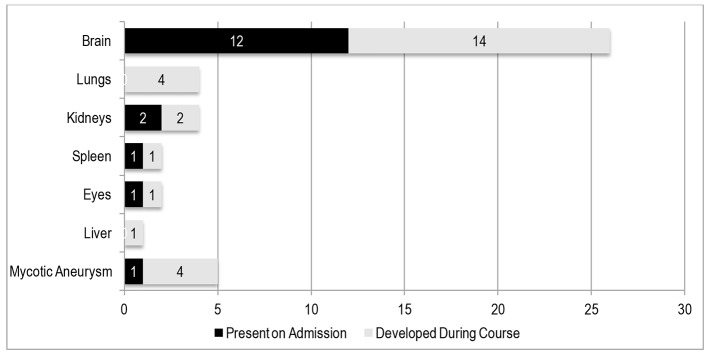
All adults admitted from 2013 to 2016 with definite IE were included. The risk for embolic events was computed on admission. All were monitored for the duration of admission for the occurrence of the primary outcome (any major embolic event: arterial emboli, intracranial hemorrhage, pulmonary infarcts, or aneurysms). Secondary outcomes were: 1) composite of death and embolic events; and 2) death from any cause.
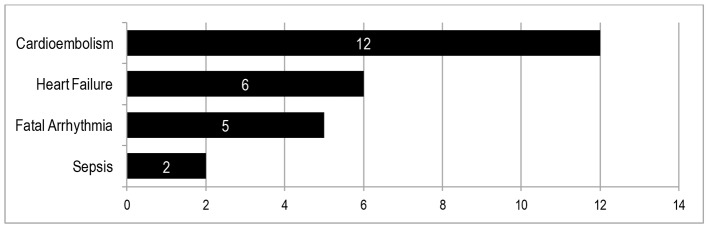
Eighty-seven adults with definite IE were included. Majority had a valvular heart disease and preserved ejection fraction (EF). The mitral valve was most commonly involved. Embolic events occurred in 25 (29%). Multivariate analysis identified a high embolic score > 7% (relative risk (RR): 15.12, P < 0.001), vegetation area ≥ 18 mm (RR: 6.39, P < 0.01), and a prior embolism (RR: 5.18, P = 0.018) to be independent predictors of embolic events. For the composite of embolic events and death, independent predictors include a high score of > 7% (RR: 13.56, P < 0.001) and a prior embolus (RR: 13.75, P = 0.002). Independent predictors of death were a high score > 7% (RR: 6.20, P = 0.003) and EF ≤ 45% (RR: 9.91, P = 0.004).
Cardioembolic events are more prevalent in our study compared to previous data. The embolic risk French calculator is a useful tool to estimate and predict risk for embolic events and in-hospital mortality. The risk of developing embolic events should be weighed against the risks of early preventive cardiac surgery, as to institute timely and appropriate management.
心源性栓塞事件是感染性心内膜炎(IE)的危及生命的并发症。法国栓塞风险计算器可估算入院时计算得出的IE栓塞风险。该工具中的变量包括年龄、糖尿病、心房颤动、既往栓塞史、赘生物长度以及培养结果。在开发此工具时,计算得出的风险>7%被视为高风险。了解该风险在我们当地环境中的应用情况对于指导临床医生预防此类灾难性并发症很重要。在IE患者中,我们旨在确定法国栓塞风险计算器使用计算得分>7%来预测主要栓塞事件的有效性。
纳入2013年至2016年入院的所有确诊为IE的成年人。入院时计算栓塞事件的风险。所有患者在住院期间均监测主要结局(任何主要栓塞事件:动脉栓塞、颅内出血、肺梗死或动脉瘤)的发生情况。次要结局为:1)死亡和栓塞事件的综合情况;2)任何原因导致的死亡。
纳入87例确诊为IE的成年人。大多数患者患有瓣膜性心脏病且射血分数(EF)保留。二尖瓣最常受累。25例(29%)发生了栓塞事件。多变量分析确定高栓塞评分>7%(相对风险(RR):15.12,P<0.001)、赘生物面积≥18mm(RR:6.39,P<0.01)和既往栓塞史(RR:5.18,P = 0.018)是栓塞事件的独立预测因素。对于栓塞事件和死亡的综合情况,独立预测因素包括高评分>7%(RR:13.56,P<0.001)和既往栓塞史(RR:13.75,P = 0.002)。死亡的独立预测因素是高评分>7%(RR:6.20,P = 0.003)和EF≤45%(RR:9.91,P = 0.004)。
与既往数据相比,我们的研究中心源性栓塞事件更为普遍。法国栓塞风险计算器是估算和预测栓塞事件风险及住院死亡率的有用工具。应权衡发生栓塞事件的风险与早期预防性心脏手术的风险,以便及时进行适当的管理。