Jawad Sarra, Barclay Craig, Whittaker William, Tickle Martin, Walsh Tanya
Department of Restorative Dentistry, University Dental Hospital of Manchester, Higher Cambridge Street, Manchester, M15 6FH, UK.
Division of Population Health, Health Services Research and Primary Care, School of Health Sciences, University of Manchester, Manchester, UK.
BMC Oral Health. 2017 Feb 15;17(1):53. doi: 10.1186/s12903-017-0333-1.
Total tooth loss (edentulism) can be a debilitating condition, impacting on ability to chew, speak and interact with others. The most common treatment is with complete removable dentures, which may be successful, but in the lower jaw, bone resorption that worsens over time makes denture-wearing difficult. Two dental implants in the mandible to retain the lower denture has been advocated as the gold standard of treatment, but has not been universally provided due largely to financial constraints and also patient fear. Mini implants (MI) are cheaper and less invasive than conventional implants (CI), but may not have equivalent longevity. Therefore, it is unknown whether they represent a cost-effective treatment modality over time. The aim of this pilot randomised controlled trial was to assess the feasibility of carrying out a trial on this cohort of patients, and to inform the study design of a large multicentre trial.
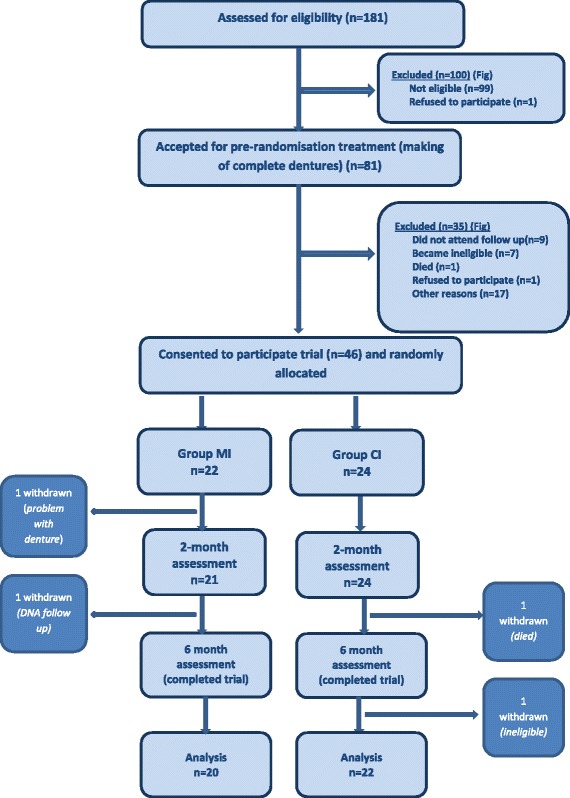
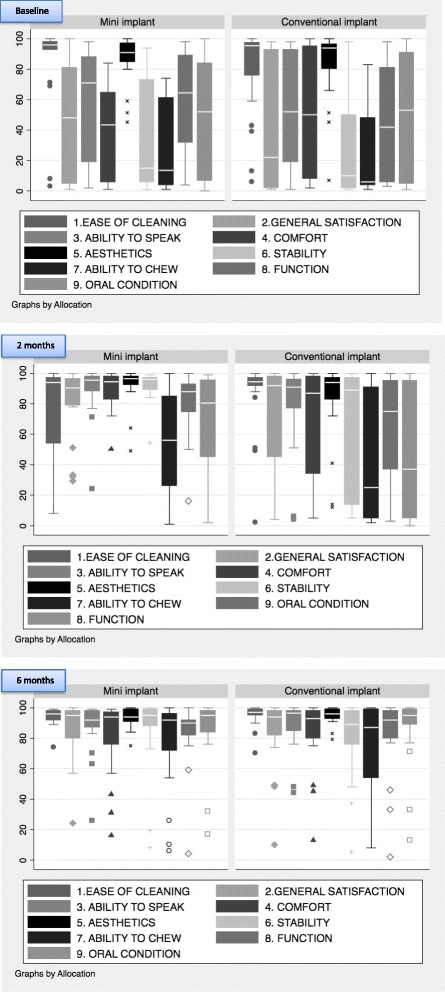
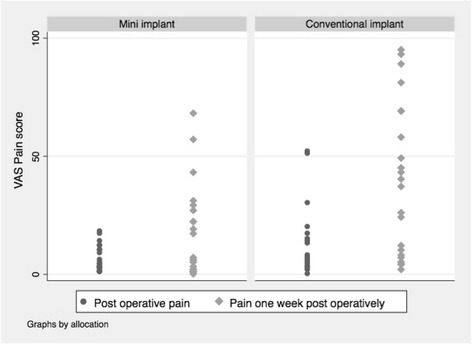
Forty-six patients were randomly allocated to receive either two mini implants or two conventional implants in the mandible to retain their lower dentures. Quality of life (QoL) questionnaires, pain and anxiety scores, and an objective "gummy jelly" chewing test were carried out at multiple timepoints, along with detailed health economics information. Implants were placed one-stage, and an early loading protocol was utilised. Patients were reviewed 8 weeks post-placement, and finally at 6 months. Implant failure, recruitment and retention rates were recorded and analysed.
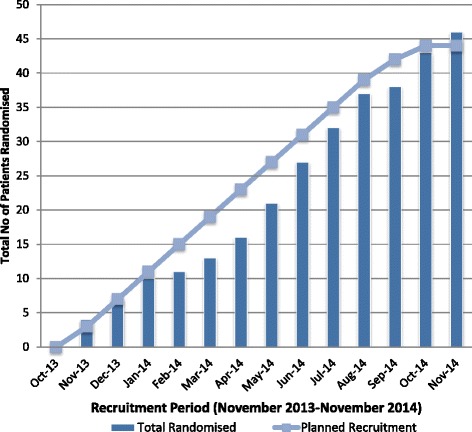
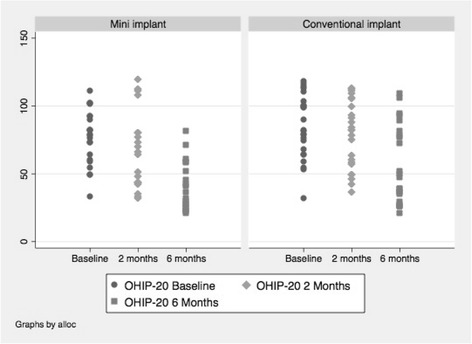
The pilot study demonstrated that it is possible to recruit, randomise and retain edentulous (mainly elderly) patients for an implant trial. We recruited to target and retention rates were acceptable. The large number of questionnaires was onerous for participants to complete, but the distribution of scores and feedback from participants helped inform the choice of primary and secondary outcomes in a full trial. The chewing test was time-consuming and inconsistent. Implant failure rate was low (1/46). The data on indirect costs gathered at every visit was viewed as repetitive and unnecessary, as there was little or no change between visits.
The pilot study has shown that acceptable recruitment and retention rates are achievable in this population of patients for this intervention. The results provide valuable information for selection of outcome variables and sample size calculations for future trials.
(ISRCTN): 87342238 Trial registration date: 05/07/2013.
全口牙齿缺失(无牙症)可能是一种使人衰弱的状况,会影响咀嚼、说话以及与他人交流的能力。最常见的治疗方法是佩戴全口可摘义齿,这种方法可能会成功,但在下颌,随着时间推移会加重的骨吸收会使佩戴义齿变得困难。提倡在下颌植入两颗牙种植体来固定下义齿,这被视为治疗的金标准,但由于经济限制以及患者的恐惧,这种方法尚未得到广泛应用。迷你种植体(MI)比传统种植体(CI)成本更低且侵入性更小,但使用寿命可能不尽相同。因此,从长期来看,它们是否代表一种具有成本效益的治疗方式尚不清楚。这项初步随机对照试验的目的是评估对这一患者群体进行试验的可行性,并为大型多中心试验的研究设计提供参考。
46名患者被随机分配,在下颌接受两颗迷你种植体或两颗传统种植体以固定下义齿。在多个时间点进行生活质量(QoL)问卷调查、疼痛和焦虑评分,以及客观的“软糖”咀嚼测试,并收集详细的卫生经济学信息。种植体采用一期植入,并采用早期负载方案。在植入后8周对患者进行复查,最终在6个月时复查。记录并分析种植体失败率、招募率和留存率。
初步研究表明,招募、随机分配并留住无牙(主要是老年)患者进行种植体试验是可行的。我们达到了招募目标,留存率也可以接受。大量问卷对参与者来说填写起来很繁琐,但分数分布和参与者的反馈有助于确定全面试验中主要和次要结果的选择。咀嚼测试耗时且结果不一致。种植体失败率很低(1/46)。每次就诊时收集的间接成本数据被认为是重复且不必要的,因为就诊之间几乎没有变化。
初步研究表明,对于这种干预措施,在这一患者群体中可以实现可接受的招募率和留存率。研究结果为未来试验的结果变量选择和样本量计算提供了有价值的信息。
(国际标准随机对照试验编号):87342238 试验注册日期:2013年7月5日。