Lee Jueseong, Bang Yong Hyeon, Lee Eun Hee, Choi Byung Min, Hong Young Sook
Department of Pediatrics, Korea University College of Medicine, Seoul, Korea.
Korean J Pediatr. 2017 Jan;60(1):10-16. doi: 10.3345/kjp.2017.60.1.10. Epub 2017 Jan 16.
Although procalcitonin (PCT) level is useful for the diagnosis of neonatal sepsis, PCT reliability is inconsistent because of the varied conditions encountered in neonatal intensive care units. This study aimed to investigate PCT levels and factors influencing increased PCT levelin newborns without bacterial infection during the first week of life.
In newborns hospitalized between March 2013 and October 2015, PCT levels were measured on the first, third, and seventh days after birth. Newborns with proven bacterial (blood culture positive for bacteria) or suspicious infection (presence of C-reactive protein expression or leukocytosis/leukopenia) were excluded. Various neonatal conditions were analyzed to identify the factors influencing increased PCT level.
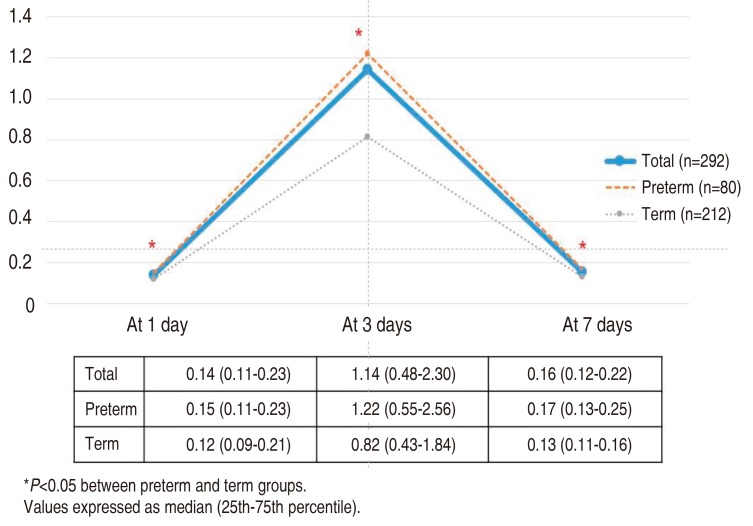
Among 292 newborns with a gestational age of 35.2±3.0 weeks and a birth weight of 2,428±643 g, preterm newborns (n=212) had higher PCT levels than term newborns (n=80). Of the newborns, 7.9% had increased PCT level (23 of 292) on the firstday; 28.3% (81 of 286), on the third day; and 3.3% (7 of 121), on the seventh day after birth. The increased PCT level was significantly associated with prenatal disuse of antibiotics (=0.004) and surfactant administration (<0.001) on the first day after birth, postnatal use of antibiotics (=0.001) and ventilator application (=0.001) on the third day after birth, and very low birth weight (=0.042) on the seventh day after birth.
In newborns without bacterial infection, increased PCT level was significantly associated with lower gestational age and respiratory difficulty during the first week of life. Further studies are needed for clinical applications.
尽管降钙素原(PCT)水平对新生儿败血症的诊断有用,但由于新生儿重症监护病房中遇到的各种情况,PCT的可靠性并不一致。本研究旨在调查出生后第一周内无细菌感染的新生儿的PCT水平及影响PCT水平升高的因素。
对2013年3月至2015年10月住院的新生儿,在出生后的第1天、第3天和第7天测量PCT水平。排除已证实有细菌感染(血培养细菌阳性)或可疑感染(存在C反应蛋白表达或白细胞增多/减少)的新生儿。分析各种新生儿情况以确定影响PCT水平升高的因素。
在292例胎龄为35.2±3.0周、出生体重为2428±643g的新生儿中,早产儿(n = 212)的PCT水平高于足月儿(n = 80)。在这些新生儿中,出生第一天有7.9%(292例中的23例)PCT水平升高;出生第三天有28.3%(286例中的81例);出生第七天有3.3%(121例中的7例)。PCT水平升高与出生后第一天产前未使用抗生素(P = 0.004)和使用表面活性剂(P < 0.001)、出生后第三天产后使用抗生素(P = 0.001)和使用呼吸机(P = 0.001)以及出生后第七天极低出生体重(P = 0.042)显著相关。
在无细菌感染的新生儿中,出生后第一周PCT水平升高与较低的胎龄和呼吸困难显著相关。临床应用还需要进一步研究。