Ko Jean Y, Rockhill Karilynn M, Tong Van T, Morrow Brian, Farr Sherry L
MMWR Morb Mortal Wkly Rep. 2017 Feb 17;66(6):153-158. doi: 10.15585/mmwr.mm6606a1.
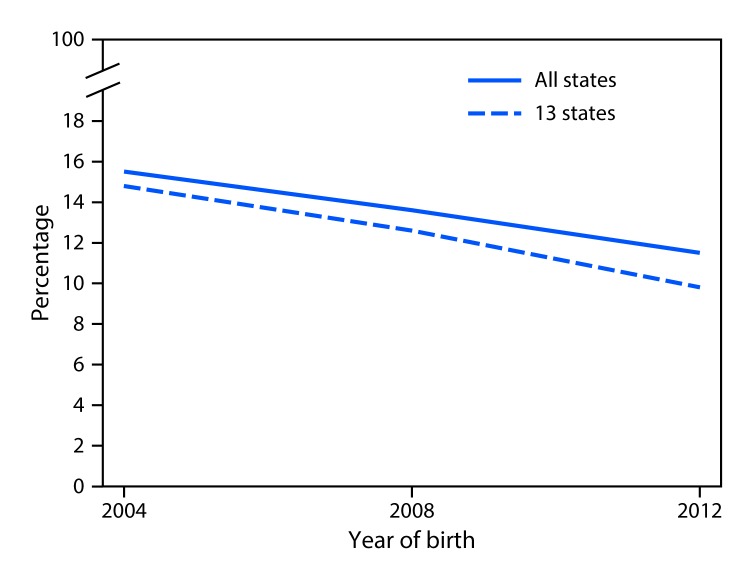
Postpartum depression is common and associated with adverse infant and maternal outcomes (e.g., lower breastfeeding initiation and duration and poor maternal and infant bonding) (1-3). A developmental Healthy People 2020 objective is to decrease the proportion of women delivering a live birth who experience postpartum depressive symptoms (PDS).* To provide a baseline for this objective, CDC sought to describe self-reported PDS overall, by reporting state, and by selected sociodemographic factors, using 2004, 2008, and 2012 data from the Pregnancy Risk Assessment Monitoring System (PRAMS). A decline in the prevalence of PDS was observed from 2004 (14.8%) to 2012 (9.8%) among 13 states with data for all three periods (p<0.01). Statistically significant (p<0.05) declines in PDS prevalence were observed for eight states, and no significant changes were observed for five states. In 2012, the overall PDS prevalence was 11.5% for 27 states and ranged from 8.0% (Georgia) to 20.1% (Arkansas). By selected characteristics, PDS prevalence was highest among new mothers who 1) were aged ≤19 years or 20-24 years, 2) were of American Indian/Alaska Native or Asian/Pacific Islander race/ethnicity, 3) had ≤12 years of education, 4) were unmarried, 5) were postpartum smokers, 6) had three or more stressful life events in the year before birth, 7) gave birth to term, low-birthweight infants, and 8) had infants requiring neonatal intensive care unit admission at birth. Although the study did not investigate reasons for the decline, better recognition of risk factors for depression and improved screening and treatment before and during pregnancy, including increased use of antidepressants, might have contributed to the decline. However, more efforts are needed to reduce PDS prevalence in certain states and subpopulations of women. Ongoing surveillance and activities to promote appropriate screening, referral, and treatment are needed to reduce PDS among U.S. women.
产后抑郁症很常见,且与不良的母婴结局相关(例如,较低的母乳喂养起始率和持续时间以及母婴情感联结不佳)(1 - 3)。《健康人民2020》的一项发展目标是降低经历产后抑郁症状(PDS)的活产妇女比例。* 为了给这一目标提供基线数据,美国疾病控制与预防中心(CDC)利用来自妊娠风险评估监测系统(PRAMS)的2004年、2008年和2012年数据,试图按报告州以及选定的社会人口学因素来总体描述自我报告的产后抑郁症状。在有所有三个时期数据的13个州中,观察到产后抑郁症状的患病率从2004年的14.8%下降到了2012年的9.8%(p<0.01)。八个州的产后抑郁症状患病率出现了具有统计学意义(p<0.05)的下降,五个州未观察到显著变化。2012年,27个州的产后抑郁症状总体患病率为11.5%,范围从8.0%(佐治亚州)到20.1%(阿肯色州)。按选定特征来看,产后抑郁症状患病率在以下新妈妈中最高:1)年龄≤19岁或20 - 24岁,2)属于美国印第安人/阿拉斯加原住民或亚裔/太平洋岛民种族/族裔,3)受教育年限≤12年,4)未婚,5)产后吸烟,6)在分娩前一年有三件或更多压力性生活事件,7)分娩出足月儿、低体重婴儿,以及8)婴儿出生时需要入住新生儿重症监护病房。尽管该研究未调查下降的原因,但对抑郁风险因素的更好认知以及孕期前后筛查和治疗的改善,包括抗抑郁药使用的增加,可能促成了这一下降。然而,仍需要做出更多努力来降低某些州以及特定女性亚人群中的产后抑郁症状患病率。需要持续进行监测以及开展促进适当筛查、转诊和治疗的活动,以降低美国女性中的产后抑郁症状患病率。