Plaitakis Andreas, Kalef-Ezra Ester, Kotzamani Dimitra, Zaganas Ioannis, Spanaki Cleanthe
Department of Neurology, Faculty of Medicine, School of Health Sciences, University of Crete, Heraklion, Crete 71003, Greece.
Icahn School of Medicine at Mount Sinai, One Gustave L. Levy Place, New York, NY 10029, USA.
Biology (Basel). 2017 Feb 8;6(1):11. doi: 10.3390/biology6010011.
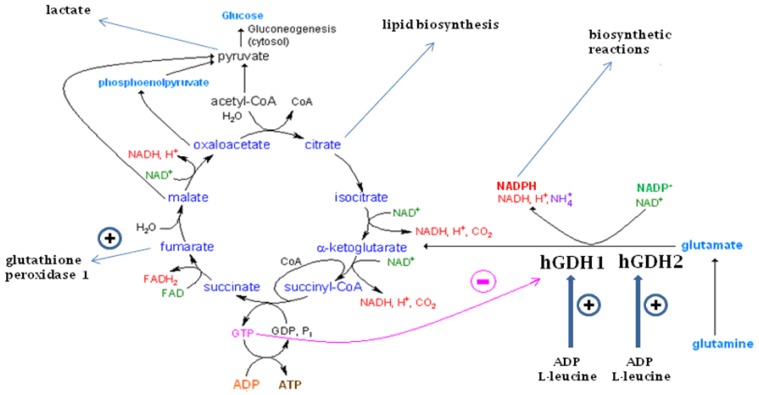
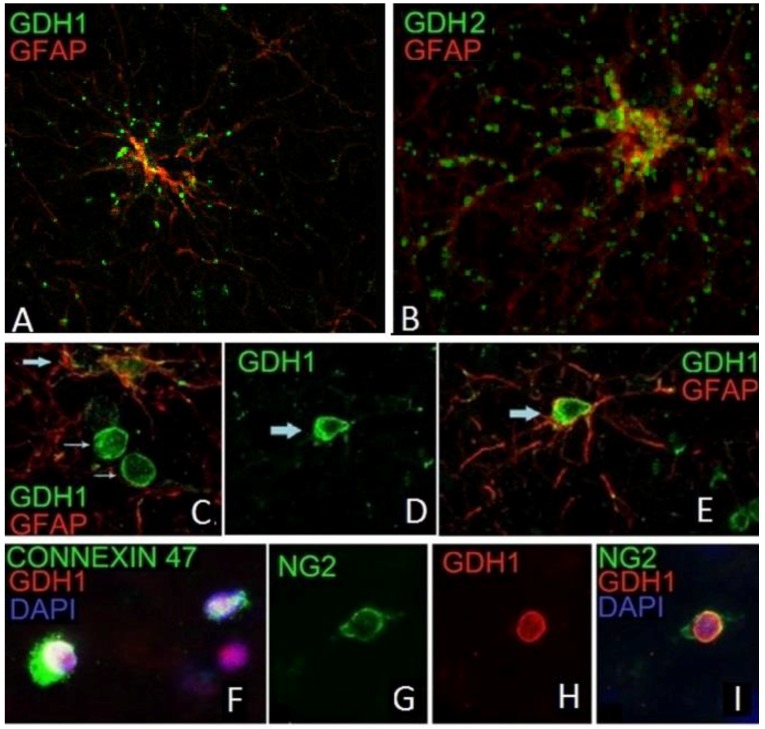
Glutamate dehydrogenase (GDH) is a hexameric enzyme that catalyzes the reversible conversion of glutamate to α-ketoglutarate and ammonia while reducing NAD(P)⁺ to NAD(P)H. It is found in all living organisms serving both catabolic and anabolic reactions. In mammalian tissues, oxidative deamination of glutamate via GDH generates α-ketoglutarate, which is metabolized by the Krebs cycle, leading to the synthesis of ATP. In addition, the GDH pathway is linked to diverse cellular processes, including ammonia metabolism, acid-base equilibrium, redox homeostasis (via formation of fumarate), lipid biosynthesis (via oxidative generation of citrate), and lactate production. While most mammals possess a single GDH1 protein (hGDH1 in the human) that is highly expressed in the liver, humans and other primates have acquired, via duplication, an hGDH2 isoenzyme with distinct functional properties and tissue expression profile. The novel hGDH2 underwent rapid evolutionary adaptation, acquiring unique properties that enable enhanced enzyme function under conditions inhibitory to its ancestor hGDH1. These are thought to provide a biological advantage to humans with hGDH2 evolution occurring concomitantly with human brain development. hGDH2 is co-expressed with hGDH1 in human brain, kidney, testis and steroidogenic organs, but not in the liver. In human cerebral cortex, hGDH1 and hGDH2 are expressed in astrocytes, the cells responsible for removing and metabolizing transmitter glutamate, and for supplying neurons with glutamine and lactate. In human testis, hGDH2 (but not hGDH1) is densely expressed in the Sertoli cells, known to provide the spermatids with lactate and other nutrients. In steroid producing cells, hGDH1/2 is thought to generate reducing equivalents (NADPH) in the mitochondria for the biosynthesis of steroidal hormones. Lastly, up-regulation of hGDH1/2 expression occurs in cancer, permitting neoplastic cells to utilize glutamine/glutamate for their growth. In addition, deregulation of hGDH1/2 is implicated in the pathogenesis of several human disorders.
谷氨酸脱氢酶(GDH)是一种六聚体酶,可催化谷氨酸可逆转化为α-酮戊二酸和氨,同时将NAD(P)⁺还原为NAD(P)H。它存在于所有生物中,参与分解代谢和合成代谢反应。在哺乳动物组织中,通过GDH进行的谷氨酸氧化脱氨生成α-酮戊二酸,后者通过三羧酸循环代谢,导致ATP的合成。此外,GDH途径与多种细胞过程相关,包括氨代谢、酸碱平衡、氧化还原稳态(通过富马酸的形成)、脂质生物合成(通过柠檬酸的氧化生成)和乳酸生成。虽然大多数哺乳动物拥有单一的GDH1蛋白(人类中的hGDH1),在肝脏中高度表达,但人类和其他灵长类动物通过基因复制获得了具有独特功能特性和组织表达谱的hGDH2同工酶。新型hGDH2经历了快速的进化适应,获得了独特的特性,使其在抑制其祖先hGDH1的条件下能够增强酶功能。这些特性被认为为人类提供了生物学优势,hGDH2的进化与人类大脑发育同时发生。hGDH2与hGDH1在人类大脑、肾脏、睾丸和类固醇生成器官中共同表达,但在肝脏中不表达。在人类大脑皮层中,hGDH1和hGDH2在星形胶质细胞中表达,星形胶质细胞负责清除和代谢神经递质谷氨酸,并为神经元提供谷氨酰胺和乳酸。在人类睾丸中,hGDH2(而非hGDH1)在支持细胞中密集表达,已知支持细胞为精子细胞提供乳酸和其他营养物质。在类固醇生成细胞中,hGDH1/2被认为在线粒体中产生还原当量(NADPH)用于甾体激素的生物合成。最后,hGDH1/2表达上调发生在癌症中,使肿瘤细胞能够利用谷氨酰胺/谷氨酸进行生长。此外,hGDH1/2的失调与几种人类疾病的发病机制有关。