Ganczak Maria, Skonieczna-Żydecka Karolina, Drozd-Dąbrowska Marzena, Adler Grażyna
Department of Epidemiology and Management, Pomeranian Medical University, Szczecin 70-204, Poland.
Department of Gerontobiology, Pomeranian Medical University, Szczecin 70-204, Poland.
Int J Environ Res Public Health. 2017 Feb 8;14(2):166. doi: 10.3390/ijerph14020166.
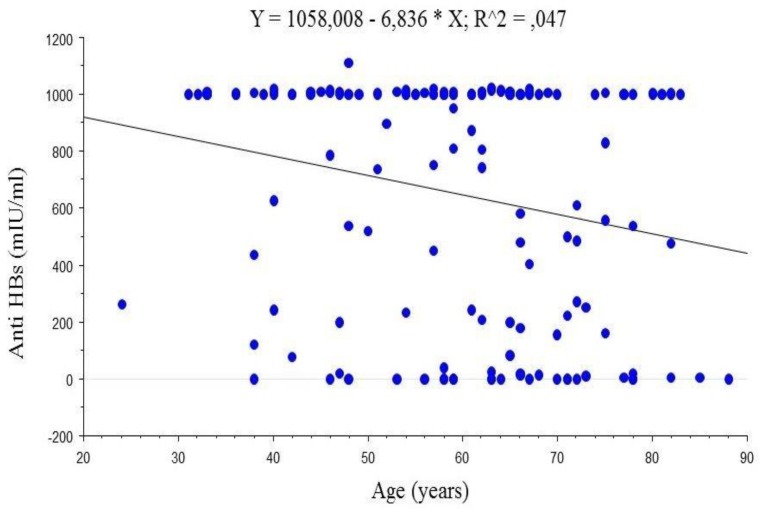
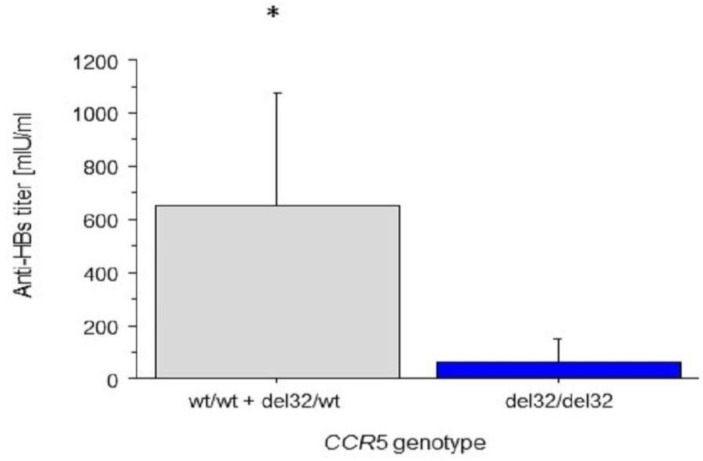
: Chemokine genetic variations are involved in infectious diseases such as hepatitis B virus (HBV). Several allelic variants might, in theory, affect the outcome of vaccination. : This study was carried out to examine the associations of Δ32 and 190G > A polymorphisms with a response to a primary course of three HBV vaccinations. : Between December 2014 and December 2016, patients from three randomly selected primary care clinics in the West Pomeranian region (Poland), 1 month after receiving the third dose of HBV vaccine, were enrolled. Enzyme-linked immunosorbent assay (ELISA) system version 3.0 was used to detect anti-HBs and anti-HBc totals. The identification of polymorphisms were performed by a polymerase chain reaction technique using a single primer extension assay. Genotype distributions of responders versus non-responders to HBV vaccination were compared on the basis of anti-HBs level. : In 149 patients (mean age 60 years) the mean anti-HBs level was 652.2 ± 425.9 mIU/mL (range: 0-1111.0 mIU/mL). There were 14.1% ( = 21) non-responders to the HBV vaccine (anti-HBs < 10.0 mIU/mL). The wild type/Δ32 genotype of gene was found in 18.1% participants, and 1.3% were Δ32/Δ32 homozygotes. The frequency of allele A of the gene was 11.1%. Lower anti-HBs levels in Δ32/Δ32 homozygotes were observed (Me = 61 mIU/mL vs. Me = 660.2 mIU/mL; = 0.048). As age was found to be a correlate to the anti-HBs titer ( = -0.218, = 0.0075; 95% CI: -0.366--0.059)-an analysis of a co-variance was performed which found a statistically significant ( = 0.04) difference in anti-HBs titres between Δ32/Δ32 homozygotes and other genotypes. The association between anti-HBs titres and genotypes was not statistically significant. : Our study-which is a preliminary report that suggest this topic deserves further observation with larger sample sizes, different ethnicities, and other single nucleotide poly-morphisms (SNPs)-suggests the possible involvement of polymorphism in impairing the immunologic response to HBV vaccination, predominantly in relation to the passage of time.
趋化因子基因变异与诸如乙型肝炎病毒(HBV)等传染病有关。理论上,几种等位基因变异可能会影响疫苗接种的结果。
本研究旨在探讨Δ32和190G>A多态性与三针乙肝疫苗初种疗程反应之间的关联。
在2014年12月至2016年12月期间,招募了来自波兰西波美拉尼亚地区三个随机选取的初级保健诊所的患者,这些患者在接种第三剂乙肝疫苗1个月后入组。使用酶联免疫吸附测定(ELISA)系统版本3.0检测抗-HBs和抗-HBc总量。多态性的鉴定通过使用单引物延伸测定的聚合酶链反应技术进行。根据抗-HBs水平比较乙肝疫苗接种应答者与无应答者的基因型分布。
在149名患者(平均年龄60岁)中,抗-HBs平均水平为652.2±425.9 mIU/mL(范围:0 - 1111.0 mIU/mL)。有14.1%(n = 21)的患者对乙肝疫苗无应答(抗-HBs<10.0 mIU/mL)。在18.1%的参与者中发现了CC趋化因子受体5(CCR5)基因的野生型/Δ32基因型,1.3%为Δ32/Δ32纯合子。CCR5基因的A等位基因频率为11.1%。观察到Δ32/Δ32纯合子的抗-HBs水平较低(中位数 = 61 mIU/mL对中位数 = 660.2 mIU/mL;P = 0.048)。由于发现年龄与抗-HBs滴度相关(r = -0.218,P = 0.0075;95%CI:-0.366 - -0.059),因此进行了协方差分析,结果发现Δ32/Δ32纯合子与其他CCR5基因型之间的抗-HBs滴度存在统计学显著差异(P = 0.04)。抗-HBs滴度与CCR5基因型之间的关联无统计学意义。
我们的研究——这是一份初步报告,表明该主题值得在更大样本量、不同种族以及其他单核苷酸多态性(SNP)的情况下进行进一步观察——表明CCR5多态性可能参与损害对乙肝疫苗的免疫反应,主要与时间推移有关。