Zou Dehui, Yi Shuhua, Cui Rui, Liu Wei, Li Chengwen, Zhong Shizhen, Yu Zhen, Li Zengjun, Lv Rui, Ru Kun, Wang Huijun, An Gang, Xu Yan, Qiu Lugui
State Key Laboratory of Experimental Hematology, Institute of Hematology and Blood Disease Hospital, Chinese Academy of Medical Sciences and Peking Union Medical College, No.288, Nanjing road, Heping district, Tianjin, 300020, China.
Department of Hematology, Tianjin First Center Hospital, Tianjin, China.
BMC Med Genet. 2017 Feb 16;18(1):16. doi: 10.1186/s12881-017-0381-z.
Diffuse large B-cell lymphoma (DLBCL) of leukemic phase is a rare clinical manifestation, but is highly prevalent with central nervous system involvement (CNSI). Little is known about this rare clinical observation.
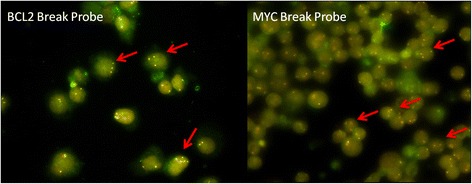
We reviewed the clinical characteristics of 40 DLBCL patients with leukemic phase identified by flow cytometry and analyzed BCL2 and MYC aberrations by fluorescence in situ hybridization.
The median age of these 40 patients was 46 years (range, 15-75) with 19 men patients. All patients had bone marrow involvement, and fourteen (35.0%) had CNSI. There were respectively 14 patients (35.0%) had the BCL2 or MYC gain/amplification and nine of them (22.5%) simultaneously had both aberrations. Compared to those without CNSI, CNSI was found more commonly in male patients (71.4 vs. 34.6%, p = 0.046), in those with IPI scores of 4-5 (57.1% vs. 11.5%, p = 0.001), and in those with elevated serum LDH (100 vs. 61.5%, p = 0.007) and both MYC and BCL2 rearrangement (88.9 vs. 19.4%; p = 0.000). BCL2 and MYC rearrangements were the sole independent factor correlated with CNSI.
It is possible that both BCL2 and MYC gene aberrations may contribute to the high incidence of CNSI observed in leukemic phase of patients with DLBCL.
白血病期弥漫性大B细胞淋巴瘤(DLBCL)是一种罕见的临床表现,但中枢神经系统受累(CNSI)的情况很常见。对于这种罕见的临床观察了解甚少。
我们回顾了40例经流式细胞术鉴定为白血病期的DLBCL患者的临床特征,并通过荧光原位杂交分析了BCL2和MYC基因异常情况。
这40例患者的中位年龄为46岁(范围15 - 75岁),男性患者19例。所有患者均有骨髓受累,14例(35.0%)有CNSI。分别有14例患者(35.0%)存在BCL2或MYC基因增益/扩增,其中9例(22.5%)同时存在两种异常。与无CNSI的患者相比,CNSI在男性患者中更常见(71.4%对34.6%,p = 0.046),国际预后指数(IPI)评分为4 - 5分的患者中更常见(57.1%对11.5%,p = 0.001),血清乳酸脱氢酶(LDH)升高的患者中更常见(100%对61.5%,p = 0.007),同时存在MYC和BCL2重排的患者中更常见(88.9%对19.4%;p = 0.000)。BCL2和MYC重排是与CNSI相关的唯一独立因素。
BCL2和MYC基因异常可能都导致了DLBCL患者白血病期CNSI的高发生率。