Nishi Makiko, Harding Máiréad, Kelleher Virginia, Whelton Helen, Allen Finbarr
Oral Health Services Research Centre, University College Cork, Wilton, Cork, Ireland.
The School of Dentistry, University of Leeds, Leeds, UK.
BMC Oral Health. 2017 Feb 16;17(1):55. doi: 10.1186/s12903-017-0345-x.
A previous study has shown deficient knowledge of caries risk factors/indicators in a Japanese adult population regarded to have a high interest in preventive dentistry. No prior research has investigated caries risk knowledge in an Irish adult population. We hypothesise there may be unexpected differences or similarities in knowledge across countries with similar levels of economic development when comparing groups with different socio-economic and cultural profiles. Understanding what influences knowledge is important for the development of effective and efficient caries prevention strategies. The current paper aims to describe the knowledge of caries risk factors/indicators in two groups with different socio-economic profiles from two culturally distinct countries.
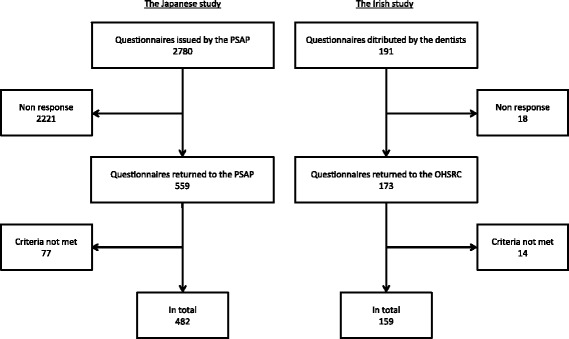
Cross-sectional surveys of adult dental patients were carried out in Japan and in the Republic of Ireland (RoI) using similar self-administered paper questionnaires. Patients were asked to identify caries risk factors/indicators from eight (Japan) or ten (RoI) listed items. The Japanese study involved 482 patients (aged ≥20 years) from 52 dental members of a nationwide web-based initiative Promoting Scientific Assessment in Prevention of Tooth Decay and Gum Disease (PSAP). The Irish study involved 159 patients (aged 20-69 years) accessing state-provided ('medical card') dental services from eight dental practices in County Cork. The two samples were compared.
A higher proportion of Irish respondents identified 'Not visiting the dentist for check-up and cleaning' (OR 2.655; 99% CI 1.550, 4.547) and 'Not using fluoride' (OR 1.714; 99% CI 1.049, 2.802) than did Japanese respondents. A lower proportion of Irish respondents identified 'A reduced amount of saliva' (OR 0.262; 99% CI 0.159, 0.433) than Japanese respondents. Similarly shown in both studies were a persistent belief that 'Not brushing teeth properly' is a caries risk factor and a lack of knowledge on saliva buffering capacity as a caries risk factor.
Deficiencies in knowledge which should be addressed: among the Japanese group, of dental check-up/cleaning visits and of fluoride use for caries prevention; among the Irish group, of saliva quantity as a caries risk factor. In addition, in both groups, we need to inform patients of the defensive role of saliva.
此前一项研究表明,在日本被认为对预防牙科有高度兴趣的成年人群体中,对龋齿风险因素/指标的了解不足。此前尚无研究调查爱尔兰成年人群体的龋齿风险知识。我们假设,在比较具有不同社会经济和文化背景的群体时,经济发展水平相似的国家在这方面的知识可能存在意想不到的差异或相似之处。了解哪些因素影响知识对于制定有效且高效的龋齿预防策略至关重要。本文旨在描述来自两个文化背景不同的国家、具有不同社会经济背景的两组人群对龋齿风险因素/指标的了解情况。
在日本和爱尔兰共和国(RoI)对成年牙科患者进行横断面调查,使用类似的自填式纸质问卷。要求患者从列出的八个(日本)或十个(RoI)项目中识别龋齿风险因素/指标。日本的研究涉及来自全国性网络倡议“促进预防龋齿和牙龈疾病的科学评估”(PSAP)的52个牙科机构的482名患者(年龄≥20岁)。爱尔兰的研究涉及来自科克郡八个牙科诊所的159名使用国家提供的(“医疗卡”)牙科服务的患者(年龄20 - 69岁)。对这两个样本进行了比较。
与日本受访者相比,更高比例的爱尔兰受访者认为“不定期看牙医进行检查和清洁”(比值比2.655;99%置信区间1.550,4.547)和“不使用氟化物”(比值比1.714;99%置信区间1.049,2.802)是龋齿风险因素。与日本受访者相比,更低比例的爱尔兰受访者认为“唾液分泌量减少”(比值比0.262;99%置信区间0.159,0.433)是龋齿风险因素。两项研究都同样表明,人们一直认为“刷牙方法不正确”是龋齿风险因素,并且对唾液缓冲能力作为龋齿风险因素缺乏了解。
需要解决的知识缺陷:在日本人群体中,是关于牙科检查/清洁就诊以及使用氟化物预防龋齿方面的知识;在爱尔兰人群体中,是关于唾液量作为龋齿风险因素方面的知识。此外,在两组人群中,我们都需要告知患者唾液的防御作用。