Rahimzadeh Poupak, Imani Farnad, Sayarifard Azadeh, Sayarifard Sara, Faiz Seyed Hamid Reza
Associate Professor of Anesthesiology, Pain Research Center, Iran University of Medical Sciences, Tehran, Iran.
Professor of Anesthesiology, Pain Research Center, Iran University of Medical Sciences, Tehran, Iran.
Med J Islam Repub Iran. 2016 Oct 24;30:433. eCollection 2016.
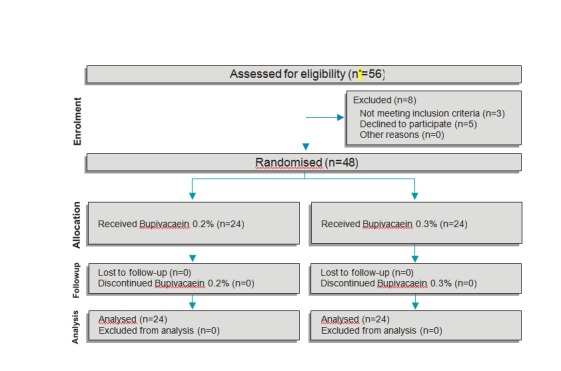
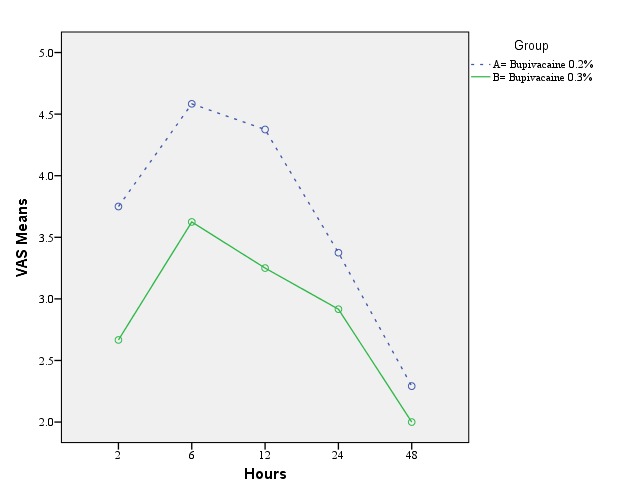
Postoperative pain is one of the major problems in patients with femoral or hip fracture. Current study investigates the effect of 0.2% and 0.3% bupivacaine in ultrasound-guided fascia iliaca compartment block (FICB) on postoperative pain. This randomized clinical trial study was conducted in Rasoul Akram Hospital of Iran University of Medical Sciences. Forty-eight patients with femoral or hip fractures who were candidates for surgery underwent FICB, divided into two groups receiving bupivacaine in 0.2% and 0.3% concentrations. Pain was evaluated with Visual Analog Scale (VAS) at times 2, 6, 12, 24, and 48 hours after surgery. Need for opioids, nausea and vomiting after surgery, patients' satisfaction with pain control and motor block were also recorded. T-test or Mann- Whitney U test and Repeated measure ANOVA was used for analysis. Pain score after surgery was significantly lower in groups receiving 0.3% than the group receiving 0.2% concentration. Patients' satisfaction with pain control in 0.2% group was significantly higher (p=0.04). Time to analgesic onset in both groups had no significant differences (p=0.5). The incidence of nausea and vomiting (p=0.5) and opioid consumption (p=0.1) between the two groups showed no significant difference. In femoral or hip fracture, bupivacaine with 0.3% concentration in fascia iliaca compartment block can cause lower pain score compared to bupivacaine with 0.2% concentration, but patients' satisfaction with pain control and severity of motor block is higher in bupivacaine 0.2%.
术后疼痛是股骨或髋部骨折患者的主要问题之一。当前研究调查了0.2%和0.3%布比卡因在超声引导下髂筋膜间隙阻滞(FICB)中对术后疼痛的影响。这项随机临床试验研究在伊朗医科大学拉苏勒·阿克兰医院进行。48例拟行手术的股骨或髋部骨折患者接受了FICB,分为两组,分别接受浓度为0.2%和0.3%的布比卡因。在术后2、6、12、24和48小时用视觉模拟量表(VAS)评估疼痛。还记录了术后对阿片类药物的需求、恶心和呕吐情况、患者对疼痛控制的满意度以及运动阻滞情况。采用t检验或曼-惠特尼U检验以及重复测量方差分析进行分析。接受0.3%布比卡因的组术后疼痛评分显著低于接受0.2%浓度布比卡因的组。0.2%组患者对疼痛控制的满意度显著更高(p = 0.04)。两组镇痛起效时间无显著差异(p = 0.5)。两组之间恶心和呕吐的发生率(p = 0.5)以及阿片类药物的消耗量(p = 0.1)均无显著差异。在股骨或髋部骨折中,与0.2%浓度的布比卡因相比,0.3%浓度的布比卡因在髂筋膜间隙阻滞中可导致更低的疼痛评分,但0.2%布比卡因患者对疼痛控制的满意度更高,运动阻滞的严重程度也更高。