Applied Chemicals and Materials Division, National Institute of Standards and Technology, 325 Broadway, Mailstop 647, Boulder, Colorado 80305, USA.
Department of Mechanical Engineering, The Catholic University of America, 620 Michigan Avenue, NE, Washington D.C., 20064, USA.
Nat Commun. 2017 Feb 17;8:14476. doi: 10.1038/ncomms14476.
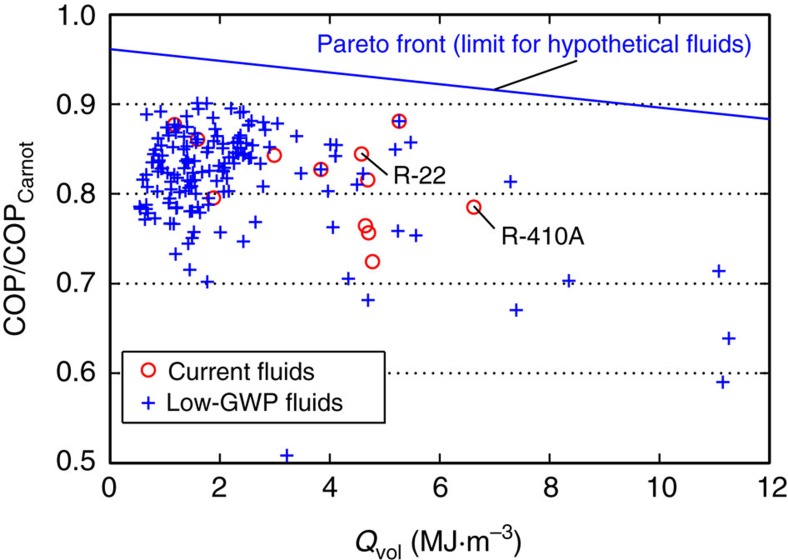
Hydrofluorocarbons, currently used as refrigerants in air-conditioning systems, are potent greenhouse gases, and their contribution to climate change is projected to increase. Future use of the hydrofluorocarbons will be phased down and, thus replacement fluids must be found. Here we show that only a few pure fluids possess the combination of chemical, environmental, thermodynamic, and safety properties necessary for a refrigerant and that these fluids are at least slightly flammable. We search for replacements by applying screening criteria to a comprehensive chemical database. For the fluids passing the thermodynamic and environmental screens (critical temperature and global warming potential), we simulate performance in small air-conditioning systems, including optimization of the heat exchangers. We show that the efficiency-versus-capacity trade-off that exists in an ideal analysis disappears when a more realistic system is considered. The maximum efficiency occurs at a relatively high volumetric refrigeration capacity, but there are few fluids in this range.
氢氟碳化物目前被用作空调系统中的制冷剂,它们是强效温室气体,预计它们对气候变化的贡献将会增加。未来将逐步淘汰氢氟碳化物的使用,因此必须找到替代品。在这里,我们表明只有少数几种纯流体具有化学、环境、热力学和安全性能的组合,这些性能是制冷剂所必需的,而且这些流体至少是轻微易燃的。我们通过将筛选标准应用于综合化学数据库来寻找替代品。对于通过热力学和环境筛选(临界温度和全球变暖潜能值)的流体,我们在小型空调系统中模拟性能,包括优化热交换器。我们表明,当考虑到一个更现实的系统时,理想分析中存在的效率与容量之间的权衡关系就消失了。最大效率出现在相对较高的容积制冷量,但在这个范围内的流体很少。