Lanspa Michael J, Shahul Sajid, Hersh Andrew, Wilson Emily L, Olsen Troy D, Hirshberg Eliotte L, Grissom Colin K, Brown Samuel M
Critical Care Echocardiography Service, Intermountain Medical Center, 5121 S Cottonwood St, Murray, UT, 84157, USA.
Division of Pulmonary and Critical Care Medicine, University of Utah, 30 N 1900 E, 701 Wintrobe, Salt Lake City, UT, 84132, USA.
Ann Intensive Care. 2017 Dec;7(1):17. doi: 10.1186/s13613-017-0240-2. Epub 2017 Feb 17.
In sepsis, tachycardia may indicate low preload, adrenergic stimulation, or both. Adrenergic overstimulation is associated with septic cardiomyopathy. We sought to determine whether tachycardia was associated with left ventricular longitudinal strain, a measure of cardiac dysfunction. We hypothesized an association would primarily exist in patients with high preload.
We prospectively observed septic patients admitted to three study ICUs, who underwent early transthoracic echocardiography. We measured longitudinal strain using speckle tracking echocardiography and estimated preload status with an echocardiographic surrogate (E/e'). We assessed correlation between strain and heart rate in patients with low preload (E/e' < 8), intermediate preload (E/e' 8-14), and high preload (E/e' > 14), adjusting for disease severity and vasopressor dependence.
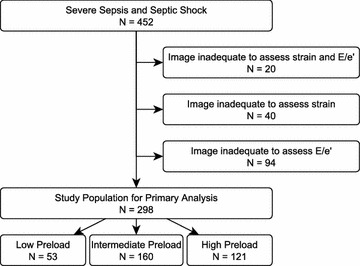
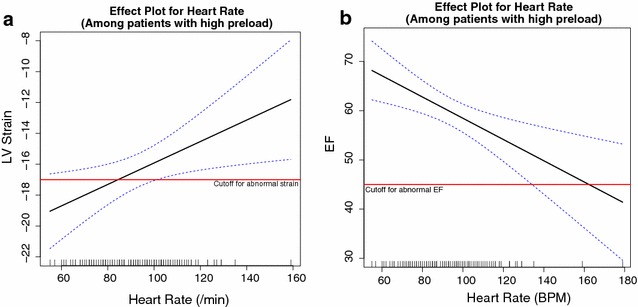
We studied 452 patients, of whom 298 had both measurable strain and preload. Abnormal strain (defined as >-17%) was present in 54%. Patients with abnormal strain had higher heart rates (100 vs. 93 beat/min, p = 0.001). After adjusting for vasopressor dependence, disease severity, and cardiac preload, we observed an association between heart rate and longitudinal strain (β = 0.05, p = 0.003). This association persisted among patients with high preload (β = 0.07, p = 0.016) and in patients with shock (β = 0.07, p = 0.01), but was absent in patients with low or intermediate preload and those not in shock.
Tachycardia is associated with abnormal left ventricular strain in septic patients with high preload. This association was not apparent in patients with low or intermediate preload.
在脓毒症中,心动过速可能提示前负荷降低、肾上腺素能刺激或两者皆有。肾上腺素能过度刺激与脓毒症性心肌病相关。我们试图确定心动过速是否与左心室纵向应变相关,左心室纵向应变是一种心脏功能障碍的指标。我们假设这种关联主要存在于前负荷较高的患者中。
我们前瞻性观察了入住三个研究重症监护病房(ICU)的脓毒症患者,这些患者接受了早期经胸超声心动图检查。我们使用斑点追踪超声心动图测量纵向应变,并使用超声心动图替代指标(E/e')评估前负荷状态。我们评估了前负荷较低(E/e' < 8)、前负荷中等(E/e' 8 - 14)和前负荷较高(E/e' > 14)的患者中应变与心率之间的相关性,并对疾病严重程度和血管升压药依赖性进行了校正。
我们研究了452例患者,其中298例同时具有可测量的应变和前负荷。54%的患者存在异常应变(定义为 > -17%)。应变异常的患者心率较高(100次/分钟对93次/分钟,p = 0.001)。在对血管升压药依赖性、疾病严重程度和心脏前负荷进行校正后,我们观察到心率与纵向应变之间存在关联(β = 0.05,p = 0.003)。这种关联在前负荷较高的患者(β = 0.07,p = 0.016)和休克患者(β = 0.07,p = 0.01)中持续存在,但在前负荷较低或中等的患者以及非休克患者中不存在。
在前负荷较高的脓毒症患者中,心动过速与左心室应变异常相关。这种关联在低或中等前负荷的患者中不明显。